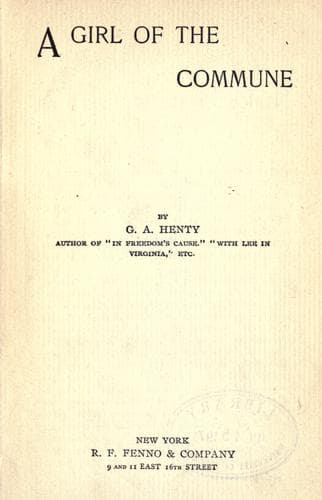
Paris (France) -- History -- Commune, 1871 -- Fiction
"There is no hurry, mes braves," the colonel said, as the Franc-tireurs
stamped with impatience as they saw the columns crossing the river,
while they remained in enforced inactivity. "At first the troops will
carry all before them as Vinoy's men have done. The fighting will only
commence in earnest when the Prussians bring up their supports. We shall
be in time for that, never fear. We ought to have begun at daybreak," he
growled, in a low voice, to the major, "four precious hours have been
wasted. By this time we ought to have gained at least three or four
miles of ground; in that case we might have been through the Prussian
lines before sunset. Every hour in these short days is of importance."
Presently the roll of musketry showed that the French skirmishers were
engaged with the German outposts. The Franc-tireurs had by this time
moved down close to the bridge; but it was not until midday that they
were able to cross; then the colonel, taking advantage of a short delay
on the part of one of the regiments to come up to the bridge, pushed the
men across, and leaving the road took them forward at the double. By
this time the roar of battle was unbroken. The batteries along the
heights behind them, the forts, and the field-guns in advance were all
hard at work, the shell flying over the heads of the advancing troops
and bursting in the villages held by the Germans. In front, the rattle
of musketry was deafening. Champigny, they learned from a wounded
soldier who was making his way to the rear, had been carried, and the
troops there had pushed some distance forward, but on the left
Villiers-la-Desert was found to be too strongly fortified to be taken.
The French batteries were, however, raining shell upon it.
As the Franc-tireurs approached Champigny they saw that the place had
not been taken without a severe struggle. The bodies of French soldiers
strewed the ground thickly, and as they passed through the streets, the
Saxon uniforms were mingled with those of their assailants. The corps
pushed forward until they ascended the low hills behind the village.
Here they found the French troops halted. It was evident Ducrot did not
intend to advance further until joined by the whole of his command.
"This is pure madness," the colonel said; "by to-morrow we shall have
fifty thousand Germans in front of us. If Ducrot hasn't got his whole
force, and his train and ambulances up, he might at least carry Villiers
by assault. Of course it could not be done without loss, but what have
we come out for but to fight. We cannot advance as long as they hold
that place, for when their supports come up, as you may be sure they
will do ere long, they can pour out from there and take us in the rear.
However, we may as well go forward to the skirmishing line. We will work
down by the right. If the German supports come up they are likely to
advance that way, and as I hear no firing in that quarter, we may find
some spot unoccupied by the line."
Public-domain text, read in full here on John Shaqi.
Reviews
Reviews
No reviews yet
Be the first to share your thoughts on this work.
Elsewhere in the archive
Join the Discussion
Join the discussion
Sign in to leave a comment or review.
Sign InorCreate an account