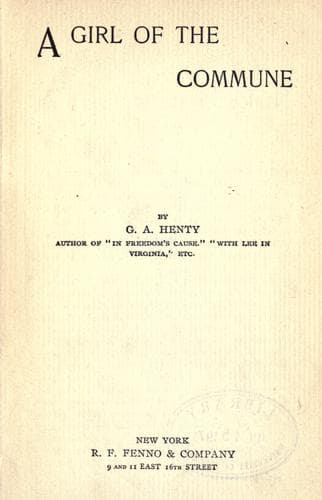
Paris (France) -- History -- Commune, 1871 -- Fiction
"I am awfully sorry, father," Cuthbert had said. "I heartily wish it had
been otherwise, but I own that I would rather live in London on an
almost starvation income than settle down here. I have really tried hard
to get to like things that you do. I feel it would have been better if I
had always stayed here and had a tutor; then, no doubt, I should have
taken to field sports and so on. However, it is no use regretting that
now, and I am very thankful for your offer."
Accordingly he had gone up to London, taken chambers in Gray's Inn,
where two or three of his college friends were established, and joined a
Bohemian Club, where he made the acquaintance of several artists, and
soon became a member of their set. He had talked vaguely of taking up
art as a profession, but nothing ever came of it. There was an easel or
two in his rooms and any number of unfinished paintings; but he was
fastidious over his own work and unable from want of knowledge of
technique to carry out his ideas, and the canvases were one after
another thrown aside in disgust. His friends upbraided him bitterly with
his want of application, not altogether without effect; he took their
remonstrances in perfect good temper, but without making the slightest
effort to improve. He generally accompanied some of them on their
sketching expeditions to Normandy, Brittany, Spain, or Algiers, and his
portfolios were the subject of mingled admiration and anger among his
artist friends in St. John's Wood; admiration at the vigor and talent
that his sketches displayed, anger that he should be content to do
nothing greater.
His days were largely spent in their studios where, seated in the most
comfortable chair he could find, he would smoke lazily and watch them at
work and criticise freely. Men grumbled and laughed at his presumption,
but were ready to acknowledge the justice of his criticism. He had an
excellent eye for color and effect and for the contrast of light and
shade, and those whose pictures were hung, were often ready enough to
admit that the canvas owed much of its charm to some happy suggestion on
Cuthbert's often ready part.
Every two or three months he went home for a fortnight. He was greatly
attached to his father, and it was the one drawback to the contentment
of his life that he had been unable to carry out the Squire's wishes,
and to settle down with him at Fairclose. He would occasionally bemoan
himself over this to his friends.
"I am as bad as the prodigal son," he would say, "except that I don't
get what I deserve, and have neither to feed on husks nor to tend swine;
but though the fatted calf would be ready for me if I were to return I
can't bring myself to do so."
Public-domain text, read in full here on John Shaqi.
Reviews
Reviews
No reviews yet
Be the first to share your thoughts on this work.
Join the Discussion
Join the discussion
Sign in to leave a comment or review.
Sign InorCreate an account