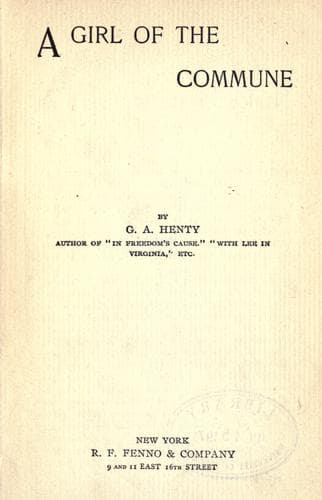
Paris (France) -- History -- Commune, 1871 -- Fiction
"Why, it is Mary Brander. I beg your pardon," he went on, taking off his
soft, broad-brimmed hat, "I ought to have said Miss Brander, but having
known you so long as Mary Brander, the name slipped out. It must have
been three years since we met, and you have shot up from a girl into a
full-grown young lady. Are your father and mother here?"
"No, I came down last week to stay with my friend, Miss Treadwyn, who
was at Girton with me. Anna, this is Mr. Cuthbert Hartington. Mr.
Hartington's place is near Abchester, and he is one of my father's
clients."
Miss Treadwyn bowed and Cuthbert took off his hat.
"We have known each other ever since we were children," Mary went on,
"that is to say ever since I was a child, for he was a big boy then; he
often used to come into our house, while Mr. Hartington was going into
business matters with my father, and generally amused himself by teasing
me. He used to treat me as if I was a small sort of monkey, and
generally ended by putting me in a passion; of course that was in the
early days."
"Before you came to years of discretion, Miss Brander. You were growing
a very discreet damsel when I last saw you, and I felt rather afraid of
you. I know that you were good enough to express much disapproval of me
and my ways."
"Very likely I did, though I don't remember it. I think I was very
outspoken in those days."
"I do not think you have changed much in that respect, Mary," Miss
Treadwyn said.
"Why should one say what one does not think," Mary said, sturdily, "it
would be much better if we all did so. Do you not agree with me, Mr.
Hartington?"
"It depends upon what 'better' means; it would be awful to think of the
consequences if we all did so. Society would dissolve itself into its
component parts and every man's hand would be against his neighbor. I do
not say that people should say what they do not think, but I am sure
that the world would not be so pleasant as it is by a long way if every
one was to say exactly what he did think. Just imagine what the
sensation of authors or artists would be if critics were to state their
opinions with absolute candor!"
"I think it were better if they did so, Mr. Hartington; in that case
there would be fewer idiotic books written and fewer men wasting their
lives in trying vainly to produce good paintings."
"That is true enough," Cuthbert laughed, "but you must remember that
critics do not buy either books or paintings, and that there are plenty
of people who buy the idiotic books and are perfectly content with
pictures without a particle of artistic merit."
"I suppose so," she admitted, reluctantly, "but so much the worse, for
it causes mediocrity!"
"But we are most of us mediocre--authors like Dickens, Thackeray, and
George Eliot are the exception--and so are artists like Millais and
Landseer, but when books and paintings give pleasure they fulfil their
purpose, don't they?"
Public-domain text, read in full here on John Shaqi.
Reviews
Reviews
No reviews yet
Be the first to share your thoughts on this work.
Join the Discussion
Join the discussion
Sign in to leave a comment or review.
Sign InorCreate an account