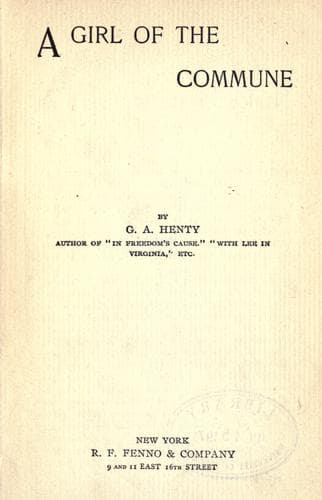
Paris (France) -- History -- Commune, 1871 -- Fiction
"Yes, I fancy I shall live in the open air as long as there is light
enough to sketch by, Miss Treadwyn, but if your mother will be good
enough to allow me to waive ceremony, I will come up some evening after
dinner; in the meantime may I say that I shall always be found somewhere
along the shore, and will be glad to receive with due humility any
chidings that my old playmate, if she will allow me to call her so, may
choose to bestow upon me."
Anna Treadwyn nodded. "I expect we shall be here every day; the sea is
new to Mary, and at present she is wild about it."
"How could you go on so, Mary," she went on, as they continued their
walk.
"How could I?" the girl replied. "Have we not agreed that one of the
chief objects of women's lives should not only be to raise their own sex
to the level of man, but generally to urge men to higher aims, and yet
because I have very mildly shown my disapproval of Cuthbert Hartington's
laziness and waste of his talents, you ask me how I can do it!"
"Well, you see, Mary, it is one thing for us to form all sorts of
resolutions when we were sitting eight or ten of us together in your
rooms at Girton; but when it comes to putting them into execution one
sees things in rather a different light. I quite agree with our theories
and I hope to live up to them, as far as I can, but it seems to me much
easier to put the theories into practice in a general way than in
individual cases. A clergyman can denounce faults from the pulpit
without giving offence to anyone, but if he were to take one of his
congregation aside and rebuke him, I don't think the experiment would be
successful."
"Nathan said unto David, thou art the man."
"Yes, my dear, but you will excuse my saying that at present you have
scarcely attained the position of Nathan."
Mary Brander laughed.
"Well, no, but you see Cuthbert Hartington is not a stranger. I have
known him ever since I can remember, and used to like him very much,
though he did delight in teasing me; but I have been angry with him for
a long time, and though I had forgotten it, I remember I did tell him my
mind last time I saw him. You see his father is a dear old man, quite
the beau-ideal of a country squire, and there he is all alone in his big
house while his son chooses to live up in London. I have heard my father
and mother say over and over again that he ought to be at home taking
his place in the county instead of going on his own way, and I have
heard other ladies say the same."
Public-domain text, read in full here on John Shaqi.
Reviews
Reviews
No reviews yet
Be the first to share your thoughts on this work.
Join the Discussion
Join the discussion
Sign in to leave a comment or review.
Sign InorCreate an account