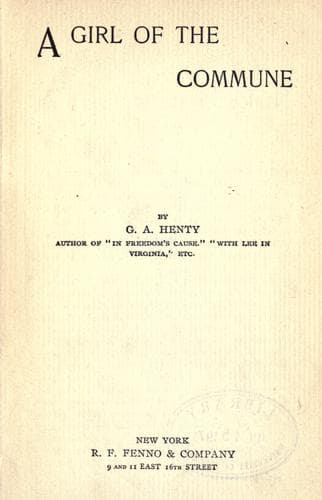
Paris (France) -- History -- Commune, 1871 -- Fiction
"Quite so, dear, and therefore I have left the matter open, and I will
leave you to fix the day and you can choose any one you like from Monday
to Saturday next week."
"But I must have time, Cuthbert," she said, desperately. "I have, of
course, things to get."
"The things that you have will do perfectly well, my dear. Besides, many
of the shops are open and you can get anything you want. As for a dress
for the occasion, if you choose to fix Saturday you will have twelve
days, which is twice as long as necessary. Putting aside my objection to
waiting any longer I want to get away from here to some quiet place
where we can forget the events of the past month, and get our nerves
into working order again. If there is any reason that you can declare
that you honestly believe to be true and valid of course I must give
way, but if not let it be Saturday week. That is right. I see that you
have nothing to urge," and a fortnight later they were settled in a
chalet high up above the Lake of Lucerne.
Rene and Pierre acted as Cuthbert's witnesses at the marriage. Pierre
had escaped before the fighting began. Rene had done service with the
National Guard until the news came that the troops had entered Paris,
then he had gone to M. Goude's who had hidden him and seven or eight of
the other students in an attic. When the troops approached, they had
taken refuge on the roof and had remained there until the tide of battle
had swept past, and they then descended, and arraying themselves in
their painting blouses had taken up their work at the studio; and when,
three days later, the general search for Communists began, they were
found working so diligently that none suspected that they had ever fired
a shot in the ranks of the Communists.
When the salon was opened, long after its usual time, Cuthbert's
pictures were well hung and obtained an amount of praise that more than
satisfied him, although his wife insisted that they were not half as
warm as the pictures deserved. It was not until they had been for some
time in Switzerland that Mary had learned the details of the deaths of
Arnold and Minette Dampierre. That both were dead she knew, for when she
mentioned their names for the first time after the close of the
fighting, Cuthbert told her that he had learned that both were dead, and
begged her to ask no question concerning them until he himself returned
to the subject.
Public-domain text, read in full here on John Shaqi.
Reviews
Reviews
No reviews yet
Be the first to share your thoughts on this work.
Elsewhere in the archive
Join the Discussion
Join the discussion
Sign in to leave a comment or review.
Sign InorCreate an account