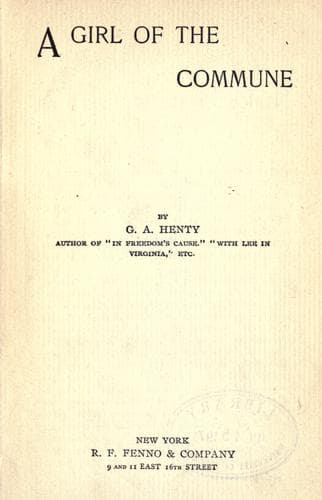
Paris (France) -- History -- Commune, 1871 -- Fiction
Mary wrote to her mother a day or two after she was married giving her
the news. An answer was received from Scarborough expressing great
satisfaction, and saying that it was probable that the family would
settle where they were. Neither Cuthbert nor his wife liked the thought
of returning to England, and for the next five years remained abroad.
After spending a few months at Dresden, Munich, Rome, and Florence, they
settled at Venice. Cuthbert continued to work hard, and each year two or
three of his pictures hung on the walls of the Academy and attracted
much attention, and were sold at excellent prices. All his earnings in
this way and the entire income of Fairclose were put aside to pay off
the mortgage, and when, at the end of the five years, Cuthbert, his
wife, and two children returned to Fairclose, the greater portion of the
mortgage had been paid off, and three years later it was entirely wiped
out.
Although very warmly received by the county, Cuthbert retained his
preference for London, and during the winter six months always moved up
to a house in the artists' quarter at St. John's Wood. Although he no
longer painted as if compelled to do so for a living, he worked
regularly and steadily while in town, and being able to take his time in
carrying out his conceptions, his pictures increased in value and he
took a place in the front rank of artists, and some fifteen years after
the siege of Paris was elected Academician. Before this he had sold
Fairclose and built himself a house in Holland Park, where he was able
to indulge his love for art to the fullest extent.
Of his wife's family he saw but little. Mary's sisters both married
before he and his wife returned from abroad. Mary went down occasionally
to Scarborough, and stayed with her father and mother, but Mr. Brander
steadily refused all invitations to visit them in London, and until his
death, fifteen years later, never left Scarborough, where he became a
very popular man, although no persuasions could induce him to take a
part in any of its institutions or public affairs.
Cuthbert has often declared that the most fortunate event in his life
was that he was a besieged resident in Paris through its two sieges. As
for Mary she has been heard to declare that she has no patience,
whatever, with the persons who frequent platforms and talk about women's
rights.
Not far from the spot in la Chaise where the pits in which countless
numbers of Communists were buried are situated, stands a small marble
cross, on whose pedestal are inscribed the words:--"To the memory of
Arnold Dampierre and his wife, Minette, whose bodies rest near this
place."
THE END.
_12mo, cloth, $1.25_
THE MASSARENES
By OUIDA
AUTHOR OF
"UNDER TWO FLAGS," "WANDA," ETC.
"The finish of the story is as artistic as is that of 'Vanity
Fair.'"--_N. Y. Journal._
"Ouida in her old age has written her best book."--_Evening Sun._
Public-domain text, read in full here on John Shaqi.
Reviews
Reviews
No reviews yet
Be the first to share your thoughts on this work.
Elsewhere in the archive
Join the Discussion
Join the discussion
Sign in to leave a comment or review.
Sign InorCreate an account