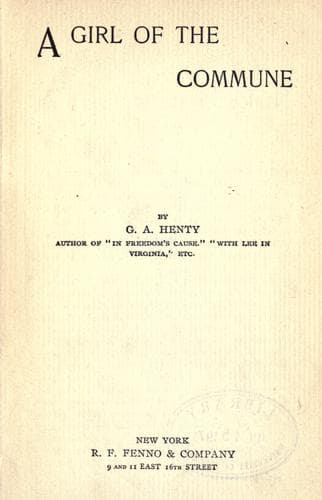
Paris (France) -- History -- Commune, 1871 -- Fiction
"My dear Mr. Hartingon,--I was in no way surprised at the receipt of
your letter, and indeed have been expecting an inquiry from you as to
the mortgage. It happened in this way: Some three years ago your father
said to me, 'I want to raise L15,000 on the estate, Brander.' I was
naturally greatly surprised, for acting for him as I did, I was, of
course, aware that he lived well within his income. He went on, 'Of
course you are surprised, Brander, but as you must know well most men
have a skeleton in a cupboard somewhere. I have one, and as I am getting
on in life I want to bury it for good. It makes no difference to you
what it is, and I have no intention of going into the matter. It
suffices that I want L15,000.' 'Of course there is no difficulty about
that, sir,' I said, 'the estate is unencumbered, and as there is no
entail you are free to do with it as you like. 'But I want it done
quietly,' he said, 'I don't want it talked about that I have mortgaged
Fairclose. The best plan by far would be for you to do it yourself,
which I have no doubt you can do easily enough if you like.' I said that
I would much rather have nothing to do with it, as I have always
considered it a mistake for lawyers to become principals in money
transactions with their clients, and had always refused to do anything
of the sort. However, he put the matter so strongly that he at last
induced me, against my better judgment, to consent to advance the money,
and at his earnest request I handed him the money in notes, so that no
one, even at the bank, should be aware that such a sum had passed
between us. Of course the mortgage was drawn up in the usual form and
duly executed and witnessed, and I have no doubt that the liquidator of
the bank will be happy to show you your father's receipt for the money
and the receipts given by me to him for the interest. As you say the
matter does not pecuniarily affect you now, but at the same time I am
naturally anxious you should satisfy yourself thoroughly that the
transaction was in every respect a bona fide one."
Cuthbert sat for some time with the letter before him.
"I suppose the dear old dad must have got into some scrape or other
years ago," he said to himself. "What it was it is no use wondering,
still less inquiring about. I am surprised he never told me, but I
suppose he could not wind himself up to the point, and I have no doubt
he intended to tell me some day, and would have done so if he hadn't
been carried off so suddenly. Anyhow, he knew me well enough to be sure
that when I heard of this mortgage, and learned how it had been done
that my love and respect for him would be sufficient to prevent my
trying to search into his past. He little thought that the mortgage
would not affect me to the extent of a penny. Well, there is an end of
it, and I won't think any more about the matter the secret is dead and
buried; let it rest there. And now it is time to be off to my work."
CHAPTER IV.
Public-domain text, read in full here on John Shaqi.
Reviews
Reviews
No reviews yet
Be the first to share your thoughts on this work.
Join the Discussion
Join the discussion
Sign in to leave a comment or review.
Sign InorCreate an account