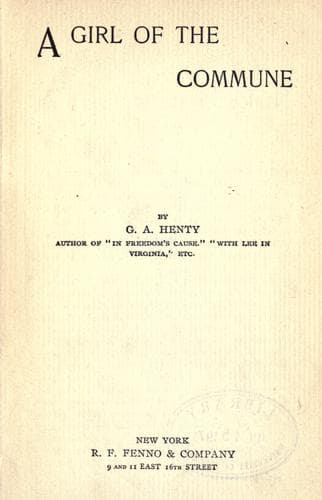
Paris (France) -- History -- Commune, 1871 -- Fiction
"Then you are altogether wrong. If you said Englishmen don't fight for
what you call glory, you would be right, but you can take my word for it
that in spite of what peace-at-any-price people may say, there are no
people in the world who are more ready to fight when they think they are
right, than Englishmen. We find it hard enough to get recruits in time
of peace, but in time of war we can get any number we want. The
regiments chosen to go to the front are delighted, those who have to
stay behind are furious. Glory has nothing to do with it. It is just the
love of fighting. I don't say that I am thinking of joining one of your
volunteer battalions because I want to fight. I do so because I think
you are in the right, and that this war has been forced upon you by the
Germans, who are likely to inflict horrible sufferings on the city."
"Never mind why you are going to fight," Leroux said, "you are going to
fight for us, and that is enough. You are a good comrade. And your
friend, here, what is he going to do?"
"I shall join also," Dampierre said. "You are a Republic now, like our
own, and of course my sympathies are wholly with you."
"Vive la Republique! Vive l'Americain!" the students shouted.
Cuthbert Hartington shrugged his shoulders.
"We were just starting for a stroll to the walls to see how they are
getting on with the work of demolition. Are any of you disposed to go
with us?"
They were all disposed, being in so great a state of excitement that
anything was better than staying indoors quietly. The streets were full
of people, carts were rumbling along, some filled with provisions,
others with the furniture and effects of the houses now being pulled
down outside the _enciente_, or from the villas and residences at Sevres
Meudon and other suburbs and villages outside the line of defence.
Sometimes they came upon battalions of newly-arrived mobiles, who were
loudly cheered by the populace as they marched along; sturdy sunburnt
peasants with but little of the bearing of soldiers, but with an earnest
serious expression that seemed to say they would do their best against
the foes who were the cause of their being torn away from their homes
and occupations. Staff officers galloped about at full speed; soldiers
of the garrison or of Vinoy's Corps, who had come in a day or two
before, lounged about the streets looking in at the shops. No small
proportion of the male population wore kepis, which showed that they
belonged either to the National Guard or to the battalions that were
springing into existence.
"Why do we not register our names to-day!" Rene exclaimed.
Public-domain text, read in full here on John Shaqi.
Reviews
Reviews
No reviews yet
Be the first to share your thoughts on this work.
Join the Discussion
Join the discussion
Sign in to leave a comment or review.
Sign InorCreate an account