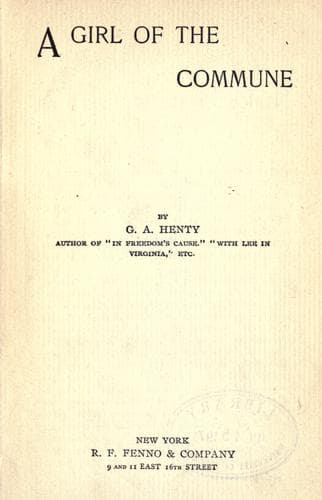
Paris (France) -- History -- Commune, 1871 -- Fiction
"I do not understand these English," Madame Michaud thought, as she drew
the lamp nearer and resumed her knitting, "here are a young woman and a
young man who are more like comrades than lovers. She was angry, more
angry than I thought she could be, for she is generally good-tempered,
when I asked her, the first time he came, if they were _affiances_, 'We
are old friends, madame,' she said, 'and nothing but friends. Cannot a
girl have a man as a friend without there being any thought of love? In
England people are friends, they can talk and laugh to each other
without any silly ideas of this sort occurring to them. This is one of
the things that keeps woman back in the scale, this supposition that she
is always thinking of love.' I did not believe her then, but I have
listened to-night when they thought I was asleep, and I even peeped out
two or three times between my eyelids. I could not understand a word of
what they said, but one can tell things by the tone without
understanding the words. There was no love-making. She scolded him and
he laughed. He sat carelessly in his chair, and did not move an inch
nearer to her. She was as straight and as upright as she always is.
"That is not the way lovers act when one is going out to fight. I peeped
out when he shook hands with her. He did not hold her hand a moment, he
just shook it. They are strange people, these English. It would be wrong
for a French girl thus to talk to a young man, but I suppose it is
different with them. Who can understand these strange islanders? Why, if
Lucien were going out to fight I should dissolve in tears, I should
embrace him and hang on his neck; I might even have hysterics, though I
have never had them in my life. She is a good girl, too, though she has
such strange ideas about women. What can she want for them? I manage the
house and Lucien goes to his office. If I say a thing is to be done in
the house it is done. I call that equality. I cannot tell what she is
aiming at. At times it seems to me that she is even more mad than her
compatriots, and yet on other subjects she talks with good sense. What
her father and mother can be about to let her be living abroad by
herself is more than I can think. They must be even more mad than she
is."
Work at M. Goude's school went on steadily during the intervals between
the turns of the Franc-tireurs des Ecoles going out beyond the walls.
Indeed M. Goude acknowledged that the work was better than usual.
Certainly the studio was never merrier or more full of life. So far from
the active exercise and the rough work entailed by the constant
vigilance necessary during the long night-watches, diminishing the
interest of the young fellows in their work in the studio, it seemed to
invigorate them, and they painted as if inflamed with the determination
to make up for lost time.
Public-domain text, read in full here on John Shaqi.
Reviews
Reviews
No reviews yet
Be the first to share your thoughts on this work.
Elsewhere in the archive
Join the Discussion
Join the discussion
Sign in to leave a comment or review.
Sign InorCreate an account