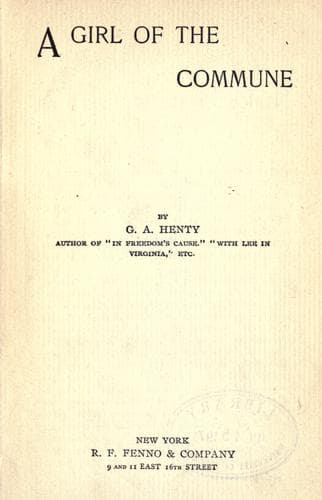
Paris (France) -- History -- Commune, 1871 -- Fiction
"We were pretty well matched," he said, "and I suppose were equally
surprised when we found each other grappling in the dark. Of course
neither of us knew how many supporters the other had close at hand, but
the first thought that struck me was that I must silence him if possible
before his comrades came to his assistance. I was only afraid that I
should not be able to shake myself free from his grip so as to get to
his throat, but fortunately he relaxed his hold the moment he felt that
I had loosened mine, and as I was on the top of him the rest was easy."
"Well, you got well out of it anyhow, Hartington," Pierre said. "You did
not see anything of the man who was knocked down by a musket, did you?"
"No, it did not occur to me to look for him, but if you like I will go
out with you and bring him in."
"That is a very good idea, Hartington, probably he was only stunned. I
will go and get leave for us to do so."
However, just as he turned to go a call was heard in front, and a minute
later the man came in.
"He had," he said, when he recovered consciousness, "heard a tremendous
fire going on, and as soon as he could collect his thoughts became
assured that the enemy must be attacking the village. He therefore
concluded that the best thing was to lie still, which he did until the
fire ceased and he could hear the Prussians retreating. Then he had
crawled in until close to the line of outposts."
"I am heartily glad to see you back again," Pierre said, shaking him by
the hand. "It would always have been a subject of regret to me if the
expedition that I proposed had lost you your life. As to those who fell
in defence of the village I have no personal responsibility, but I
should certainly have felt that your death always lay at my door."
CHAPTER X.
Another month and a great change had come over Paris. The spirit of
empty gasconnade had been succeeded by one more befitting the time and
circumstances. As the hopes of assistance from without lessened, the
spirit of resistance grew stronger and firmer. There was no longer any
talk of sweeping the Prussians out of France, no longer was it an
article of faith that Paris would be saved; but the thought of surrender
was farther than ever from men's minds. Paris would resist to the last.
She would give time to France to reorganize herself, and would set such
an example of devotion and patience under suffering, that when at last
famine forced her to surrender, the world should at least say that Paris
had proved herself worthy of her reputation.
Public-domain text, read in full here on John Shaqi.
Reviews
Reviews
No reviews yet
Be the first to share your thoughts on this work.
Elsewhere in the archive
Join the Discussion
Join the discussion
Sign in to leave a comment or review.
Sign InorCreate an account