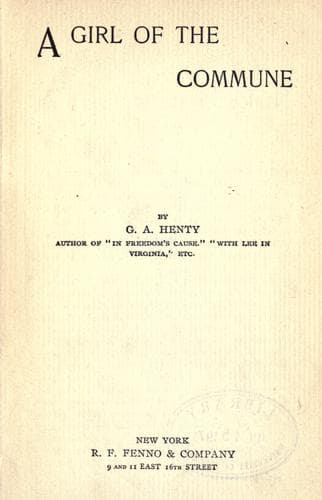
Paris (France) -- History -- Commune, 1871 -- Fiction
"All this," he said, "has wiped away old quarrels. If I were fit for it
I would do as so many of the artists of Paris have done--take my place
in the ranks--but I am past the age for marching and sleeping in
ditches; but I can entertain no further anger against men who are
fighting for France. It is the duty of those who cannot fight to paint.
When the Salon opens we must show the world that, in spite of these
barbarians, France still holds her head high, and is at the head of
civilization."
Cuthbert, however, was not among the number of those who used the
painting-room. He had chosen his lodging so as to have a north light,
and kept his door closed from early morning until the light faded. An
ardor for work had seized him, and it was with reluctance that he put
aside his brush when the day's work was over. He was engaged upon two
pictures, and worked upon them alternately as the mood seized him. When
he had done for the day the canvas was always covered up and the easels
placed behind a screen in the corner of the room and the doors opened to
his friends.
Once a week for two days, when the corps marched out to take its turn at
outpost work, the work was laid by. Between the regular troops on either
side there was but an occasional exchange of shots, except when one or
the other side attempted to advance its position, but this was seldom,
for every post of advantage and every village was now so strongly
fortified as to defy capture except by a large force.
The Germans had recognized already that Paris was not to be taken by
force, at the cost except of a tremendous expenditure of life,
therefore, they were content to close every avenue of escape and to
leave it to famine to do the work for them. The French on their side
felt that minor operations to enlarge their boundary somewhat, were but
a vain effort, and reserved themselves for a great attempt to break
through the line. The Franc-tireurs, however, were ever active. They
kept up an increasing fusilade upon the Prussian outposts night and day,
keeping them in a state of perpetual irritation and watchfulness.
Except when on this service, Cuthbert saw but little of Arnold
Dampierre. The latter had entirely given up painting and was seldom at
his lodgings; nor when at home did he join in the smoking-parties at one
or other of the students rooms. Other luxuries had given out, but
tobacco was still fairly cheap and its solace made up for many
privations. Nor was Arnold's absence regretted. He had never been
popular, and on the few occasions when he appeared among them, he was so
moody and taciturn that his absence was felt as a relief. When on duty
with the corps, however, he was always in good spirits. He seemed to
delight in action and was ever ready to volunteer for any dangerous
work, such as crawling up close to the German outposts to ascertain
their precise positions. He had so many narrow escapes that his comrades
declared that he held a charmed life against Prussian bullets.
Public-domain text, read in full here on John Shaqi.
Reviews
Reviews
No reviews yet
Be the first to share your thoughts on this work.
Elsewhere in the archive
Join the Discussion
Join the discussion
Sign in to leave a comment or review.
Sign InorCreate an account