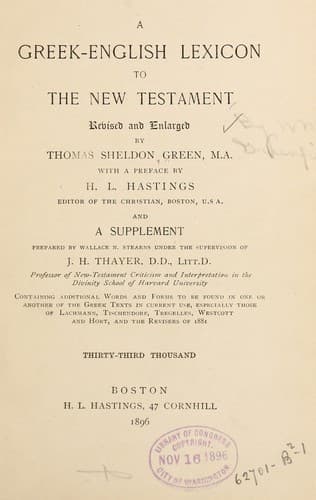
A Greek-English Lexicon to the New TestamentGreenfield, William
Religion
A Greek-English Lexicon to the New Testament
Greenfield, William
Bible. New Testament -- Dictionaries -- English; Greek language, Biblical -- Dictionaries -- English
13.13; contentious disposition,
Ro. 1.29. Phi. 1.15, et al.
Ἐρίφιον, ίου, τό,
a goat, kid, Mat. 25.33: dim. from
Ἔρῐφος, ου, ὁ, ἡ,
a goat, kid, Mat. 25.32. Lu. 15.29.
Ἑρμηνεία, ας, ἡ,
interpretation, explanation, 1 Co. 14.26; meton. the power
or faculty of interpreting, 1 Co. 12.10:
from
Ἑρμηνεύω, (ἑρμηνεύς, an interpreter)
f. εύσω,
to explain, interpret, translate, Jno. 1.39, 43; 9.7. He. 7.2.
Ἑρμῆς, οῦ, ὁ,
Hermes or Mercury, son of Jupiter and Maia, the messenger
and interpreter of the gods, and the patron of eloquence,
learning, &c., Ac. 14.12.
Ἑρπετόν, οῦ, τό, (ἕρπω, to creep)
a creeping animal, a reptile, Ac. 10.12, et al.
Ἐρυθρός, ά, όν,
red, Ac. 7.36. He. 11.29.
Ἔρχομαι,
f. ἐλεύσομαι, a.2. ἤλῠθον, by sync. ἦλθον, p. ἐλήλῠθα,
to come, to go, to pass. By the combination of this verb with
other terms, a variety of meaning result, which, however, is
due, not to a change of meaning in the verb, but to the adjuncts.
Ὁ ἐρχόμενος, He who is coming, the expected Messiah, Mat. 11.3.
et al.
Ἐρωτάω, ῶ,
f. ήσω,
to ask, interrogate, inquire of, Mat. 21.24. Lu. 20.3; in N.T.,
to ask, request, beg, beseech, Mat. 15.23. Lu. 4.38. Jno. 14.16,
et al.
Ἐσθής, ῆτος, ἡ, (ἕννυμι, to clothe)
a robe, vestment, raiment, Lu. 23.11. Ac. 1.10, et al.:
whence
Ἔσθησις, εως, ἡ,
a garment, robe, raiment, Lu. 24.4. L.G.
Ἐσθίω, (ἔδω)
f. ἔδομαι, & in N.T. φάγομαι, εσια, a.2. ἔφαγον,
to eat, Mat. 12.1; 15.27; ἐσθίειν καὶ πίνειν, to eat and drink,
to eat and drink in the usual manner, follow the common mode of
living, Mat. 11.18; also with the assocaited notion of supposed
security, Lu. 17.27; to feast, banquet, Mat. 24.49; met. to devour,
consume, He. 10.27. Ja. 5.3; from the Heb. ἄρτον ἐσθίειν, to eat
bread, to take food, take the usual meals, Mat. 15.2, et al.
Ἔσοπτρον, ου, τό, (ὄψομαι)
a mirror, speculum, Ja. 1.23. 1 Co. 13.12.
Ἑσπέρα, ας, ἡ,
fem. of ἕσπερος, evening, Lu. 24.29. Ac. 4.3; 28.23.
Ἔσχᾰτος, η, ον,
farthest; last, latest, Mat. 12.45. Mar. 12.6; lowest,
Mat. 19.30; 20.16, et al.:
whence
Ἐσχάτως,
adv. extremely; ἐσχάτως ἔχειν, to be in the last extremity,
Mar. 5.23.
Ἔσω,
adv., for the more usual form εἰσω, in, within, in the interior of,
Mat. 26.58. Jno. 20.26, et al.; ὁ, ἡ, τό ἔσω, inner, interior,
internal; met. within the pale of community, 1 Co. 5.12;
ὁ ἔσω ἄνθρωπος, the inner man, the mind, soul, Ro. 7.22:
whence
Ἔσωθεν,
adv. from within, from the interior, Mar. 7.21, 23; within,
in the internal parts, Mat. 7.15, et al.; ὁ, ἡ, τό ἔσωθεν,
interior, internal, Lu. 11.39, 40; ὁ ἔσωθεν ἄνθρωπος,
the mind, soul, 2 Co. 4.16.
Ἐσώτερος, α, ον,
inner, interior, Ac. 16.24. He. 6.19.
Ἑταῖρος, ου, ὁ,
a companion, associate, fellow, comrade, friend,
Mat. 11.16; 20.13; 22.12; 26.50.
Ἑτερόγλωσσος, ου, ὁ, ἡ, (ἕτερος & γλῶσσα)
one who speaks another or foreign language, 1 Co. 14.21. L.G.
Ἑτεροδιδασμαλέω, ῶ, (ἕτερος & διδασκαλία)
f. ήσω,
Public-domain text, read in full here on John Shaqi.
Reviews
Reviews
No reviews yet
Be the first to share your thoughts on this work.
Elsewhere in the archive
Join the Discussion
Join the discussion
Sign in to leave a comment or review.
Sign InorCreate an account