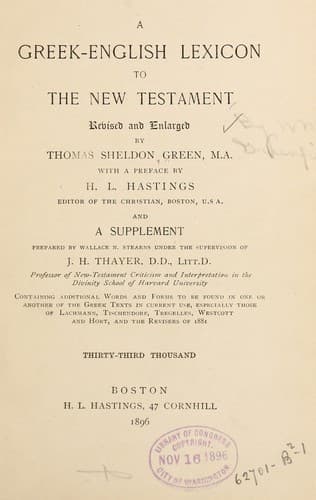
A Greek-English Lexicon to the New TestamentGreenfield, William
Religion
A Greek-English Lexicon to the New Testament
Greenfield, William
Bible. New Testament -- Dictionaries -- English; Greek language, Biblical -- Dictionaries -- English
Ἤ,
either, or, Mat. 6.24, et al.; after comparatives, and ἄλλος,
ἕτερος, expressed or implied, than, Mat. 10.15, 18.8. Ac. 17.21;
24.21; intensive after ἀλλά & πρίν, Lu. 12.51. Mat. 1.18; it
also serves to point an interrogation, Ro. 3.29, et al.
Ἧ,
a particle occurring in the N.T. only in the combination ἧ μήν,
introductory to the terms of an oath, He. 6.14.
Ἡγεμονεύω, (ἡγεμών)
f. εύσω,
to be a guide, leader, chief; in N.T., to hold the office of a
Roman provincial governor, Lu. 2.2; 3.1.
Ἡγεμονία, ας, ἡ,
leadership, sovereignty; in N.T., a reign, Lu. 3.1:
from
Ἡγεμών, όνος, ὁ,
a guide; a leader; a chieftain, prince, Mat. 2.6; a Roman
provincial governor, under whatever title, Mat. 27.2, et al.
Ἡγέομαι, οῦμαι,
f. ήσομαι,
to lead the way; to take the lead, Ac. 14.12; to be chief,
to preside, govern, rule, Mat. 2.6. Ac. 7.10; ἡγούμενος, a
chief officer in the church, He. 13.7, 17,24; also, with
p. ἥγημαι, to think, consider, count, esteem, regard,
Ac. 26.2. 2 Co. 9.5, et al.
Ἡδέως, (ἡδύς)
adv. with pleasure, gladly, willingly, Mar. 6.20; 12.37.
2 Co. 11.19.
Ἥδη,
adv. before now, now, already, Mat. 3.10; 5.28, et al.; ἥδη ποτέ,
at length, Ro. 1.10. Phi. 4.10.
Ἥδιστα,
adv. (pr. neut. pl. superlat. of ἡδύς) with the greatest pleasure,
most gladly, 2 Co. 12.9, 15.
Ἡδονή, ῆς, ἡ, (ἧδος)
pleasure, gratification, esp. sensual pleassure, Lu. 8.14.
Tit. 3.3. Ja. 4.3. 2 Pe. 2.13; a passion, Ja. 4.1.
Ἡδύοσμον, ου, τό, (ἡδύς & ὀσμή)
garden mint, Mat. 23.23. Lu. 11.42.
Ἥθος, εος, τό,
pr. a place of customary resort, a haunt; hence, a settled
habit of mind and manners, 1 Co. 15.33.
Ἥκω,
f. ἥξω, imperf. ἧκον,
to be come, have arrived, Lu. 15.27, et al.
Ἠλί, (Heb. אלי)
my God! Mat. 27.46.
Ἠλικία, ας, ἡ, (ἧλιξ)
a particular period of life; the period fitted for a particular
function, prime, He. 11.11; full age, years of discretion,
Jno. 9.21, 23; perhaps, the whole duration of life, Mat. 6.27.
Lu. 12.25; otherwise, stature, Lu. 19.3. Ep. 4.13.
Ἡλίκος, η, ον,
as great as; how great, Col. 2.1. Ja. 3.5. (ῐ).
Ἥλιος, ου, ὁ,
the sun, Mat. 13.43; 17.2. Mar. 1.32, et al.; meton. light of
the sun, light, Ac. 13.11.
Ἧλος, ου, ὁ,
a nail, Jno. 20.25, bis.
Ἡμέρα, ας, ἡ,
day, a day, the interval from sunrise to sunset,
opp. to ηύξ, Mat. 4.2; 12.40. Lu 2.44; the interval of
twenty-four hours, comprehending day and night,
Mat. 6.34; 15.32; fr. the Heb. ἠμέρᾳ καὶ ἠμέρᾳ, day by day,
every day, 2 Co. 4.16; ἡμέραν ἐξ ἡμέρας, from day to day,
continually, 2 Pe. 2.8; καθ' ἡμέραν, every day, daily,
Ac. 17.17. He. 3.13; a point or period of time, Lu. 19.42.
Ac. 15.7. Ep. 6.13 et al.; a judgment, trial, 1 Co. 4.3.
Ἡμέτερος, α, ον,
our, Ac. 2.11; 24.6, et al.
Ἡμιθᾰνής, έος, οῦς, ὁ, ἡ, (ἡμι— & θνήσκω)
half dead, Lu. 10.30.
Ἥμῐσυς, σεια, συ,
half, Mar. 6.23. Lu. 19.8. Re. 11.11; 12.14.
Ἠμιώριον, ου, τό, (ἡμι— & ὥρα)
half an hour, Re. 8.1. L.G.
Ἡνίκα,
adv.
Public-domain text, read in full here on John Shaqi.
Reviews
Reviews
No reviews yet
Be the first to share your thoughts on this work.
Elsewhere in the archive
Join the Discussion
Join the discussion
Sign in to leave a comment or review.
Sign InorCreate an account