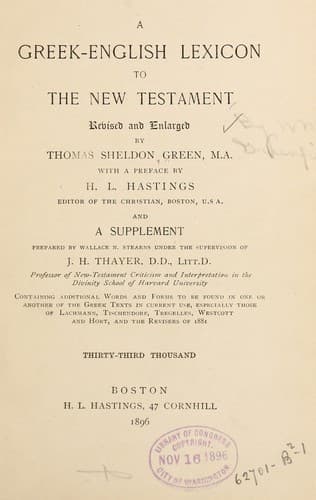
A Greek-English Lexicon to the New TestamentGreenfield, William
Religion
A Greek-English Lexicon to the New Testament
Greenfield, William
Bible. New Testament -- Dictionaries -- English; Greek language, Biblical -- Dictionaries -- English
when, 2 Co. 3.15, 16. (ῐ)
Ἤπερ, (ἤ & περ)
an emphatic form of ἤ, than, Jno. 12.43.
Ἤπιος, ου, ὁ, ἡ,
mild, gentle, kinid, 1 Thes. 2.7. 2 Ti. 2.24.
Ἤρεμος, ου, ὁ, ἡ,
equivalent to the ordinary form ἠρεμαῖος, tranquil, quiet,
1 Ti. 2.2. N.T.
Ἡρωδιανοί, ῶν, οἱ,
Herodians, partisans of Ἡρώδης, Herod Antipas, Mat. 22.16.
Mar. 3.6; 12.13.
Ἡσυχάζω, (ἥσυχος)
f. άσω,
to be still, at rest; to live peaceably, be quiet,
1 Thes. 4.11; to rest from labour, Lu. 23.56; to be
silent or quiet, acquiesce, to desist from discussion
Lu. 14.4. Ac. 11.18; 21.14.
Ἡσυχία, ας, ἡ,
rest, quiet, tranquillity; a quiet tranquil life, 2 Thes. 3.12;
silence, silent attention, Ac. 22.2. 1 Ti. 2.11, 12.
Ἡσύχιος, ου, ὁ, ἡ,
equivalent to ἥσῠχος, quiet, tranquil, peaceful,
1 Ti. 2.2. 1 Pe. 3.4.
Ἥτοι, (ἤ & τοι)
conj. in N.T. only in the usage, ἤτοι— ἥ, whether, with an
elevated tone, Ro. 6.16.
Ἡττάομαι, ῶμαι,
f. ἥττηθησομαι & ἡττήσομαι, p. ἥττημαι, (ἥττων)
to be less, inferior to; to fare worse, to be in a less
favoured condition, 2 Co. 12.13; by impl. to be overcome,
vanquished, 2 Pe. 2.19, 20:
whence
Ἤττημα, ατος, τό,
an inferiority to a particular standard; default, failure,
shortcoming, Ro. 11.12 1 Co. 6.7. S.
Ἥττων, Att. for ἥσσων, ονος, ὁ, ἡ,
less, 2 Co. 12.15; worse, 1 Co. 11.17.
Ἠχέω, ῶ, (ἠχή)
f. ήσω,
to sound, ring, 1 Co. 13.1; to roar, as the sea, Lu. 21.25.
Ἠχος, ου, ὁ,
equivalent to ἠχή, sound, noise, Ac. 2.2. He. 12.19;
met. report, fame, rumour, Lu. 4.37.
Θ, θ, Θῆτα
Public-domain text, read in full here on John Shaqi.
Reviews
Reviews
No reviews yet
Be the first to share your thoughts on this work.
Elsewhere in the archive
Join the Discussion
Join the discussion
Sign in to leave a comment or review.
Sign InorCreate an account