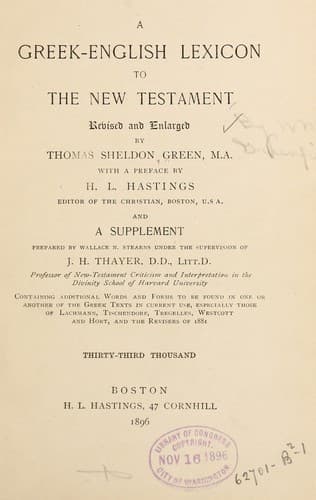
A Greek-English Lexicon to the New TestamentGreenfield, William
Religion
A Greek-English Lexicon to the New Testament
Greenfield, William
Bible. New Testament -- Dictionaries -- English; Greek language, Biblical -- Dictionaries -- English
Θάλασσα, ης, ἡ
the sea, Mat. 23.15. Mar. 9.42; a sea, Ac. 7.36; an inland sea,
lake, Mat. 8.24, et al.
Θάλπω,
f. ψς,
to impart warmth; met. to cherish, nurse, foster, Ep. 5.29.
1 Thes. 2.7.
Θαμβέω, ῶ,
f. ήσω, a.1. ἐθάμβησα,
to be astonished, amazed, Ac. 9.6; later, pass. to be
astonished, amazed, awe-struck, Mar. 1.27; 10.24, 32:
from
Θάμβος, εος, τό,
astonishment, amazement, awe, Lu. 4.36, et al.
Θανάσῐμος, ου, ὁ, ἡ, (θάνατος)
deadly, mortal, fatal, Mar. 16.18.
Θανατηφόρος, ου, ὁ, ἡ, (θάνατος & φέρω)
mortiferous, bringing or causing death, deadly,
fatal, Ja. 3.8.
Θάνᾰτος, ου, ὁ (θνήσκω)
death, the extinction of life, whether naturally, Lu. 2.26.
Mar. 9.1; or violently, Mat. 10.21; 15.4; imminent danger of
death, 2 Co. 4.11, 12; 11.23; in N.T. death, as opposed
to ζωή in its spiritual sense, spiritual condemnation, exclusion
from salvation, the penal state of loss of salvation.
Jno. 8.51. Ro. 6.16, et al.:
whence
Θανατόω, ῶ,
f. ώσω, a.1. ἐθανάτωσα,
to put to death, deliver to death, Mat. 10.21; 26.59. Mar. 13.12;
pass. to be exposed to imminent danger of death, Ro. 3.36; in N.T.,
met. to subdue, mortify, Ro. 8.13; pass. to be dead to, to be
rid, parted from, as if by the intervention of death, Ro. 7.4.
Θάππω,
f. ψω, τέτᾰφα, a.1. ἔθαχα, a.2. pass ἐτάφην,
to bury, inter, Mat. 8.21, 22; 14.12, et al.
Θαρσέω, ῶ, & new Attic, θαρρέω, ῶ, (θάρσος, θάρρος),
f. ήσω, imperat. θάρσει,
to be of good courage, be of good cheer, Mat. 9.2, et al.;
to be confident, hopeful, 2 Co. 7.16, et al.; to be bold,
maintain a bold bearing, 2 Co. 10.1, 2.
Θάρσος, εος, τό,
courage, confidence, Ac. 28.15.
Θαῦμα, ατος, τό,
a wonder; wonder, admiration, astonishment, Re. 17.6:
whence
Θαυμάζω,
f. άσω, p. τεθαύμακα, a.1. ἐθαύμασα,
to admire, regard with adminration, wonder at, Lu. 7.9.
Ac. 7.31; to reverence, adore, 2 Thes. 1.10; absol to wonder,
be filled with wonder, admiration, or astonishment,
Mat. 8.10. Lu. 4.22, et al.; whence
Θαυμάσιος, α, ον,
wonderful, admirable, marvellous; τὸ θαυμάσιον, a wonder,
wonderful work, Mat. 21.13.
Θαθμαστός, ή, όν,
wondrous, glorious, 1 Pe. 2.9. Re. 15.1; marvellous, strange,
uncommon, Mat. 21.42. Mar. 12.11.
Θεά, ᾶς, ἡ, (Θεός)
a goddess, Ac. 19.27, 35, 37.
Θεάομαι, ῶμαι,
f. άσομαι, p. τεθέᾱμαι, a.1. pass. ἐθεάθην,
to gaze upon, Mat. 6.1; 23.5. Lu. 7.24; to see, discern with the
eyes, Mar. 16.11, 14. Lu. 5.27. Jno. 1.14, 32, 38, et al.;
to see, visit, Ro. 15.24.
Θεατρίζομαι,
to be exposed as in a theatre, be made a gazing-stock,
object of scorn, He. 10.33 (N.T.) from
Θέᾱτρον, ου, τό, (θεάομαι)
a theatre, a place where public games and spectacles are
exhibited, Ac. 19.29, 31; meton. a show, gazing-stock,
1 Co. 4.9.
Θεῖον, ου, τό,
brimstone, sulphur, Lu. 17.29. Re. 9.17.18, et al.
Θεῖος, α, ον, (Θεός)
divine, pertaining to God, 2 Pe. 1.3, 4; τὸ θεῖον,
the divine nature, divinity, Ac. 17.29:
whence
Public-domain text, read in full here on John Shaqi.
Reviews
Reviews
No reviews yet
Be the first to share your thoughts on this work.
Elsewhere in the archive
Join the Discussion
Join the discussion
Sign in to leave a comment or review.
Sign InorCreate an account