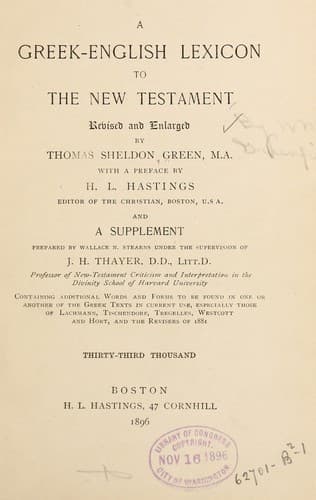
A Greek-English Lexicon to the New TestamentGreenfield, William
Religion
A Greek-English Lexicon to the New Testament
Greenfield, William
Bible. New Testament -- Dictionaries -- English; Greek language, Biblical -- Dictionaries -- English
the harvest of the Gospel, Mat. 9.37, 38,
Lu. 10.2; a crop; met. the crop of vengeance, Re. 14.15
Θεριστής, οῦ, ὁ,
one who gathers in the harvest, a reaper, Mat. 13.30, 39.
Θερμαίνω,
f. ανῶ,
to warm; mid. to warm one's self, Mar. 14.54, 67.
Jno. 18.18, 25. Ja. 2.16:
from
Θέρμη, ης, ἡ, (θερμός, θέρω)
heat, warmth, Ac. 28.3.
Θέρος, εος, τό,
the warm season of the year, summer, Mat. 24.32.
Mar. 13.38. Lu. 21.30.
Θεωρέω, ῶ,
f. ήσω,
to be a spectator, to gaze on, contemplate;
to behold, view with interest and attention Mat. 27.55; 28.1, et al.;
to contemplate mentally, consider, He. 7.4; in N.T.,
to see, perceive, Mar. 3.11, et al.;
to come to a knowledge of, Jno. 6.40
fr. the Heb. to experience, undergo, Jno. 8.51, et al.:
Θεωρία, ας, ἡ,
a beholding; a sight, spectacle, Lu. 23.48.
Θήκη, ης, ἡ, (τίθημι)
a repository, receptacle; a case, sheath, scabbard,
Jno. 18.11.
Θηλάζω, (θηλή, a nipple)
f. άσω, a.1. ἐθήλασα,
to suckle, give suck, Mat. 24.19. Mar. 13.17. Lu. 21.23; 23.29;
to suck, Mat. 21.16. Lu. 11.27.
Θῆλυς, θήλεια, θῆλυ,
female; τὸ θῆλυ, sc. γενός, a female, Mat. 19.4. Mar. 10.6.
Ga. 3.28; ἡ θήλεια, woman, Ro. 1.26, 27.
Θήρα, ας, ἡ, (θήρ, a wild beast)
hunting, the chase; met. means of capture, a cause of
destruction, Ro. 11.9:
whence
Θηρεύω,
f. εύσω,
to hunt, catch; met. to seize on, lay hold of, Lu. 11.54.
Θηριομαχέω, ῶ, (θηρίον & μάχομαι)
f. ήσω, a.1. ἐθηριομάχησα,
to fight with wild beasts; met. to be exposed to furious
hostility, 1 Co. 15.32. L.G.
Θηρίον, ου, τό, (equivalent to θήρ, but pr. a dmin. from it)
a beast, wild animal, Mar. 1.13. Ac. 10.12, et al.;
met. a brutish man, Tit. 1.12.
Θησαυρίζω,
f. ίσω, a.l. ἐθησαύρισα,
to collect and lay up stores or wealth, treasure up,
Mat. 6.19, 20; to heap up, accumulate, Ro. 2.5. 1 Co. 16.2;
to reserve, keep in store, 2 Pe. 3.7:
from
Θησαυρός, οῦ, ὁ,
a treasury, a store, treasure, precious deposit,
Mat. 6.19, 20, 21, et al.; a receptacle in which
precious articles are kept, a casket, Mat. 2.11;
a store house, Mat. 12.35.
Θιγγάνω,
f. θίξομαι, a.2. ἔθιγον,
to touch, Col. 2.21. He. 12.20; to harm, He. 11.28.
Θλίβω,
f. ψω, p. pass. τέθλιμμαι,
to squeeze, press; to press upon, emcumber, throng,
crowd, Mar. 3.9; met. to distress, afflict, 2 Co. 1.6; 4.8,
et al.; pass. to be compressed, narrow, Mat. 7.14: (ῑ)
whence
Θλῖψις, εως, ἡ
pr. pressure, compression; met. affliction, distress of mind,
2 Co. 2.4; distressing circumstances, trail, affliction,
Mat. 24.9, et al. L.G.
Θνήσκω,
f. θανοῦμαι, p. τέθνηκα, a.2. ἔθανον,
to die; in N.T., only in the p. and plup., τέθηνκα, ἐτεθνήκειν,
to be dead, Mat. 2.20; Mar. 15.44, et al.:
whence
Θνητός, ή, όν,
mortal, obnoxious to death, Ro. 6.12; 8.11. 2 Co. 4.11;
τὸ θνητόν, mortality, 1 Co. 15.53, 54. 2 Co. 5.4.
Θορυβέω, ῶ,
f. ήσω,
intrans. to make a din, uproar; trans. to disturb, throw
into commotion, Ac.
Public-domain text, read in full here on John Shaqi.
Reviews
Reviews
No reviews yet
Be the first to share your thoughts on this work.
Elsewhere in the archive
Join the Discussion
Join the discussion
Sign in to leave a comment or review.
Sign InorCreate an account