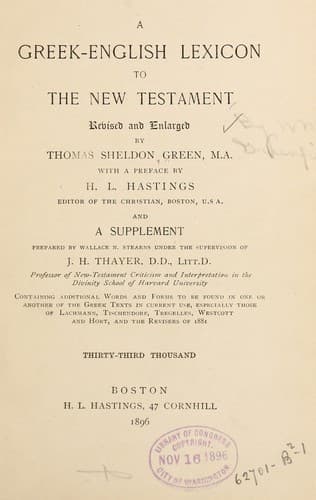
A Greek-English Lexicon to the New TestamentGreenfield, William
Religion
A Greek-English Lexicon to the New Testament
Greenfield, William
Bible. New Testament -- Dictionaries -- English; Greek language, Biblical -- Dictionaries -- English
27.60,
et al.; in N.T., met. an opening, occasion, opportunity,
Ac. 14.27. 1 Co. 16.9, et al.; meton. a medium or means
of entrance, Jno. 10.7, 9:
whence
Θυρεός, οῦ, ὁ,
a stone or other material employed to close a doorway,
later, a large oblong shield, Ep. 6.16.
Θυρίς, ίδος, ἡ
a small opening; a window, Ac. 20.9. 2 Co. 11.33.
Θυρωρός, οῦ, ὁ (θύρα & οὖρος, a keeper)
a door-keeper, porter, Mar. 13.34. Jno. 10.3; 18.16, 17.
Θυσία, ας, ἡ, (θύω)
sacrifice, act of sacrificing, He. 9.26; the thing sacrificed,
a victim, Mat. 9.13; 12.7; the flesh of victims, eaten by
the sacrificers, 1 Co. 10.18; in N.T., an offering or service
to God, Phi. 4.18, et al.
Θυσιαστήριον, ίου, τό,
an altar, Mat. 5.23, 24. Lu. 1.11, et al.; spc. the altar
of burnt offering, Mat. 23.35. Lu. 11.51; meton. a class of
sacrifices, He. 13.10: (S.)
from
Θύω,
f. θύσω, p. τεθῠκα, a.1. ἔθῡσα, pass. p. τέθυμαι, a.1. ἐτύθην,
to offer; to kill in sacrifice, sacrefice, immolate,
Ac. 14.13, 18, et al.; in N.T., to slaughter for food,
Mat. 22.4, et al. (-ῠ in θύω, ῠ in ἐτύθην).
Θώραξ, ᾱκος, ὁ,
a breastplate, armour for the body, consisting of two
parts, one covering the breast and the other the back,
Re. 9.9, 17. Ep. 6.14. 1 Th. 5.8.
Ι, ι, Ἰῶτα
Ἴᾱμα, ατος, το,
healing, cure, 1 Co. 12.9, 28, 30:
from
Ἰάομαι, ῶμαι,
f. άσομαι, a.1. ἰᾱσάμην, p. pass. ἴᾱμαι, a.1. ἰάθην,
to heal, cure, Mat. 8.8. Lu. 9.2; met. to heal spiritually,
restore from a state of sin and condemnation, Mat. 13.15.
He. 12.13, et al.:
whence
Ἴᾱσις, εως, ἡ,
healing, cure, Lu. 13.32. Ac. 4.22, 30.
Ἴασπις, ιδος, ἡ,
jasper, a precious stone of various colours as purple,
cerulean, green, &c. Re. 4.3; 21.11, 18, 19.
Ἰᾱτρος, οῦ, ὁ, (ἰάομαι)
a physician, Mat. 9.12. Mar. 2.17; 5.26, et al.
Ἴδε, or ἰδέ, imperat. of εἶδον, used as an interj.,
lo! behold! Jno. 11.36; 16.29; 19.4, 5, et al.
Ἰδέα, ας, ἡ, (ἰδεῖν)
form; look, aspect, Mat. 28.3.
Ἴδιος, ια, ιον,
one's own, Mar. 15.20. Jno. 7.18, et al.; due, proper,
specially assigned, Ga. 6.9. 1 Ti. 2.6; 6.15. Tit. 1.3;
also used in N.T. as a simple possessive, Eph. 5.22, et al.;
τὰ ἴδια, one's home, household, people, Jno. 1.11; 16.32; 19.27;
οἱ ἴδιοι, members of one's household, friends, Jno. 1.11.
Ac. 24.23, et al.; ἰδίᾳ, adverbially, severally, respectively,
1 Co. 12.11; κατ' ἰδίαν, adv. privately, aside, by one's self,
alone, Mat. 14.13, 23, et al.;
whence
Ἰδιώτης, ου, ὁ,
pr. one in private life; one devoid of special learning
or gifts, a plain person, Ac. 4.13. 1 Co. 14.16, 23, 24.
2 Co. 11.6.
Ἰδού, varied in accent from ἰδοῦ,
imperat. of εἰδόμην, a particle serving to call attention,
lo! Mat. 1.23. Lu. 1.38. Ac. 8.36, et al. freq.
Ἰδρώς, ῶτος, ὁ, (ἶδος, sweat)
sweat, Lu. 22.44.
Ἱερᾱτεία, ας, ἡ,
priesthood, sacerdotal office, Lu. 1.9.
Ἱεράτευμα, ατος, τό,
a priesthood; meton. a body of priests, 1 Pe. 2.5, 9: (S.)
from
Ἱερατεύω,
Public-domain text, read in full here on John Shaqi.
Reviews
Reviews
No reviews yet
Be the first to share your thoughts on this work.
Elsewhere in the archive
Join the Discussion
Join the discussion
Sign in to leave a comment or review.
Sign InorCreate an account