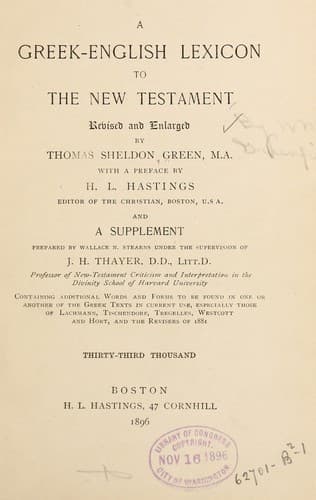
A Greek-English Lexicon to the New TestamentGreenfield, William
Religion
A Greek-English Lexicon to the New Testament
Greenfield, William
Bible. New Testament -- Dictionaries -- English; Greek language, Biblical -- Dictionaries -- English
to determine against, condemn, blame, reprehend,
Ga. 2.11. 1 Jno. 3.20, 21.
Κατάγνυμι, v. -ύω, (κατά & ἄγνυμι, to break)
f. κατάξω, & κατεάξω, a.1. κατέαξα, a.2. pass. κατεάγην (ᾱ),
subj. κατεαγῶ,
to break in pieces, crush, break in two, Mat. 12.20.
Jno. 19.31, 32, 33.
Κατάγω, (κατά & ἄγω)
f. ξω, a.2. κατήγαγον,
to lead, bring, or conduct down, Ac. 9.30; 22.30; 23.15, 20, 28;
to bring a ship to land; pass. κατάγομαι, a.1. κατήχθην,
to come to land, land, touch, Lu. 5.11, et al.
Καταγωνίζομαι, (κατά & ἀγωνίζομαι)
f. ίσομαι a.1 κατηγωνισάμην,
to subdue, vanquish, conquer, He. 11.33. L.G.
Καταδέω, (κατά & δέω)
f. ήσω,
to bind down; to bandage a wound, Lu. 10.34.
Κατάδηλος, ου, ὁ, ἡ, τό, -ον, (κατά & δῆλος)
quite manifest or evident, He. 7.15.
Καταδικάζω, (κατά & δικάζω)
f. άσω,
to give judgement against, condemn, Mat. 12.7, 37.
Lu. 6.37. Ja. 5.6.
Καταδίκη, ης, ἡ, (κατά & δίκη)
condemnation, sentence of condemnation, v.r. Ac. 25.15.
Καταδιώκω, (κατά & διώκω)
f. ξω,
to follow hard upon; to track, follow perseveringly, Mar. 1.36.
Καταδουλόω, ῶ (κατά & δουλόω)
f. ώσω,
to reduce to absolute servitude, make a slave of, 2 Co. 11.20.
Καταδυναστεύω, (κατά & δυναστεύω, to rule, reign)
f. εύσω,
to tyrannise over, oppress, Ac. 10.38. Ja. 2.6.
Κατάθεμα, ατος, τό, (κατατίθημι)
an execration, curse, by meton. what is worthy of execration,
i.q. κατανάθεμα, v.r. Re. 22.3: (N.T.)
whence
Καταθεματίζω,
f. ίσω,
to curse, v.r. Mat. 26.74. N.T.
Καταισχύνω, (κατά & αἰσχύνω)
f. υνῶ,
to shame, put to shame, put to the blush, 1 Co. 1.27;
pass. to be ashamed, be put to the blush, Lu. 13.17;
to dishonour, disgrace, 1 Co. 11.4, 5; fr. the Heb. to frustrate,
disappoint, Ro. 5.5; 9.33.
Κατακαίω, (κατά & καίω)
f. καύσω, a.2. pass. κατεκάην,
to burn up, consume with fire, Mat. 3.12; 13.30, 40, et al.
Κατακαλύπτομαι, (mid of κατακαλύπτω, to veil, fr. κατά & καλύπτω)
to veil one's self, to be veiled or covered, 1 Co. 11.6, 7.)
Κατακαυχάομαι, ῶμαι,(κατά & καυχάομαι)
f. ήσομαι,
to vaunt one's self against, to glory over, to assume
superiority over, Ro. 11.18. Ja. 2.13; 3.14. S.
Κατάκειμαι, (κατά & κεῖμαι)
f. είσομαι,
to lie, be in a recumbent posture, be laid down, Mar. 1.30; 2.4;
to recline at table, Mar. 2.15; 14.3, et al.
Κατακλάω, ῶ, (κατά & κλάω)
f. άσω, a.1. κατέκλᾰσα,
to break, break in pieces, Mar. 6.41. Lu. 9.16.
Κατακλείω, (κατά & κλείω)
f. είσω,
to close, shut fast; to shut up, confine, Lu. 3.20. Ac. 26.10.
Κατακληροδοτέω, ῶ, (κατά, κλῆρος, & δίδωμι
f. ήσω,
to divide out by lot, distribute by lot, Ac. 13.19. S.
Κατακληρονομέω, ῶ, (κατά, κλῆρος, & νέμω, to distribute)
same a preceding, for which it is a v.r.
Κατακλίνω, (ῑ), (κατά & κλίνω)
f. ινῶ, a.1. κατέκλῑνα, a.1. pass. κατεκλίθην (ῐ),
to cause to lie down, cause to recline at table, Lu. 9.14;
mid. to lie down, recline, Lu. 14.8; 24.30.
Public-domain text, read in full here on John Shaqi.
Reviews
Reviews
No reviews yet
Be the first to share your thoughts on this work.
Elsewhere in the archive
Join the Discussion
Join the discussion
Sign in to leave a comment or review.
Sign InorCreate an account