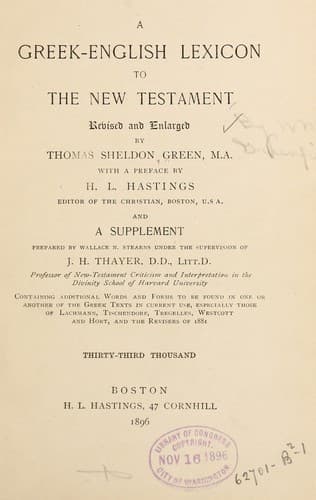
A Greek-English Lexicon to the New TestamentGreenfield, William
Religion
A Greek-English Lexicon to the New Testament
Greenfield, William
Bible. New Testament -- Dictionaries -- English; Greek language, Biblical -- Dictionaries -- English
Κατακλύζω, (κατά & κλύζω, to lave, wash)
f. ύσω, a.1. pass. κατεκλύσθην,
to inundate, deluge, 2 Pe. 3.6:
whence
Κατακλυσμός, οῦ, ὁ,
an inundation, deluge, Mat. 24.38, 39, et al.
Κατακολουθέω, ῶ (κατά & ἀκολουθέω)
f. ήσω,
to follow closely or earnestly, Lu. 23.55. Ac. 16.17
Κατακόπτω, (κατά & κόπτω)
f. ψω,
to cut or dash in pieces; to mangle, wound, Mar. 5.5.
Κατακρημνίζω, (κατά & κρημνός, a precipice)
f. ίσω,
to cast down headlong, precipitate, Lu. 4.29.
Κατάκρῐμα, ατος, τό,
condemnation, condemnatory sentence, Ro. 5.16, 18; 8.1: (L.G.)
from
Κατακρίνω, (ῑ), (κατά & κρίνω)
f. ινῶ, a.1. κατέκρῑνα, p. pass. κατακέκρῐμαι,
a.1. pass. κατεκρίθην (ῐ),
to give judgment against, condemn, Mat. 27.3 Jno. 8.10, 11, et al.;
to condemn, to place in a guilty light by contrast, Mat. 12.41, 42.
Lu. 11.31, 32. He. 11.7:
whence
Κατάκρῐσις, εως, ἡ,
condemnation, 2 Co. 3.9; censure, 2 Co. 7.3. S.
Κατακυριεύω, (κατά & κυριεύω)
f. εύσω,
to get into one's power; in N.T., to bring under, master,
overcome, Ac. 19.16; to domineer over, Mat. 20.25, et al. L.G.
Καταλᾰλέω, ῶ, (κατά & λαλέω)
f. ήσω,
to blab out; to speak against, calumniate, Ja. 4.11. 1 Pe. 2.12; 3.16:
whence
Καταλαλία, ας, ἡ
evil-speaking, detraction, backbiting, calumny, 2 Co. 12.20.
1 Pe. 2.1. S.
Κατάλᾰλος, ου, ὁ, ἡ,
slanderous, a detractor, calumniator, Ro. 1.30. N.T.
Καταλαμβάνω, (κατά & λαμβάνω)
f. λύψομαι, a.2. κατέλᾰβον,
to lay hold of, grasp; to obtain, attain, Ro. 9.30. 1 Co. 9.24;
to seize, take possesssion of, Mar. 9.18; to come suddenly upon,
overtake, surprise, Jno. 12.35; to deprehend, detect in the act,
seize, Jno. 8.3, 4; met. to comprehend, apprehend, Jno. 1.5;
mid. to understand, perceive, Ac. 4.13; 10.34, et al.
Καταλέγω, (κατά & λέγω)
f. ξω,
to select; to reckon in a number, enter in a list or catalogue,
enrol. 1 Ti. 5.9.
Κατάλειμμα, ατος, τό,
a remnant, a small residue, Ro. 9.27: (L.G.)from
Καταλείπω, (κατά & λείπω)
f. ψω, a.2 κατέλῐπον,
to leave behind; to leave behind at death, Mar. 12.19; to
relinquish, let remain, Mar. 14.52; to quit, depart from,
forsake, Mat. 4.13; 16.4; to neglect, Ac. 6.2; to leave alone,
or without assistance, Lu. 10.40; to reserve, Ro. 11.4.
Καταλιθάζω, (κατά & λιθάζω)
f. άσω,
to stone, kill by stoning, Lu. 20.6. S.
Καταλλᾰγή, ῆς, ἡ,
pr. an exchange; reconciliation, restoration to favour,
Ro. 5.11; 11.15. 2 Co. 5.18, 19:
from
Καταλλάσσω, (κατά & ἀλλάσσω)
f. άξω, a.2. pass. κατηλλάγην (ᾰ),
to change, exchange; to reconcile; pass. to be reconciled,
Ro. 5.10. 1 Co. 7.11. 2 Co. 5.18-20.
Κατάλοιπος, ου, ὁ, ἡ, (καταλείπω)
remaining; οἱ κατάλοιποι, the rest, Ac. 15.17.
Κατάλῠμα, ατος, τό,
a lodging, inn, khan, Lu. 2.7; a guest-chamber, cœnaculum,
Mar. 14.14. Lu. 22.11: (L.G.)
from
Καταλύω (ῡ), (κατά & λύω)
f. ύσω, a.1. pass. κατελύθην (ῠ),
to dissolve; to destroy, demolish, overthrow, throw down,
Mat.
Public-domain text, read in full here on John Shaqi.
Reviews
Reviews
No reviews yet
Be the first to share your thoughts on this work.
Elsewhere in the archive
Join the Discussion
Join the discussion
Sign in to leave a comment or review.
Sign InorCreate an account