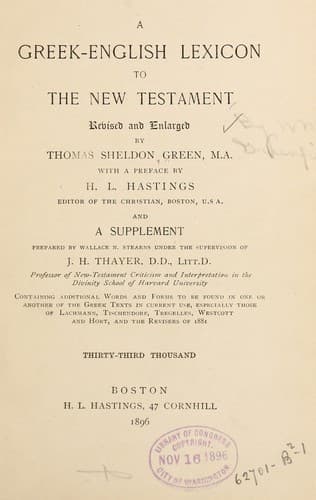
A Greek-English Lexicon to the New TestamentGreenfield, William
Religion
A Greek-English Lexicon to the New Testament
Greenfield, William
Bible. New Testament -- Dictionaries -- English; Greek language, Biblical -- Dictionaries -- English
to glory, boast, Ro. 2.17, 23; ὑπέρ τινος, to boast of a
person or thing, undertake a laudatory testimony to, 2 Co. 12.5;
to rejoice, exult, Ro. 5.2, 3, 11, et al.:
whence
Καύχημα, ατος, τό
a glorying, boasting, 1 Co. 5.6; ground or matter of glorying
or boasting, Ro. 4.2; joy, exultation, Phi. 1.26; laudatory
testimony, 1 Co. 9.15, 16. 2 Co. 9.3, et al.
Καύχησις, εως, ἡ,
a later equivalent to καυχημα, Ro. 3.27. 2 Co. 7.4, 14; 11.10, et al.
Κέδρος, ου, ἡ,
a cedar, Jno. 18.1, where κέδρων is a false reading for the
proper name Κεδρών.
Κεῖμαι,
f. κείσομαι,
to lie, to be laid; to recline, to be lying, to have been
laid down, Mat. 28.6. Lu 2.12, el al.; to have been laid,
placed, set, Mat. 3.10. Lu. 3.9. Jno. 2.6, et al.; to be
situated as a city, Mat. 5.14. Re. 21.16; to be in store,
Lu. 12.19; met. to be specially set, solemnly appointed,
destined, Lu. 2.34. Phi. 1.17. 1 Th. 3.3; to lie under an
influence, to be involved in, 1 Jno. 5.19.
Κειρία, ας, ἡ,
a bandage, swath, roller; in N.T., pl. grave-clothes, Jno. 11.44.
Κείρω,
f. κερῶ, a.1. mid. ἐκειράμην,
to cut off the hair, shear, shave, Ac. 8.32; 18.18.
1 Co. 11.6, bis.
Κέλευσμα, ατος, τό,
a word of command; a mutual cheer; hence, in N.T., a loud
shout, an arousing outcry, 1 Th. 4.16:
from
Κελεύω, (κέλω, κέλομαι, idem)
f. εύσω, a.1 ἐκέλευσα,
to order, command, direct, bid, Mat. 8.18; 14.19, 28, et al.
Κενοδοξία, ας, ἡ
emply conceit, vain glory, Phi. 2.3:
from
Κενόδοξος, ου, ὁ, ἡ, (κενός & δόξα)
vain-glorious, desirous of vain glory, Ga. 5.26.
Κενός, ή, όν,
empty; having nothing, empty-handed, Mar. 12.3;
met. vain, fruitless, void of effect, Ac. 4.25. 1 Co. 15.10;
εἰς κενόν, in vain, to no purpose, 2 Co. 6.1, et al.; hollow,
fallacious, false, Ep. 5.6. Col. 2.8; inconsiderate, foolish,
Ja. 2.20.
Κενοφωνία, ας, ἡ, (κενός & φωνή)
vain, empty babbling, vain disputation, fruitless discussion,
1 Ti. 6.20. 2 Ti. 2.16. N.T.
Κενόω, ῶ, (κενός)
f. ώσω, a.1. ἐκένωσα,
to empty, evacuate; ἑαυτόν, to divest one's self, of one's
prorogatives, abase one's self, Phi. 2.7; to deprive a thing
of its proper functions, Ro. 4.14. 1 Co. 1.17; to show to be
without foundation, falsify, 1 Co. 9.15. 2 Co. 9.3.
Κέντρον, ου, τό, (κεντέω, to prick)
a sharp point; a sting, Re. 9.10; a prick, stimulus, goad,
Ac. 9.5; 26.14. met., of death, destructive power, deadly
venom, 1 Co. 15.55, 56.
Κεντυρίων, ωνος, ὁ (Lat. centurio, fr. centum, a hundred)
in its original signification, a commander of a hundred
foot-soldiers, a centurion, Mar. 15.39, 44, 45.
Κενῶς (κενός)
adv. in vain, to no purpose, unmeaningly, Ja. 4.5. L.G.
Κεραία, ας, ἡ (κέρας)
pr. a horn-like projection, a point, extremity; in N.T.,
an apex, or fine point, as of letters; the minutest part,
a tittle, Mat. 5.18. Lu. 16.17.
Κερᾰμεύς, έως, ὁ, (κέραμος)
a potter, Mat. 27.7, 10. Ro. 9.21.
Κεραμῐκός, ή, όν, (fr. same)
made by a potter, earthen, Re.
Public-domain text, read in full here on John Shaqi.
Reviews
Reviews
No reviews yet
Be the first to share your thoughts on this work.
Elsewhere in the archive
Join the Discussion
Join the discussion
Sign in to leave a comment or review.
Sign InorCreate an account