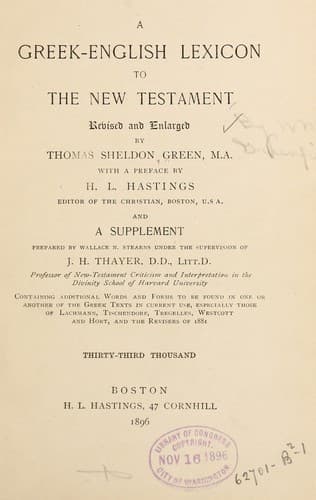
A Greek-English Lexicon to the New TestamentGreenfield, William
Religion
A Greek-English Lexicon to the New Testament
Greenfield, William
Bible. New Testament -- Dictionaries -- English; Greek language, Biblical -- Dictionaries -- English
2.27.
Κεράμιον, ίου, τό, (dimin. of κέραμος)
an earthenware vessel, a pitcher, jar, Mar. 14.13. Lu. 22.10
Κέρᾰμος, ου, ὁ,
potter's clay; earthenware; a tile, tiling, Lu. 5.19.
Κεράννῡμι, v. νύω, (κεράω)
f. κεράσω, a.1. ἐκέρᾰσα, p. pass. κέκρᾱμαι later κεκέρασμαι,
to mix, mingle, drink; to prepare for drinking,
Re. 14.10; 18.6, bis.
Κέρας, ᾱτος, τό,
a horn, Re. 5.6; 12.3, et al.; a projecting extremity at the
corners of an altar, Re. 9.13; fr. the Heb., used symbolically
for strength, power, Lu. 1.69.
Κεράτιον, ίου, τό, (dimin. of κέρας)
pr. a little horn; in N.T., a pod, the pod of the carob tree,
or Ceratonia siliqua of Linnœus, a common tree in the East
and the south of Europe, growing to a considerable size, and
producing long slender pods, with a pulp of sweetish taste
and several brown shining seeds like beans, sometimes eaten
by the poorer people in Syria and Palestine, and commonly
used for fattening swine, Lu. 15.16.
Κερδαίνω,
f. δανῶ, κερδήσω & ομαι, a.1. ἐκέρδησα,
to gain as a matter of profit, Mat. 25.17, et al.; to win,
acquire possession of, Mat. 16.26; to profit in the avoidance
of, to avoid, Ac. 27.21; in N.T., Χριστόν, to win Christ,
to become possessed of the privileges of the gospel, Ph. 3.8;
to win over from estrangement Mat. 18.15; to win over to embrace
the gospel, 1 Co. 9.19, 20, 21, 22. 1 Pe. 3.1; absol. to make gain,
Ja. 4.13:
from
Κέρδος, εος, τό,
gain, profit, Phi. 1.21; 3.7. Tit. 1.11.
Κέρμα, ατος, τό, (κείρω)
something clipped small; small change, small pieces of
money, coin, Jno. 2.15:
whence
Κερματιστής, οῦ, ὁ,
a money changer, Jno. 2.14. N.T.
Κεφάλαιον, ου, τό, (κεφαλή)
a sum total; a sum of money, capital, Ac. 22.28; the crowning
or ultimate point to preliminary matters, He. 8.1:
whence
Κεφαλαιόω, ῶ,
f. ώσω,
to sum up; but in N.T., equiv. to κεφαλίζω, to wound on the
head, Mar. 12.4.
Κεφᾰλή, ῆς, ἡ,
the head, Mat. 5.36; 6.17, et al.;
the head, top; κεφαλή γωνίας, the head of the corner,
the chief corner stone, Mat. 21.42. Lu. 20.17;
met. the head, superior, chief, principal, one
to whom others are subordinate, 1 Co. 11.3. Ep. 1.22, et al.
Κεφαλίς, ίδος, ἡ, (dimin. of κεφαλή)
in N.T., a roll, volume, division of a book, He. 10.7.
Κημόω, ῶ, (κημός, a curb, bridle, muzzle)
f. ώσω,
to muzzle, v.r. 1 Co. 9.9.
Κῆνσος, ου, ὁ, (Lat. census )
a census, assessment, enumeration of the people and a valuation
of their property; in N.T., tribute, tax, Mat. 17.25; poll-tax,
Mat. 22.17, 19. Mar. 12.14.
Κῆπος, ου, ὁ,
a garden, any place planted with trees and herbs, Lu. 13.19.
Jno. 18.1, 26; 19.41.
Κηρουρός, οῦ, ὁ, (κῆπος & οὖρος, a watcher)
a garden-keeper, gardener, Jno. 20.15.
Κηρίον, ου, τό, (κηρός, beeswax)
a honeycomb; a comb filled with honey, Lu. 24.42.
Κήρυγμα, ατος, τό, (κηρύσσω)
proclamation, proclaiming, public annunciation, Mat. 12.41;
public inculcation, preaching, 1 Co. 2.4; 15.14; meton. what
Public-domain text, read in full here on John Shaqi.
Reviews
Reviews
No reviews yet
Be the first to share your thoughts on this work.
Elsewhere in the archive
Join the Discussion
Join the discussion
Sign in to leave a comment or review.
Sign InorCreate an account