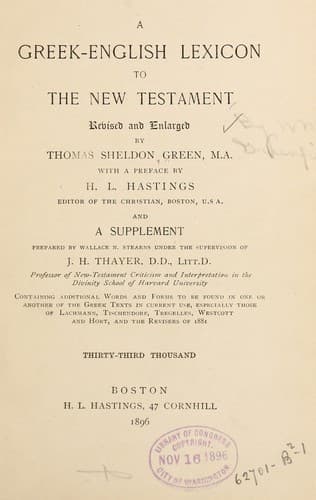
A Greek-English Lexicon to the New TestamentGreenfield, William
Religion
A Greek-English Lexicon to the New Testament
Greenfield, William
Bible. New Testament -- Dictionaries -- English; Greek language, Biblical -- Dictionaries -- English
is publicly inculcated, doctrine, &c. Ro. 16.25, et al.
Κήρυξ, ῡκος, ὁ,
a herald, public messenger; in N.T., a proclaimer, publisher,
preacher, 1 Ti. 2.7. 2 Ti. 1.11. 2 Pe. 2.5.
Κηρύσσω,
f. κηρύξω, a.1. ἐκήρυξα,
to publish, proclaim, as a herald, 1 Co. 9.27; to announce
openly and publicly, Mar. 1.4. Lu. 4.18; to noise abroad,
Mar. 1.45; 7.36; to announce as a matter of doctrine, inculcate,
preach, Mat. 24.14. Mar. 1.38; 13.10. Ac. 15.21. Ro. 2.21, et al.
Κῆτος, εος, τό,
a large fish, sea monster, whale, Mat. 12.40.
Κηφᾶς, ᾶ, ὁ, (Aramæan, כיפא)
Cephas, a rock, rendered into Greek by Πέτρος,
Jno. 1.43. 1 Co. 1.12, et al.
Κιβωτός, οῦ, ἡ,
a chest, coffer; the ark of the covenant, He. 9.4;
the ark of Noah, Mat. 24.38. Lu. 17.27, et al.
Κιθάρα, ας, ἡ,
a lyre, 1 Co. 14.7. Re. 5.8; 14.2; 15.2. (ᾰ):
whence
Κιθαρίζω,
f. ίσω
to play on a lyre, to harp, 1 Co. 14.7. Re. 14.2.
Κιθαρῳδός, οῦ, ὁ, (κιθάρα & ἀείδω)
one who plays on a lyre and accompanies it with his voice,
a harper. Re. 14.2. 18.22.
Κινάμωμον, v. κιννάμωμον, ου, τό,
cinnamon, the aromatic bark of the Laurus cinnamomum,
which grows in Arabia, Syria, &c. Re. 18.13.
Κινδυνεύω,
f. εύσω,
to be in danger or peril, Lu. 8.23. Ac. 19.27, 40. 1 Co. 15.30:
from
Κίνδῡνος, ου, ὁ,
danger, peril, Ro. 8.35. 2 Co. 11.26.
Κῑνέω, ῶ, (κίω, to go)
f. ήσω, a.1. ἐκίνησα,
to set a-going; to move, Mat. 23.4; to excite, agitate,
Ac. 24.5; 21.30; to remove, Re. 2.5; 6.14; in N.T., κεφαλήν,
to shake the head in derision, Mat. 27.39. Mar. 15.29;
mid. to move, possess the faculty of motion, exercise the
functions of life, Ac. 17.28:
whence
Κίνησις, εως, ἡ,
a moving, motion, Jno. 5.3.
Κιννάμωμον,
see κινάμωμον.
Κλάδος, ου, ὁ, (κλάω, to break off)
a bough, branch, shoot, Mat. 13.32; 21.8, et al.;
met. offspring, progeny, posterity, Ro. 11.16, 21.
Κλαίω,
f. κλαύσομαι, in N.T. κλαύσω, a.1. ἔκλαυσα,
intrans. to weep, shed tears, Mat. 26.75. Mar. 5.38, 39.
Lu. 19.41; 23.28, et al.; trans. to weep for, bewail,
Mat. 2.18.
Κλάσις, εως, ἡ, (κλάω)
a breaking, the act of breaking, Lu. 24.35. Ac. 2.42.
Κλάσμα, ατος, τό, (fr. same)
a piece broken off, fragment, Mat. 14.20; 15.37. Mar. 6.43. et al.
Κλαυθμός, οῦ, ὁ, (κλαίω)
weeping, Mat. 2.18; 8.12. et al.
Κλάω,
f. κλάσω, a.1. ἔκλᾰσα,
to break off; in N.T., to break bread, Mat. 14.19, et al.;
with figurative reference to the violent death of Christ,
1 Co. 11.24.
Κλείσ, κλειδός, κλειδί, κλεῖδα & κλεῖν, ἡ, pl. κλεῖδες, & κλεῖς,
a key used in the N.T. as the symbol of power, authority, &c.
Mat. 16.19. Re. 1.18; 3.7; 9.1; 20.1; met. means of attaining
knowledge, Lu. 11.52:
from
Κλείω,
f. είσω, a.1. ἔκλεισα, p. pass. κέκλεισμαι, a.1. pass. ἐκλείσθην,
to close, shut, Mat. 6.6; 25.10, et al.; to shut up a person,
Re. 20.3; met. of the heavens, Lu. 4.25. Re. 11.6; κλεῖσαι
τὰ σπλάγχνα, to shut up one's bowels, to be hard-hearted,
void of compassion, 1 Jno.
Public-domain text, read in full here on John Shaqi.
Reviews
Reviews
No reviews yet
Be the first to share your thoughts on this work.
Elsewhere in the archive
Join the Discussion
Join the discussion
Sign in to leave a comment or review.
Sign InorCreate an account