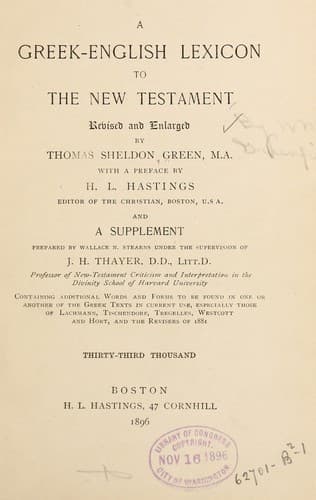
A Greek-English Lexicon to the New TestamentGreenfield, William
Religion
A Greek-English Lexicon to the New Testament
Greenfield, William
Bible. New Testament -- Dictionaries -- English; Greek language, Biblical -- Dictionaries -- English
20.8, et al.; a potentate, sovereign, Ac. 25.26;
a power, deity, 1 Co. 8.5; the Lord, Jehovah, Mat. 1.22,
et al.; the Lord Jesus Christ, Mat. 24.42. Mar. 16.19.
Lu. 10.1. Jno. 4.1. 1 Co. 4.5, et al. freq.; Κύριε,
a term of respect of various force, Sir, Lord, Mat. 13.27.
Ac. 9.6, et al. freq.:
whence
Κυριότης, τητος, ἡ,
lordship; constituted authority, Eph. 1.21. 2 Pe. 2.10.
Ju. 8; pl. authorities, potentates, Col. 1.16. N.T.
Κυρόω, ῶ, (κῦρος, authority, confirmation)
f. ώσω, p. κεκύρωκα,
to confirm, ratify, Ga. 3.15; to assure, 2 Co. 2.8.
Κύων, κυνός, ὁ, ἡ,
a dog, Lu. 16.21. 2 Pe. 2.22; met. a dog, a religious
corrupter, Phi. 3.2; miscreant, Re. 22.15.
Κῶλον, ου, τό,
a member or limb of the body, He. 3.17.
Κωλύω,
f. ύσω, a.1. ἐκώλῡσα, a.1. pass. ἐκωλύθην (ῡ),
to hinder, restrain, prevent, Mat. 19.14. Ac. 8.36.
Ro. 1.13, et al.
Κώμη, ης, ἡ,
a village, a country town, Mat. 9.35; 10.11.
Lu. 8.1, et al.
Κωμόπολις, εως, ἡ, (κώμη & πόλις)
a large village, open town, Mar. 1.38. L.G.
Κῶμος, ου, ὁ,
pr. a festive procession, a merry-making; in N.T.,
a revel, lascivious feasting, Ro. 13.13. Ga. 5.21. 1 Pe. 4.3.
Κώνωψ, ωπος, ὁ,
a gnat, culex, which is found in wine when acescent,
Mat. 23.24.
Κωφός, ή, όν,
pr. blunt, dull, as a weapon; dull of hearing, deprived
of hearing, deaf, Mat. 11.5. Mar. 7.32, 37. Lu. 7.22;
dumb, mute, Mat. 9.32, 33, et al.; meton. making dumb,
causing dumbness, Lu. 11.14.
Λ, λ, Λάμβδα
Λαγχάνω,
f. Λήξομαι, p. εἴληχα, p.2. λέλογχα, a.2. ἔλᾰχον,
to have assigned to one, to obtain, receive, Ac. 1.17.
2 Pe. 1.1; to have fall to one by lot, Lu. 1.9;
absol. to cast lots, Jno. 19.24
Λάθρα, (λανθάνω)
adv. secretly, Mat. 1.19; 2.7, et al.
Λαίλαψ, ᾰπος, ἡ
a squall of wind, a hurricane, Mar. 4.37, et al.
Λακτίζω, (λάξ, with the heel)
f. ίσω,
to kick, Ac. 9.5; 26.14.
Λαλέω, ῶ
f. ήσω, p. λελάληκα, a.1. ἐλάλησα,
to make vocal utterance; to babble, to talk; in N.T.,
absol., to exercise the faculty of speech, Mat. 9.33, et al.;
to speak, Mat. 10.20, et al.; to hold converse with, to talk
with, Mat. 12.46. Mar. 6.50. Re. 1.12, et al.; to discourse,
to make an address, Lu. 11.37. Ac. 11.20; 21.39, et al.;
to make an announcement, to make a declaration, Lu. 1.55, et al.;
to make mention, Jno. 12.41. Ac. 2.31. He. 4.8. 2 Pe. 3.16;
trans., to speak, address, preach, Mat. 9.18. Jno. 3.11.
Tit. 2.1, et al.; to give utterance to, to utter, Mar. 2.7.
Jno. 3.34, et al.; to tell, recount, Mat. 26.13, et al.;
to declare, announce, reveal, Lu. 24.25, et al.; to disclose,
2 Co. 12.4.
Λαλιά, ᾶς, ἡ,
talk; in N.T., matter of discourse, Jno. 4.42; 8.43; language,
dialect, Mat. 26.73. Mar. 14.70.
Λαμά v. Λαμμᾶ (Heb. למה)
for what? why? wherefore? Mat. 27.46. Mar. 15.34.
Λαμβάνω,
f. λήψομαι, p. εἴληφα, a.2. ἔλᾰβον, a.1. pass. ἐλήφθην,
to take, take up, take in the hand, Mat. 10.38; 13.31, 33, et al.;
to take on one's self, sustain, Mat.
Public-domain text, read in full here on John Shaqi.
Reviews
Reviews
No reviews yet
Be the first to share your thoughts on this work.
Elsewhere in the archive
Join the Discussion
Join the discussion
Sign in to leave a comment or review.
Sign InorCreate an account