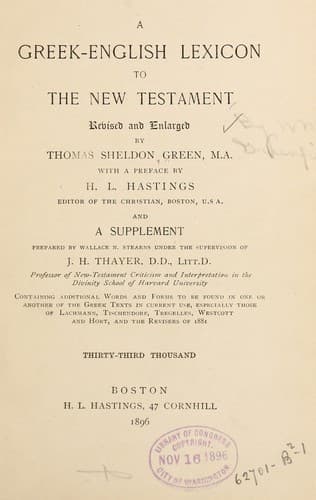
A Greek-English Lexicon to the New TestamentGreenfield, William
Religion
A Greek-English Lexicon to the New Testament
Greenfield, William
Bible. New Testament -- Dictionaries -- English; Greek language, Biblical -- Dictionaries -- English
8.17; to take, seize, seize
upon, Mat. 5.40; 21.34. Lu. 5.26. 1 Co. 10.13, et al.; to catch,
Lu 5.5. 2 Co. 12.16; to assume, put on, Phi. 2.7; to make a
rightful or successful assumption of, Jno. 3.27; to conceive,
Ac. 28.15; to take by way of provision, Mat. 16.5; to get, get
together, Mat. 16.9; to receive as payment, Mat. 17.24. He. 7.8;
to take to wife, Mar. 12..19; to admit, give reception to,
Jno. 6.21; 2 Jno. 10; met. to give mental reception to,
Jno. 3.11, et al.; to be simply recipient of; to receive,
Mat. 7.8 Jno. 7.23, 39; 19.30. Ac. 10.43; in N.T.,
λαμβάνειω πεῖραν, to make encounter of a matter of difficulty
or trail, He. 11.29, 36;
λαμβάνειν ἀρχή, to begin, He. 2.3;
λαμβάνειν συμβούλιον, to take counsel, consult, Mat. 12.14;
λαμβάνειν λήθην, to forget, 2 Pe. 1.9;
λαμβάνειν ὑπόμνησιν, to recollect, recall to mind, 2 Ti. 1.5.;
λαμβάνειν περιτομήν, to receive circumcision, be circumcised,
Jno. 7.23;
λαμβάνειν καταλλαγήν, to be reconciled, Ro. 5.11;
λαμβάνειν κρίμα, to receive condemnation or punishment,
be punished, Mar. 12.40; fr. the Heb. πρόσωπον
λαμβάνειν, to accept the person of any one, to show partiality
towards, Lu. 20.21.
Λαμμᾶ,
see λαμά.
Λαμπάς, άδος, ἡ, (λάμπω)
a light, Ac. 20.8; a lamp, Re. 4.5; a portable lamp, lantern,
or flambeau, Mat. 25.1, 3, 4, 7, 8. Jno. 18.3.
Λαμπρός, ά, όν, (λάμπω)
bright, resplendent, Re. 22.16; clear, pellucid, Re. 22.1;
white, glishtering, Ac. 10.30. Re. 15.6; of a bright colour,
gaudy, Lu. 23.11; by impl. splendid, magnificent, sumptuous,
Ja. 2.2, 3. Re. 18.14:
whence
Λαμπρότης, τητος, ἡ,
brightness, splendour, Ac. 26.13.
Λαμπρῶς,
adv. splendidly; magnificently, sumptuously, Lu. 16.19.
Λάμπω,
f. ψω & ψομαι, a.1. ἔλαμψα,
to shine, give light, Mat. 5.15, 16; 17.2. Lu. 17.24, et al.
Λανθάνω,
f. λήσω, a.2. ἔλᾰθον, p. λέληθα,
to be unnoticed; to escape the knowledge or observation
of a person, Ac. 26.26. 2 Pe. 3. 5, 8;
absol. to be concealed, escape detection, Mar. 7.24. Lu. 8.47;
with a participle of another verb, to be unconscious of an
action while the subject or object of it, He. 13.2.
Λαξευτός, ή, όν, (λᾶς, a stone, & ξέω, to cut, hew)
cut in stone, hewn out of stone or rock, Lu. 23.53. S.
Λαοδῐκεύς, έως, ὁ,
a Laodicean, an inhabitant of Λαοδίκεια, Laodicea,
Col. 4.16. Re. 3.14.
Λαός, οῦ, ὁ,
a body of people; a concourse of people, a multitude,
Mat. 27.25. Lu. 8.47, et al.; the common people,
Mat. 26.5, et al.; a people, nation, Mat. 2.4. Lu. 2.32.
Ti. 2.14, et al.; ὁ λαός, the people of Israel, Lu. 2.10.
Λάρυγξ, υγγος, ὁ,
the throat, gullet, Ro. 3.13.
Λάσκω,
f. λᾱκήσω, a.1. ἐλάκησα,
pr. to emit a sound, ring; hence, to break with a sharp noise;
to burst, Ac. 1.18.
Λᾱτομέω, ῶ, (λᾶς, a stone, & τέμνω)
f. ήσω, p. λελατόμηκα, a.1. ἐλατόμησα,
to hew stones; to cut out of stone, hew from stone,
Mat. 27.60. Mar. 15.46. L.G.
Λατρεία, ας, ἡ,
service, servitude; religious service, worship, Jno.
Public-domain text, read in full here on John Shaqi.
Reviews
Reviews
No reviews yet
Be the first to share your thoughts on this work.
Elsewhere in the archive
Join the Discussion
Join the discussion
Sign in to leave a comment or review.
Sign InorCreate an account