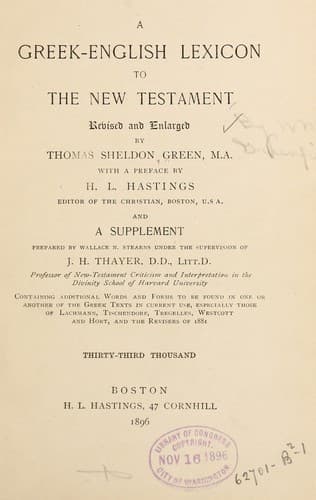
A Greek-English Lexicon to the New TestamentGreenfield, William
Religion
A Greek-English Lexicon to the New Testament
Greenfield, William
Bible. New Testament -- Dictionaries -- English; Greek language, Biblical -- Dictionaries -- English
8.2; 10.8, et al.
Λεπτόν, οῦ, τό, (λεπτός, thin, fine, small)
a mite, the smallest Jewish coin, equal to half a κοδράντης,
and consequently to about three-eighths of a farthing,
Mar. 12.42, et al.
Λευΐτης, ου, ὁ,
a Levite, one of the posterity of Λευΐ, Levi, Lu. 10.32.
Jno. 1.19. Ac. 4.36:
whence
Λευϊτικός, ή, όν,
Levitical, pertaining to the Levites, He. 7.11.
Λευκός, ή, όν,
pr. light, bright; white, Mat. 5.36; 17.2, et al.; whitening,
growing white, Jno. 4.35.
Λέων, οντος, ὁ,
a lion, He. 11.33. 1 Pe. 5.8, et al.; met. a lion, cruel
adversary, tyrant, 2 Ti. 4.17; a lion, a hero, deliverer,
Re. 5.5.
Λήθη, ης, ἡ (λανθάνω)
forgetfulness, oblivion, 2 Pe. 1.9.
Ληνός, οῦ, ὁ, ἡ,
pr. a tub, trough; a wine-press, into which grapes were
cast and trodden, Re. 14.19, 20; 19.15; a wine-vat,
i.q. ὑπολήνιον, the lower vat into which the juice of
the trodden grapes flowed, Mat. 21.33.
Λῆρος, ου, ὁ,
idel talk; an empty tale, Lu. 24.11.
Λῃστής, οῦ, ὁ, (ληίζομαι, ληίς, plunder)
a plunderer, robber, highwayman, Mat. 21.13; 26.55.
Mar. 11.17. Lu. 10.30. 2 Co. 11.26, et al.; a bandit,
brigand, Mat. 27.38, 44. Mar. 15.27. Jno. 18.40; trop.
a robber, rapacious imposter, Jno. 10.1, 8.
Λῆψις, εως, ἡ (λαμβάνω)
a taking; receiving, receipt, Phi. 4.15.
Λίαν,
adv. much, greatly, exceedingly, Mat. 2.16; 4.8; 8.28, et al.
Λιβᾰνός, οῦ, ὁ,
arbor thurifera, the tree producing frankincense, growing
in Arabia and Mount Lebanon; in N.T., frankincense, the
transparent gum which distils from incisions in the tree,
Mat. 2.11. Re. 18.13:
whence
Λιβανωτός, οῦ, ὁ, ἡ,
frankincense, in N.T., a censer, Re. 8.3, 5.
Λιβερτπῖνος, ου, ὁ (Lat. libertinus)
a freed-man, one who having been a slave has obtained
his freedom, or whose father was a freedman; in N.T.,
the λιβερτῖνοι probably denote Jews who had been carried
captive to Rome, and subsequently manumitted, Ac. 6.9.
Λιθάζω, (λίθος)
f. άσω,
to stone, pelt or kill with stones,
Jno. 10.31, 32, 33, et al.
Λίθῐνος, η, ον, (fr. same)
made of stone, Jno. 2.6, et al.
Λιθοβολέω, ῶ, (λίθος & βάλλω)
f. ήσω, a.1. ἐλιθοβόλησα,
to stone, pelt with stones, in order to kill,
Mat. 21.35; 23.37, et al. L.G.
Λίθος, ου, ὁ,
a stone, Mat. 3.9; 4.3, 6, et al.; used figuratively,
of Christ Eph. 2.20. 1 Pe. 2.6, et al.; of believers,
1 Pe. 2.5; meton. a tablet of stone, 2 Co. 3.7;
a precious stone, Re. 4.3, et al.
Λιθόστρωτον, ου, τό, (neut. of λιθόστρωτος, paved with stone,
λίθος & στρώννυμι)
a tessellated pavement, Jno. 19.13.
Λικμάω, ῶ,
f. ήσω
pr. to winnow grain; in N.T., to scatter like chaff,
Mat. 21.44. Lu. 20.18.
Λῐμήν, ένος, ὁ
a port, haven, harbour, Ac. 27.8, 12.
Λίμνη, ης, ἡ,
a tract of standing water; a lake, Lu. 5.1, 2, et al.
Λῑμός, οῦ, ὁ,
famine, scarcity of food, want of grain, Mat. 24.7;
famine, hunger, famishment, Lu. 15.17. Ro. 8.35, et al.
Λίνον, ου, τό,
flax; by meton. a flaxen wick, Mat. 12.20; linen, Re.
Public-domain text, read in full here on John Shaqi.
Reviews
Reviews
No reviews yet
Be the first to share your thoughts on this work.
Elsewhere in the archive
Join the Discussion
Join the discussion
Sign in to leave a comment or review.
Sign InorCreate an account