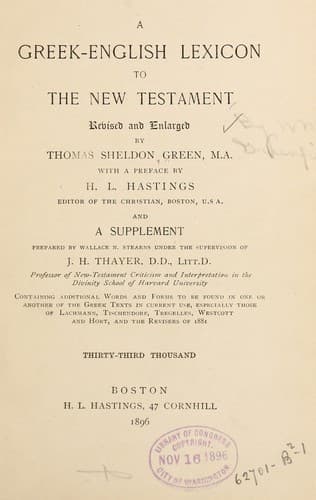
A Greek-English Lexicon to the New TestamentGreenfield, William
Religion
A Greek-English Lexicon to the New Testament
Greenfield, William
Bible. New Testament -- Dictionaries -- English; Greek language, Biblical -- Dictionaries -- English
16.2.
Ro. 9.4; 12.1. He. 9.1, 6:
from
Λατρεύω, (λάτρις, a servant)
f. εύσω, a.1. ἐλάτρευσα,
to be a servant, to serve, Ac. 27.23; to render religious
service and homage, worship, Mat. 4.10. Lu. 1.74;
spc. to offer sacrifices, present offerings, He. 8.5; 9.9.
Λάχᾰνον, ου, τό, (λαχαίνω, to dig)
a garden herb, vegetable, Mat. 13.32. Lu. 11.42. Ro. 14.2.
Λεγεών, ῶνος, ὁ, (Lat. legio)
a Roman legion; in N.T., legion used indefinitely for a
great number, Mat. 26.53. Mar. 5.9, 15. Lu. 8.30.
Λέγω,
f. ξς,
to say, Mat. 1.20, et al. freq.; to speak, make an address
or speech, Ac. 26.1; to say mentally, in thought, Mat. 3.9.
Lu. 3.8; to say in written language, Mar. 15.28. Lu. 1.63.
Jno. 19.37, et al.; to say, as distinguished from acting,
Mat. 23.3; to mention, speak of, Mar. 14.71. Lu. 9.31.
Jno. 8.27; to tell, declare, narrate, Mat. 21.27. Mar 10.32;
to express, He. 5.11; to put forth, propound, Lu. 5.36; 13.6.
Jno. 16.29; to mean, to intend to signify, 1 Co. 1.12; 10.29;
to say, declare, affirm, maintain, Mat. 3.9; 5.18. Mar. 12.18
Ac. 17.7; 26.22. 1 Co. 1.10, et al.; to enjoin, Ac. 15.24; 21.21.
Ro. 2.22; to term designate, call, Mat. 19.17. Mar. 12.37.
Lu. 20.37; 23.2. 1 Co. 8.5, et al.; to call by a name,
Mat. 2.23, et al.; pass. to be further named, to be surnamed,
Mat. 1.16, et al.; to be explained, interpreted, Jno. 4.25; 20.16, 24;
in N.T., σὺ λέγεις, thou sayest, a form of affirmative answer
to a question, Mat. 27.11. Mar. 15.2. Jno. 18.37.
Λεῖμμα, ατος, τό, (λείπω)
pr. a remnant; in N.T., a small residue, Ro. 11.5.
Λεῖος, εία, εῖον,
smooth, level, plain, Lu. 3.5.
Λείπω,
f. ψω, a.2. ἔλῐπον,
trans. to leave, forsake; pass. to be left, deserted;
by impl. to be destitute of, deficient in, Ja. 1.4, 5; 2.15;
intrans. to fail, be wanting, be deficient, Lu. 18.22, et al.
Λειτουργέω, ῶ, (λειτουργός)
f. ησω, p. λελειτούργηκα,
pr. to perform some public service at one's own expense;
in N.T., to officiate as a priest, He. 10.11; to minister
in the Christian church, Ac. 13.2; to minister to, assist,
succour, Ro. 15.27.
Λειτουργία, ας, ἡ, (fr. same)
pr. a public service discharged by a citizen at his own expense;
in N.T., a sacred ministration, Lu. 1.23. Phi. 2.17. He. 8.6; 9.21;
a kind office, aid, relief, 2 Co. 9.12. Phi. 2.30.
Λειτουργικός, ή, όν,
ministering; engaged in subordinate service, He. 1.14: (S)
from
Λειτουργος, οῦ, ἱ (λεῖτος, public, & ἔργον)
pr. a person of property who performed a public duty or
service to the state at his own expense; in N.T., a minister
or servant, Ro. 13.6, et al.; one who ministers relief,
Phi. 2.25.
Λέντιον, ίου, τό, (Lat. linteum)
a coarse cloth, with which servants were girded, a towel,
napkin, apron. Jno. 13.4, 5.
Λεπίς, ίδος, ἡ,
a scale, shell, rind, crust, incrustation, Ac. 9.19:
whence
Λέπρα, ας, ἡ,
the leprosy, Mat. 8.3. Mar. 1.42. Lu. 5.12, 13.
Λεπρός, οῦ, ὁ, (fr. same)
leprous; a leper, Mat.
Public-domain text, read in full here on John Shaqi.
Reviews
Reviews
No reviews yet
Be the first to share your thoughts on this work.
Elsewhere in the archive
Join the Discussion
Join the discussion
Sign in to leave a comment or review.
Sign InorCreate an account