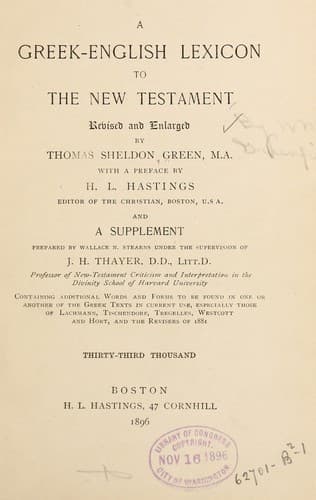
A Greek-English Lexicon to the New TestamentGreenfield, William
Religion
A Greek-English Lexicon to the New Testament
Greenfield, William
Bible. New Testament -- Dictionaries -- English; Greek language, Biblical -- Dictionaries -- English
7.27; to set free, set at liberty, deliver, Lu. 13.16;
to break, Ac. 27.41. Re. 5.2, 5; to break up, dismiss,
Ac. 13.43; to destroy, demolish, Jno. 2.19. Ep. 2.14; met.
to infringe, Mat. 5.19. Jno. 5.18; 7.23; to make void,
nullify, Jno. 10.35; in N.T., to declare to be lawful and
allowable, or, to admit to privileges, Mat. 16.19, et al.
Μ, μ, Μῦ
Μαγεία, ας, ἡ,
pr. the system of the magians; magic, Ac. 8.11:
from
Μαγεύω,
f. εύσω,
to be a magian; to use magical arts, practise magic,
sorcery, &c. Ac. 8.9:
from
Μάγος, ου, ὁ, (Pers. mogh, Heb. מג akin to μέγας, magnus)
a magus, sage of the magian religion, magian, Mat. 2.1, 7, 16;
a magician, sorcerer, Ac. 13.6, 8.
Μαθητεύω,
f. εύσω, a.1. ἐμαθήτευσα,
intrans. to be the disciple of, follow as a disciple,
Mat. 27.57; in N.T., trans. to make a disciple of, to
train in discipleship, Mat. 28.19. Ac. 14.21;
pass. to be trained, disciplined, instructed, Mat. 13.52: (L.G.)
from
Μαθητής, οῦ, ὁ, (μανθάνω)
a disciple, Mat. 10.24, 42, et al.:
whence
Μαθήτρια, ας, ἡ,
a female disciple, a female Christian, Ac. 9.36.
Μαίνομαι,
f. μανήσομαι & μανοῦμαι, p. μέμηνα,
to be disordered in mind, mad, Jno. 10.20, et al.
Μακαρίζω,
f. ίσω, At. ιῶ,
to pronounce happy, felicitate, Lu. 1.48. Ja. 5.11:
from
Μακάριος, ία, ιον, (μάκαρ, idem)
happy, blessed, Mat. 5.3, 4, 5, 7. Lu. 1.45, et al.
Μακαρισμός, οῦ, ὁ, (μακαρίζω)
a calling happy, the act of pronouncing happy, felicitation,
Ro. 4.6, 9; self-congratulation, Ga. 4.15.
Μάκελλον, ου, τό, (Lat. macellum)
a place where all kinds of provisions are exposed to sale,
provision mart, shambles, 1 Co. 10.25.
Μακράν, (acc. fem. of μακρός)
adv. far, far off, at a distance, far distant, Mat. 8.30.
Mar. 12.34, et al.; met. οἱ μακράν, remote, foreign, alien,
Ep. 2.13, 17.
Μακρόθεν, (fr. same)
adv. far off, at a distance, from afar, from a distance,
Mar. 8.3; 11.13; preceded by ἀπό, in the same sense, Mat. 26.58.
Μακροθῡμέω, ῶ, (μακρόθυμος, μακρός & θυμός)
f. ήσω,
to be slow towards, be long enduring; to exercise
patience, be long suffering, clement, or indulgent,
to forbear, Mat. 18.26, 29. 1 Co. 13.4. 1 Th. 5.14.
2 Pe. 3.9; to have patience, endure patiently,
wait with patient expectation, He. 6.15. Ja. 5.7, 8;
to bear long with entreaties for deliverance and
avengement, Lu. 18.7:
whence
Μακροθυμία, ας, ἡ,
patience; patient enduring of evil, fortitude, Col. 1.11;
slowness of avenging injuries, long suffering, forbearance,
clemency, Ro. 2.4; 9.22. 2 Co. 6.6; patient expectation,
He. 6.12, et al.
Μακροθύμως,
adv. patiently, with indulgence, Ac. 26.3.
Μακρός, ά, όν, (μῆκος)
long; of space, far, distant, remote, Lu. 15.13; 19.12;
of time, of long duration; prolix, Mat. 23.13. Mar. 12.40.
Lu. 20.47.
Μακροχρόνιος, ου, ὁ, ἡ, (μακρός & χρόνος)
of long duration; long-lived, Ep. 6.3. L.G.
Μαλακία, ας, ἡ,
softness; languor, indisposition, weakness, infirmity of
Public-domain text, read in full here on John Shaqi.
Reviews
Reviews
No reviews yet
Be the first to share your thoughts on this work.
Elsewhere in the archive
Join the Discussion
Join the discussion
Sign in to leave a comment or review.
Sign InorCreate an account