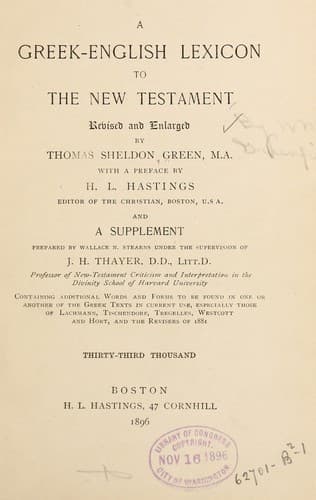
A Greek-English Lexicon to the New TestamentGreenfield, William
Religion
A Greek-English Lexicon to the New Testament
Greenfield, William
Bible. New Testament -- Dictionaries -- English; Greek language, Biblical -- Dictionaries -- English
body, Mat. 4.23, et al.;
from
Μαλᾰκός, ή, όν,
soft, soft to the touch, delicate, Mat. 11.8. Lu. 7.25;
met. cinædus, an instrument of unnatural lust, effeminate,
1 Co. 6.9.
Μάλιστα, (superlat. of μάλα, very, much)
adv. most, most of all, chiefly, especially,
Ac. 20.38; 25.26, et al.
Μᾶλλον, (comparat. of μάλα)
adv. more, to a greater extent, in a higher degree,
Mat. 18.13; 27.24. Jno. 5.18. 1 Co. 14.18, et al.;
rather, in preference, Mat. 10.6. Eph. 4.28, et al.;
used in a periphrasis for the comparative, Ac. 20.35, et al.;
as an intensive with a comparative term, Mat. 6.26.
Mar. 7.36. 2 Co. 7.13. Phi. 1.23; μᾶλλον δέ, yea rather,
Ro. 8.34. Ga. 4.9. Eph. 5.11.
Μάμμη, & μάμμα, ης, ἡ,
a mother; later, a grandmother, 2 Ti. 1.5.
Μαμμωνᾶς, v. Μαμωνᾶς, ᾶ, ὁ, (Aram. ממון)
wealth, riches, Lu. 16.9, 11; personified, like the
Greek Πλοῦτος, Mammon, Mat. 6.24. Lu. 16.13.
Μανθάνω,
f. μαθήσομαι, a.2. ἔμᾰθον, p. μεμάθηκα,
to learn, be taught, Mat. 9.13; 11.29; 24.32; to learn
by practice or experience, acquire a custom or habit,
Phi. 4.11. 1 Ti. 5.4, 13; to ascertain, be informed,
Ac. 23.27, et al.; to understand, comprehend, Re. 14.3.
Μανία, ας, ἡ, (μαίνομαι)
madness, insanity, Ac. 26.24.
Μάννα, τό, (Heb. מן, Exod. 16.15.)
manna, the miraculous food of the Israelites while in
the desert, Jno. 6.31, 49, 58, et al.
Μαντεύομαι, (μάντις, a soothsayer, diviner)
f. εύσομαι,
to utter oracles, to divine, Ac. 16.16
Μαραίνω,
f. ανῶ, a.1. pass. ἐμαράνθην,
to quench, cause to decay, fade, or wither;
pass. to wither, waste away;
met. to fade away, disappear, perish, Ja. 1.11.
Μαρὰν ἀθά, (Aram. מרן אתא)
i.q. κύριος ἔρχεται, the Lord cometh,
or will come to judgment, 1 Co. 16.22.
Μαργαρίτης, ου, ὁ, (μάργαρος)
a pearl, Mat. 7.6; 13.45, 46, et al. (ῑ).
Μάρμᾰρος, ου, ὁ, (μαρμαίρω, to glisten, shine)
a white glistening stone, marble, Re. 18.12.
Μαρτῠρέω, ῶ,
f. ήσω, p. μεμαρτύρηκα, a.1. ἐμαρτύρησα,
trans. to testify, depose, Jno. 3.11, 32. 1 Jno. 1.2.
Re. 1.2; 22.20; absol. to give evidence, Jno. 18.23;
to bear testimony, testify, Lu. 4.22. Jno. 1.7, 8, et al.;
to bear testimony in confirmation, Ac. 14.3; to declare
distinctly and formally, Jno. 4.44; pass. to be the
subject of testimony, to obtain attestation to character,
Ac. 6.3; 10.22. 1 Ti. 5.10. He. 11.2, 4; mid., equivalent
to μαρτύρομαι, to make a solemn appeal, Ac. 26.22. 1 Th. 2.12.
Μαρτυρία, ας, ἡ,
judicial evidence, Mar. 14.55, 56, 59. Lu. 22.71; testimony
in general, Tit. 1.13. 1 Jno. 5.9; testimony, declaration
in a matter of fact or doctrine, Jno. 1.19; 3.11. Ac. 22.18,
et al.; attestation to character, Jno. 5.34, 36, et al.;
reputation, 1 Ti. 3.7.
Μαρτύριον, ίον, τό,
testimony, evidence, 2 Co. 1.12. Ja. 5.3; testification,
Ac. 4.33; in N.T., testimony, mode of solemn declaration or
testification, Mat. 8.4. Lu. 9.5, et al.; testimony, matter
of solemn declaration, 1 Co. 1.6; 2.1. 1 Ti. 2.6;
Public-domain text, read in full here on John Shaqi.
Reviews
Reviews
No reviews yet
Be the first to share your thoughts on this work.
Elsewhere in the archive
Join the Discussion
Join the discussion
Sign in to leave a comment or review.
Sign InorCreate an account