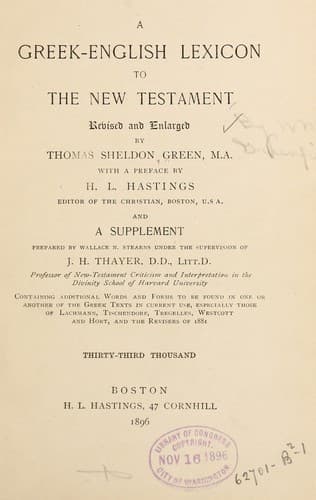
A Greek-English Lexicon to the New TestamentGreenfield, William
Religion
A Greek-English Lexicon to the New Testament
Greenfield, William
Bible. New Testament -- Dictionaries -- English; Greek language, Biblical -- Dictionaries -- English
σκηνὴ τοῦ μαρτυρίου, a title of the Mosaic tabernacle,
Ac. 7.44. Re. 15.5.
Μαρτύρομαι,
to call to witness; intrans. to make a solemn affirmation
or declaration, asseverate, Ac. 20.26. Ga. 5.3; to make a
solemn appearl, Eph. 4.17.
Μάρτυς, ῠρος, ὁ, ἡ,
a judicial witness, deponent, Mat. 18.16. He. 10.28, et al.;
generally, a witness to a circumstance, Lu. 24.48. Ac. 10.41,
et al.; in N.T., a witness, a testifier of a doctrine,
Re. 1.5; 3.14; 11.3; a martyr, Ac. 22.20. Re. 2.13.
Μασσάομαι, rather μασάομαι, ῶμαι,
f. ήσομαι,
to chew, masticate; in N.T., to gnaw, Re. 16.10.
Μαστῑγόω, ῶ, (μάστιξ)
f. ώσω, a.1. ἐμαστίγωσα,
to scourge, Mat. 10.17; 20.19, et al.; met. to chastise,
He. 12.6.
Μάστίζω,
f. ίξω,
to scourge, Ac. 22.25: (poet. & L.G.)
from
Μάστιξ, ῑγος, ἡ,
a scourge, whip, Ac. 22.24. He. 11.36; met. a scourge, pain,
disease, Mar. 3.10; 5.29, 34. Lu. 7.21.
Μαστός, οῦ, ὁ, (a collateral form of μαζός)
the breast, pap, Lu. 11.27, et al.
Ματαιολογία, ας, ἡ,
vain talking, idle disputation, 1 Ti. 1.6: (L.G.)
from
Ματαιολόγος, ου, ὁ, ἡ, (μάταιος & λέγω)
a vain talker, given to vain talking or trivial disputation,
Tit. 1.10.
Μάταιος, αία, αιον,
vain, ineffective, bootless, 1 Co. 3.20; groundless,
deceptive, fallacious, 1 Co. 15.17; uselesss, fruitless,
unprofitable, Tit. 3.9. Ja. 1.26; fr. the Heb. erroneous
in principle, corrupt, perverted, 1 Pe. 1.18; τὰ μάταια,
superstition, idolatry, Ac. 14.15:
whence
Ματαιότης, τητος, ἡ,
vanity, folly, 2 Pe. 2.18; fr. the Heb., religious error,
Eph. 4.17; false religion, Ro. 8.20. S.
Ματαιόω, ῶ,
f. ώσω,
to make vain; fr. the Heb., pass. to fall into religious
error, to be perverted, Ro. 1.21. S.
Μάτην,
adv. in vain, fruitlessly, without profit,
Mat. 15.9. Mar. 7.7.
Μάχαιρα, ας, ἡ,
a large knife, poniard; a sword, Mat. 26.47, 51, et al.;
the sword of the executioner, Ac. 12.2. Ro. 8.35. He. 11.37;
hence, φορεῖν μάχαιραν, to bear the sword, to have the power
of life and death, Ro. 13.4; meton. war. Mat. 10.34.
Μάχη, ης, ἡ,
a fight, battle; in N.T., contention, strife, dispute,
controversy, 2 Co. 7.5. 2 Ti. 2.23, et al.:
from
Μάχομαι,
f. οῦμαι, v. έσομαι,
to fight, to quarrel, Ac. 7.26; to contend, dispute,
Jno. 6.52, et al.
Μεγαλαυχέω, ῶ, (μέγας & αὐχέω, to boast)
f. ήσω,
to boast, vaunt; to cause a great stir, Ja. 3.5.
Μεγαλεῖος, εία, εῖον, (μέγας)
magnificent, splendid; τὰ μεγαλεῖα, great things,
wonderful works, Lu. 1.49. Ac. 2.11:
whence
Μεγαλειότης, τητος, ἡ,
majesty, magnificence, glory, Lu. 9.43. Ac. 19.27. 2 Pe. 1.16. S.
Μεγαλοπρεπής, έος, οῦς, ὁ, Ἡ, (μέγας & πρέπω)
pr. becoming a great man, magnificent, glorious, most
splendid, 2 Pe. 1.17.
Μεγαλύνω, (μέγας)
f. υνῶ, a.1. ἐμεγάλῡνα,
to enlarge, amplify, Mat. 23.5; to manifest in an
extraordinary degree, Lu. 1.58; to magnify, exalt,
extol, Lu. 1.46. Ac. 5.13, et al.
Μεγάλως, (μέγας)
adv.
Public-domain text, read in full here on John Shaqi.
Reviews
Reviews
No reviews yet
Be the first to share your thoughts on this work.
Elsewhere in the archive
Join the Discussion
Join the discussion
Sign in to leave a comment or review.
Sign InorCreate an account