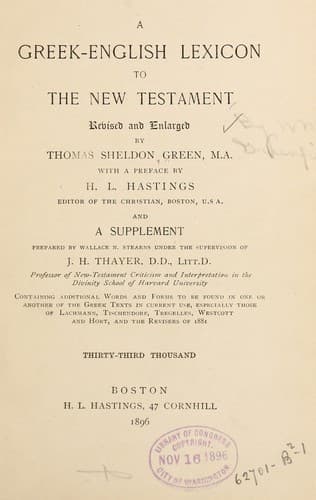
A Greek-English Lexicon to the New TestamentGreenfield, William
Religion
A Greek-English Lexicon to the New Testament
Greenfield, William
Bible. New Testament -- Dictionaries -- English; Greek language, Biblical -- Dictionaries -- English
Ἀλληγορέω, ῶ, (ἄλλος & ἀγορεύω, to speak)
to say what is either designed or fitted to convey a meaning
other than the leteral one, to allegorize, Ga. 4.24. L.G.
Ἁλληλούϊα, Heb. הללו־יה
Praise ye Jehovah, Re. 19.1, 3, 4, 6.
Ἀλλήλων,
gen. pl., ἀλλήλοις, αις, οις, dat. ἀλλήλους, ας, α,
acc. (fr. ἄλλος)
one another, each other.
Ἀλλογενής, έος, ὁ, ἡ, (ἄλλος & γένος)
of another race or nation i.e. not a Jew; a stranger,
foreigner, Lu. 17.18. S.
Ἅλλομαι,
f. ἁλοῡμαι, a.1. ἡλάμην,
to leap, jump, leap up, Ac. 3.8; 14.10; to spring,
as water, Jno. 4.14.
Ἄλλος, η, ο,
another, some other; ὀ ἄλλος, the other; οἱ ἄλλοι,
the others, the rest.
Ἀλλοτριοέπισκοπος, ου, ὁ, ἡ,
pr. one who meddles with the affairs of others, a busy-body
in other men's matters; factious, 1 Pe. 4.15 (N.T.)
fr ἐπίσκοπος and
Ἀλλότριος, ία, ιον, (ἄλλος)
belonging to another, alienus, foreign; a foreigner, alien.
Ἀλλόφῡλος, ου, ὁ, ἡ, (ἄλλος & φυλή)
of another race or natio, i.e. not a Jew, a foreigner, Ac. 10.28.
Ἄλλως,
adv. (ἄλλος) otherwise, 1 Ti. 2.25.
Ἀλοάω, ῶ,
f. ήσω, & άσω,
to thresh; to tread, or thresh out, 1 Co. 9.9, 10. 1 Ti. 5.18.
Ἀλογος, ου, ὁ, ἡ, τό, -ον, (ἀ & λόγος)
without speech or reason, irrational, brute; unreasonable, absurd,
Ac. 25.27. 2 Pe. 2.12. Jude 10.
Ἀλόη, ης, ἡ,
also termed ξυλαλόη, ἀγάλλογον, aloe, lign-aleo, excoecaria
agallochon Linn.,
a tree which grows in India and Cochin-China, the wood of which
is soft and bitter though highly aromatic. It is used by the
Orientals as a perfume; and employed for the purposes of embalming,
Jno. 19.39. L.G.
Ἅλς, ἀλός, ὁ,
salt, Mar. 9.49.
Ἁλῠκός, ή, όν, (ἅλς)
brackish, bitter, salt, Ja. 3.12.
Ἄλῡπος, ου, ὁ, ἡ, (ἀ & λύπη)
free from grief or sorrow, Phi. 2.28.
Ἅλῠσις, εως, ἡ,
a chain, Mar. 5.3, 4.
Ἀλυσιτελής, έος, ὁ, ἡ, (ἀ & λυσιτελής, i.e. λύων τὰ τέλη)
pr. bringing in no revenue or profit; hence, unprofitable,
useless; and by impl. destructive, fatal, He. 13.17.
Ἅλων, ωνος, ἡ
(a later form of ἅλως, ω, ἡ)
a threshing-floor, a place where corn is trodden out;
meton. the corn which is trodden out, Mat. 3.12. Lu. 3.17.
Ἀλώπηξ, εκος, ἡ,
a fox; met. a crafty man, Mat. 8.20. Lu. 9.58; 13.32.
Ἅλωσις, εως, ἡ, (ἁλίσκομαι)
a taking, catching, capture.
Ἅμα,
adv. with, together with; at the same time.
Ἀμᾰθής, έος, ὁ, ἡ, (ἀ & μανθάνω)
unlearned, uninstructed, rude, 2 Pe. 3.16.
Ἀμαράντινος, ου, ὁ, ἡ,
&
Ἀμάραντος, ου, ὁ, ἡ, (ἀ & μαραίνομαι)
unfading; hence, enduring, 1 Pe. 1.4; 5.4. L.G.
Ἁμαρτάνω,
f. ἁμαρτήσομαι & ἁμαρτήσω, a.1. ἡμάρτησα, a.2, ἥμαρτον,
pr. to miss a mark; to be in error; to sin; to wrong:
whence
Ἁμάρτημα, ατος, τό,
an error, sin; offence, Mar. 3.28; 4.12. Ro. 3.25. 1 Co. 6.18.
Ἁμαρτία, ας, ἡ,
error; offence, sin; a principle or cause of sin;
proneness to sin, sinful propensity; guilt or imputation of sin;
a guilty subject, sin-offering, expiatory victim.
Public-domain text, read in full here on John Shaqi.
Reviews
Reviews
No reviews yet
Be the first to share your thoughts on this work.
Join the Discussion
Join the discussion
Sign in to leave a comment or review.
Sign InorCreate an account