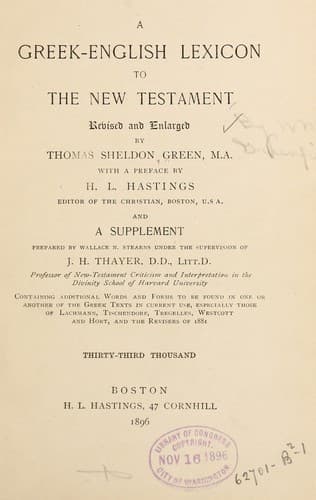
A Greek-English Lexicon to the New TestamentGreenfield, William
Religion
A Greek-English Lexicon to the New Testament
Greenfield, William
Bible. New Testament -- Dictionaries -- English; Greek language, Biblical -- Dictionaries -- English
a record, memorial, Ac. 10.4; honourable remembrance,
Mat. 26.13. Mar. 14.9.
Μνηστεύω,
f. εύσω, a.1. pass. ἐμνηστεύθην,
to ask in marriage; to betroth; pass. to be betrothed,
affianced, Mat. 1.18. Lu. 1.27; 2.5.
Μογιλάλος, ου, ὁ, ἡ, (μόγις & λαλέω)
having an impediment in one's speech, speaking with
difficulty, a stammerer, Mar. 7.32. (ᾰ). S.
Μόγις, (μόγος, labour, toil)
adv. with difficulty, scarcely, hardly, Lu. 9.39.
Μόδιος, ου, ὁ, (Lat. modius)
a modius, a Roman measure for things dry, containing
16 sextarii, and equivalent to about a peck; in N.T.,
a corn measure, Mat. 5.15. Mar. 4.21. Lu. 11.33.
Μοιχᾰλίς, ίδος, ἡ, (equiv. to μοιχάς, fem. of μοιχός)
an adulteress, Ro. 7.3. Ja. 4.4; by meton. an adulterous
mien, lustful significance, 2 Pe. 2.14; from the Heb.,
spiritually adulterous, faithless, ungodly, Mat. 12.39; 16.4.
Mar. 8.38. L.G.
Μοιχάομαι, ῶμαι, (mid. of μοιχάω, to defile a married woman,
fr. μοιχός)
f. ήσομαι,
to commit or be guilty of adultery, Mat. 5.32, et al.
Μοιχεία, ας, ἡ, (μοιχός)
adultery, Mat. 15.19. Mar. 7.21, et al.
Μοιχεύω,
f. εύσω, a.1. ἐμοίχευσα,
trans. to commit adultery with, debauch, Mat. 5.28;
absol. and mid. to commit adultery, Mat. 5.27.
Jno. 8.4, et al.; to commit spiritual adultery,
be guilty of idolatry, Re. 2.22: et al.
Μοιχός, οῦ, ὁ,
an adulterer, Lu. 18.11. 1 Co. 6.9. He. 13.4. Ja. 4.4.
Μόλις, (μόλος, labour)
adv. with difficulty, scarcely, hardly, Ac. 14.18; 27.7, 8, 16.
Ro. 5.7. 1 Pe. 4.18.
Μολύνω,
f. υνῶ, a.1. ἐμόλῡνα, p. pass. μεμόλυσμαι, a.1. ἐμολύνθην,
pr. to stain, sully; to defile, contaminate morally, 1 Co. 8.7.
Re. 14.4; to soil, Re. 3.4:
whence
Μολυσμός, οῦ, ὁ,
pollution, 2 Co. 7.1. L.G.
Μομφή, ῆς, ἡ, (μέμφομαι)
a complaint, cause or ground of complaint, Col. 3.13.
Μονή, ῆς, ἡ, (μένω)
a stay in any place; an abode, dwelling, mansion, Jno. 14.2, 23.
Μονογενής, έος, οῦς, ὁ, ἡ, (μόνος & γένος)
only begotten, only born, Lu. 7.12; 8.42; 9.38. He. 11.17;
by impl. most dear, most beloved, Jno. 1.14, 18; 3.16, 18.
1 Jno. 4.9.
Μόνον,
adv. only Mat. 5.47; 8.8; οὐ μόνον—ἀλλὰ καὶ, not only—but also,
Mat. 21.21. Jno. 5.18; μὴ μόνον—ἀλλὰ, not only—but, Ph. 2.12,
et al.:
from
Μόνος, η, ον,
without accompaniment, alone, Mat. 14.23; 18.15. Lu. 10.40, et al.;
singly existent, sole, only, Jno. 17.3, et al.;
lone, solitary, Jno. 8.29; 16.32;
alone in respect of restriction, only, Mat. 4.4; 12.4, et al.;
alone in respect of circumstances, only, Lu. 24.18;
not multiplied by reproduction, lone, barren, Jno. 12.24.
Μονόφθαλμος, ου, ὁ, ἡ, (μόνος & ὀφθαλμός)
one-eyed; deprived of an eye, Mat. 18.9. Mar. 9.47.
Μονόω, ῶ, (μόνος)
f. ώσω, p. pass. μεμόνωμαι,
to leave alone; pass. to be left alone, be lone, 1 Ti. 5.5.
Μορφή, ῆς, ἡ,
form, Mar. 16.12. Phi. 2.6, 7:
whence
Μορφόω, ῶ,
f. ώσω, a.1. pass. ἐμορφώθην,
to give shape to, mould, fashion, Ga. 4.19:
whence
Μόρφωσις, εως, ἡ,
pr.
Public-domain text, read in full here on John Shaqi.
Reviews
Reviews
No reviews yet
Be the first to share your thoughts on this work.
Elsewhere in the archive
Join the Discussion
Join the discussion
Sign in to leave a comment or review.
Sign InorCreate an account