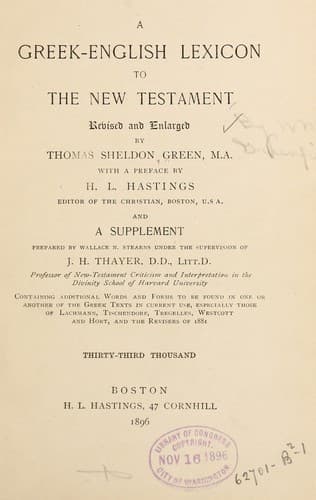
A Greek-English Lexicon to the New TestamentGreenfield, William
Religion
A Greek-English Lexicon to the New Testament
Greenfield, William
Bible. New Testament -- Dictionaries -- English; Greek language, Biblical -- Dictionaries -- English
a shaping, moulding; in N.T., external form, appearance,
2 Ti. 3.5; a settled form, prescribed system, Ro. 2.20.
Μοσχοποιέω, ῶ, (μόσχος & ποιέω)
f. ήσω, a.1. ἐμοσχοποίησα,
to form an image of a calf, Ac. 7.41. N.T.
Μόσχος, ου, ὁ, ἡ,
pr. a tender branch, shoot; a young animal; a calf, young
bullock, Lu. 15.23, 27, 30. He. 9.12, 19. Re. 4.7.
Μουσικός, ή, όν, (μοῦσα, a muse, song, music)
pr. devoted to the arts of the Muses; a musician; in N.T.,
perhaps, a singer, Re. 18.22.
Μόχθος, ου, ὁ,
wearisome labour, toil, travail, 2 Co. 11.27.
1 Th. 2.9. 2 Th. 3.8.
Μυελός, οῦ, ὁ,
marrow, He. 4.12.
Μυέω, ῶ, (μύω, to shut the mouth)
f. ήσω, p. pass. μεμύημαι,
to initiate, instruct in the sacred mysteries; in N.T.
pass., to be disciplined in a practical lesson, to learn
a lesson, Phi. 4.12.
Μῦθος, ου, ὁ,
a word, speech, a tale; a fable, figment, 1 Ti. 1.4, et al.
Μυκάομαι, ῶμαι,
to low, bellow, as a bull; also, to roar, as a lion, Re. 10.33.
Μυκτηρίζω, (μυκτήρ, the nose)
f. ίσω,
to contract the nose in contempt and derision,
toss up the nose; to mock, deride, Ga. 6.7.
Μυλικός, ή, όν, (μύλη, a mill)
of a mill, belonging to a mill, Mar. 9.42.
Μύλος, ου, ὁ, (fr. same)
a mill-stone, Mat. 18.6, et al.:
whence
Μυλών, ῶνος, ὁ,
a mill-house, a place where the grinding of corn
was performed, Mat. 24.41.
Μυριάς, άδος, ἡ, (μυρίος, innumerable)
a myriad, ten thousand, Ac. 19.19; indefintely,
a vast multitude, Lu. 12.1. Ac. 21.20, et al.
Μυρίζω, (μύρον)
f. ίσω,
to anoint, Mar. 14.8.
Μυρίοι, αι, α, (μυρίος, innumerable)
indefinitely, a great number, 1 Co. 4.15; 14.19;
specifically, μύριοι, a myriad, ten thousand, Mat. 18.24.
Μύρον, ου, τό,
pr. aromatic juice which distils from trees; ointment,
unguent, usually perfumed, Mat. 26.7, 12. Mar. 14.3, 4, et al.
Μυστήριον, ίου, τό, (μύστης, an initiated person, μυέω)
a matter to the knowledge of which initiation is necessary;
a secret which would remain such but for revelation,
Mat. 13.11. Ro. 11.25. Col. 1.26, et al.; a concealed
power or principle, 2 Th. 2.7; a hidden meaning of a
symbol, Re. 1.20; 17.7.
Μυωπάζω, (μύω, to shut, close, & ὤψ)
f. άσω,
pr. to close the eyes, contract the eyelids, wink; to be
nearsighted, dimsighted, purblind, 2 Pe. 1.9.
Μώλωψ, ωπος, ὁ,
the mark of a blow; a stripe, a wound, 1 Pe. 2.24.
Μωμάομαι, ῶμαι,
f. ήσομαι, a.1. pass. ἐμωμήθην,
to find fault with, censure, blame, 2 Co. 8.20;
passively, 2 Co. 6.3:
from
Μῶμος, ου, ὁ,
blame, ridicule; a disgrace to society, a stain, 2 Pe. 2.13.
Μωραίνω, (μωρός)
f. ανῶ, a.1. ἐμώρᾱνα,
to be foolish, play the fool; in N.T., trans. to make
foolish, convict of folly, 1 Co. 1.20; pass. to be
convicted of folly, to incur the character of folly,
Ro. 1.22; to be rendered insipid, Mat. 5.13. Lu. 14.34.
Μωρία, ας, ἡ, (fr. same)
foolishness, 1 Co. 1.18, 21, 23, et al.
Μωρολογία, ας, ἡ, (μωρός & λόγος)
foolish talk, Ep. 5.4.
Public-domain text, read in full here on John Shaqi.
Reviews
Reviews
No reviews yet
Be the first to share your thoughts on this work.
Elsewhere in the archive
Join the Discussion
Join the discussion
Sign in to leave a comment or review.
Sign InorCreate an account