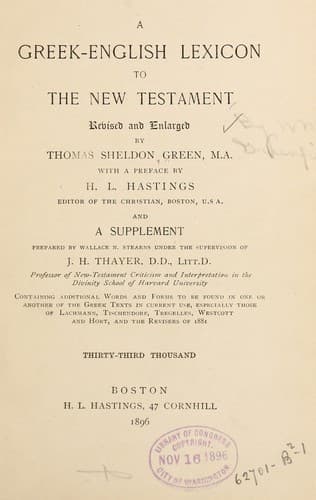
A Greek-English Lexicon to the New TestamentGreenfield, William
Religion
A Greek-English Lexicon to the New Testament
Greenfield, William
Bible. New Testament -- Dictionaries -- English; Greek language, Biblical -- Dictionaries -- English
comprehend, Mat. 15.17, et al.; to conceive, Eph. 3.20:
whence
Νοήμα, ατος, τό,
the mind, the understanding, intellect, 2 Co. 3.14; 4.4;
the heart, soul, affections, feeling, disposition, 2 Co. 11.3;
a conception of the mind, thought, purpose, device,
2 Co. 2.11; 10.5.
Νόθος, ου, ὀ, ἡ,
spurious, bastard, He. 12.8.
Νομή, ῆς, ἡ, (νέμω)
pasture, pasturage, Jno. 10.9; ἔχειν νομήν, to eat its way,
spread corrosion, 2. Ti. 2.17.
Νομίζω, (νόμος)
f. ίσω, p. νενόμικα, a.1. ἐνόμισα,
to own as settled and established; to deem, 1 Co. 7.26.
1 Ti. 6.5; to suppose, presume, Mat. 5.17; 20.10.
Lu. 2.44, et al.; pass. to be usual, customary, Ac. 16.13.
Νομικός, ή, όν, (fr. same)
pertaining to law; relating to the Mosaic law, Tit. 3.9;
as subst. one skilled in law, a jurist, lawyer, Tit. 3.13;
spc. an interpreter and teacher of the Mosaic law,
Mat. 22.35, et al.
Νομιμῶς, (fr. same)
adv. lawfully, agreeably to law or custom, rightfully,
1 Ti. 1.8. 2 Ti. 2.5.
Νόμισμα, ατος, τό, (νομίζω)
pr. a thing sanctioned by law or custom; lawful money,
coin, Mat. 22.19.
Νομοδιδάσκᾰλος, ου, ὁ, (νόμος & διδάσκαλος)
a teacher and interpreter of the Mosaic law,
Lu. 5.17, et al. N.T.
Νομοθεσία, ας, ἡ,
legislation; ἠ νομοθεσια, the gift of the divine Law, or,
the Mosaic Law itself, Ro. 9.4:
from
Νομοθετέω, ῶ,
f. ήσω,
to impose a law, give laws; in N.T., pass. to have a law
imposed on one's self, receive a law, He. 7.11;
to be enacted, constitued, He. 8.6:
from
Νομοθέτης, ου, ὁ, (νόμος & τίθημι)
a legislator, lawgiver, Ja. 4.12.
Νόμος, ου, ὁ, (νέμω)
a law, Ro. 4.15. 1 Ti. 1.9; the Mosaic law, Mat. 5.14, et al. freq.;
the Old Testament Scripture, Jno. 10.34; a legal tie, Ro. 7.2, 3;
a law, a rule, standard, Ro. 3.27; a rule of life and conduct,
Ga. 6.2. Ja. 1.25.
Νοσέω, ῶ, (νόσος)
f. ήσω,
to be sick; met. to have a diseased appetite or craving of a
thing, have an excessive and vicious fondness for a thing,
to dote, 1 Ti. 6.4:
whence
Νόσημα, ατος, τό,
disease, sickness, Jno. 5.4.
Νόσος, ου, ἡ,
a disease, sickness, distermper,
Mat. 4.23, 24; 8.17; 9.35, et al.
Νοσσιά, ᾶς, ἡ, (contr. for νεοσσιά, fr. νεοσσός)
a brood of young birds, Lu. 13.34.
Νοσσίον, ου, τό, (contr. for νεοσσίον, dim. from νεοσσός)
the young of birds, a chick; pl. a brood of young birds,
Mat. 23.37.
Νοσσός, οῦ, ὁ, (contr. for νεοσσός)
a young bird, v.r. Lu. 2.24.
Νοσφίζω, (νόσφι, apart, separate)
f. ίσω,
to deprive, rob; mid. to appropriate; to make secret
reservation, Ac. 5.2, 3; to purloin, Tit. 2.10.
Νότος, ου, ὁ,
the south wind, Lu. 12.55. Ac. 27.13; meton. the south,
the southern quarter of the heavens, Mat. 12.42.
Lu. 11.31; 13.29. Re. 21.13.
Νουθεσία, ας, ἡ,
warning, admonition, 1 Co. 10.11. Ep. 6.4. Tit. 3.10:
from
Νουθετέω, ῶ, (νοῦς & τίθημι)
f. ήσω,
pr. to put in mind; to admonish, warn, Ac. 20.31.
Ro. 15.14, et al.
Νουμηνία, ας, ἡ, (contr. for νεομηνία, νέος & μήν)
Public-domain text, read in full here on John Shaqi.
Reviews
Reviews
No reviews yet
Be the first to share your thoughts on this work.
Elsewhere in the archive
Join the Discussion
Join the discussion
Sign in to leave a comment or review.
Sign InorCreate an account