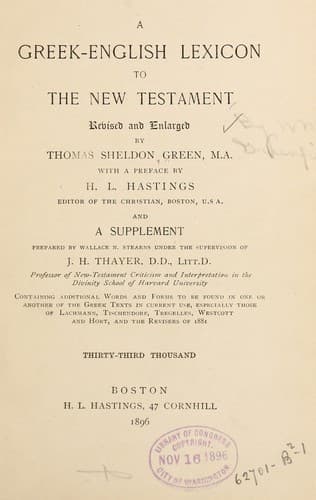
A Greek-English Lexicon to the New TestamentGreenfield, William
Religion
A Greek-English Lexicon to the New Testament
Greenfield, William
Bible. New Testament -- Dictionaries -- English; Greek language, Biblical -- Dictionaries -- English
a neophyte, one newly
implanted into the Cchristian Church, a new convert,
1 Ti. 3.6. S.
Νεύω,
f. νεύσω, a.1. ἔνευσα,
to nod; to intimate by a nod or significant gesture,
Jno. 13.24. Ac. 24.10.
Νεφέλη, ης, ἡ,
a cloud, Mat. 17.5; 24.30; 26.64, et al.
Νέφος, εος, τό,
a cloud; trop. a cloud, a throng of persons, He. 12.1.
Νεφρός, οῦ, ὁ,
a kidney; pl. νεφροί, the kidneys, reins; fr. the Heb.
put for the inmost mind, the most secret thoughts, desires,
and affections, Re. 2.23.
Νεωκόρος, ου, ὁ, ἡ, (ναός, At. νεώς & κορέω, to sweep clean)
pr. one who sweeps or cleanses a temple; generally,
one who has the charge of a temple, ædituus; in N.T.,
a devotee city, as having specially dedicated a temple
to some deity, Ac. 19.35.
Νεωτερικός, ή, όν,
juvenile, natural to youth, youthful, 2 Ti. 2.22. (L.G.)
from
Νεώτερος, α, ον, (campar. of νέος)
younger, more youthful, Lu. 15.12, 13, et al.
Νή,
a particle used in affirmative oaths,by, 1 Co. 15.31.
Νήθω, (νέω, idem)
f. νήσω,
to spin, Mat. 6.28. Lu. 12.27.
Νηπιάζω,
f. άσω,
to be childlike, 1 Co. 14.20:
from
Νήπιος, ίου, ὁ, (νή & ἔπος)
pr. not speaking, infans; an infant, babe, child,
Mat. 21.16. 1 Cor. 13.11; one below the age of manhood,
a minor, Ga. 4.1; met. a babe in knowledge, unlearned,
simple, Mat. 11.25. Ro. 2.20.
Νησίον, ου, τό,
a small island, Ac. 27.16: dimin. of
Νῆσος, ου, ἡ, (νέω, to swim)
an island, Ac. 13.6; 27.26, et al.
Νηστεία, ας, ἡ,
fasting, want of food, 2 Co. 6.5; 11.27; a fast religious
abstenence from food, Mat. 17.21. Lu. 2.37, et al.;
spc. the annual public fast of the Jews, the great day
of atonement, occurring in the month Tisri, corresponding
to the new moon of October, Ac. 27.9:
from
Νηστεύω,
f. εύσω, a.1. ἐνήστευσα,
to fast, Mat. 4.2; 6.16, 17, 18; 9.15, et al.:
from
Νῆστις, ιος, εως, & ιδος, ὁ, ἡ, (νή & ἐσθίω)
fasting, Mat. 15.32. Mar. 8.3.
Νηφάλιος, and later νηφαλέος, ίου, ὁ, ἡ.
sober, temperate, abstinent in respect to wine, &c.; in N.T. met.,
vigilant, circumspect, 1 Ti. 3.2, 11. Tit. 2.2:
from
Νήφω,
f. ψω, a.1. ἔνηψα,
to be sober, not intoxicated; in N.T. met., to be vigilant,
circumspect, 1 Th. 5.6, 8, et al.
Νῑκάω, ῶ,
f. ήσω, p. νενίκηκα, a.1. ἐνίκησα,
to conquer, overcome, vanquish, subdue, Lu. 11.22. Jno, 16.33;
absol. to overcome, prevail, Re. 5.5; to come off superior
in a judicial cause, Ro. 3.4:
from
Νίκη, ης, ἠ,
victory; meton. a victorious principle, 1 Jno. 5.4.
Νῖκος, εος, τό (a later equiv. to νίκη)
victory, Mat. 12.20. 1 Co. 15.54, 55, 57.
Νιπτήρ, ῆρος,
a basin for washing some part of the person, Jno. 13.5: (N.T.)
from
Νίπτω, (a from of later use for νίζω)
f. ψω, a.1. ἔνιψα,
to wash; spc. to wash some part of the person,
as distingushed from λούω, Mat. 6.17. Jno. 13.8, et al.
Νοέω, ῶ, (νόος)
f. ήσω, a.1. ἐνόησα,
to percieve, observe; to mark attentively,
Mat. 24.15. Mar. 13.14. 2 Ti. 2.7; to understand,
Public-domain text, read in full here on John Shaqi.
Reviews
Reviews
No reviews yet
Be the first to share your thoughts on this work.
Elsewhere in the archive
Join the Discussion
Join the discussion
Sign in to leave a comment or review.
Sign InorCreate an account