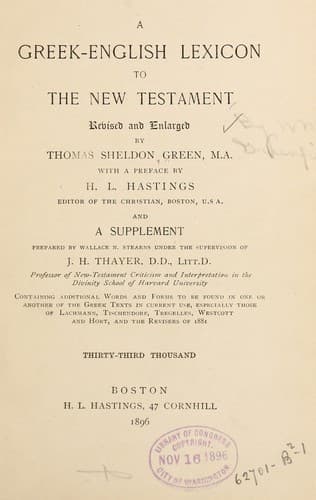
A Greek-English Lexicon to the New TestamentGreenfield, William
Religion
A Greek-English Lexicon to the New Testament
Greenfield, William
Bible. New Testament -- Dictionaries -- English; Greek language, Biblical -- Dictionaries -- English
intrans. to rush, Mat. 8.32. Mar. 5.13. Lu. 8.33, et al.:
from
Ὀρμή, ῆς, ἡ, (ὄρω, ὄρνυμι, to put in motion)
impetus, impulse; assault, violent attempt, Ac. 14.5;
met. impulse of mind, purpose will, Ja. 3.4.
Ὁρμημα, ατος, τό, (ὁρμάω)
violent or impetuous motion; violence, Re. 18.21.
Ὄρνεον, ου, τό,
a bird, fowl, Re. 18.2; 19.17, 21.
Ὄρνις, ῑθος, ὁ, ἡ,
a bird, fowl; the domestic hen, Mat. 23.37. Lu. 13.34.
Ὁροθεσία, ας, ἡ, (ὅρος, a bound, limit, & τίθημι)
pr. the act of fixing boundaries; a bound set, certain bound,
fixed limit, Ac. 17.26. N.T.
Ὄρος, εος, τό,
a mountain, hill, Mat. 5.1, 14; 8.1; 17.20, et al.
Ὀρύσσω, v. ττω,
f. ξω, a.1. ὤρυξα,
to dig, excavate, Mat. 21.33; 25.18. Mar. 12.1.
Ὀρφᾰνός, ἡ, όν, v. οῦ, ὁ, ἡ,
bereaved of parents, orphan, Ja. 1.27; bereaved, desolate, Jno. 14.18.
Ὀρχέομαιν, οῦμαι,
f. ήσομαι, a.1. ὠρχησάμην,
to dance, Mat. 11.17, et al.
Ὅς, ἥ, ὅ,
rel. pron. who, which, qui, quæ, quod,
Mat. 1.16, 23, 25, et al.; in N.T.,
interrog. ἐφ᾽ ὃ, wherefore, why, Mat. 26.50; in N.T.,
ὅς μὲν— ὅς δὲ, for ὁ μὲν—ὁ δὲ, Mat. 21.35. 2 Co. 2.16, et al.
Ὁσάκις, (ὅσος)
as often as, 1Co. 1.25, 26. Re. 11.6. (ᾰ.)
Ὅσιος, ία, ιον,
pr. sanctioned by the supreme law of God and nature; pious,
devout, Tit. 1.8; pure, 1 Ti. 2.8; supremely holy, Ac. 2.27; 13.35.
He. 7.26. Re. 15.4; 16.5; τὰ ὅσια, pledged bounties, mercies,
Ac. 13.34:
whence
Ὁσιότης, τητον, ἡ,
piety, sacred observance of all duties towards God,
holiness, Lu. 1.75. Ep. 5.24.
Ὁσίως,
adv. piously, holily, 1 Th. 2.10.
Ὀσμή, ῆς, ἡ, (ὄζω)
smell, odour, fragrant odour, Jno. 12.3. Ep. 5.2; Phil. 4.18;
met. 2 Co. 2.14, 16.
Ὅσος, η, ον,
a correlative to τόσος, τοσοῦτος, &c., as great, as much,
Mar. 7.36. Jno. 6.11. He. 1.4; 8.6; 10.25; ἐφ᾿ ὅσον χρόνον,
for how long a time, while, as long as, Ro. 7.1;
so ἐφ᾿ ὅσον, sc. χρόνον, Mat. 9.15; ὅσον χρόνον,
how long, Mar. 2.19; neut. ὅσον repeated, ὅσον ὅσον,
used to give intensity to other qualifying words,
e.g. μικρόν, the very least, a very, very little while,
He. 10.37; ἐφ᾿ ὅσον, in as much as, Mat. 25.40, 45;
καθ᾿ ὅσον, by how much, so far as, He. 3.3; or,
in as much as, as, so, He. 7.20; 9.27; pl.
ὅσα, so far as, as much as, Re. 1.2; 18.7;
how great, how much, how many, what, Mar. 3.8; 5.19, 20;
how many soever, as many as, all who,
2 Cor. 1.20. Ph. 3.15. 1 Ti. 6.1;
ὅσος ἅν, v. ἐὰν, whosoever, whatsoever, Mat. 7.12; 18.18.
Ὅσπερ, ἥπερ, ὅπερ, (ὅς & περ)
an emplatic form of the relative, Mar. 15.6.
Ὀστέον, οῦν, έου, οῦ, τό,
a bone, Mat. 23.27. Lu. 24.39, et al.
Ὅστις, ἥτις, ὅ τι, (ὅς & τις)
gen. οὗτινος, ἧστινος, οὗτινος, & ὅτου,
rel. pron. whoever, whatever; whosoever, whatsoever,
Mat. 5.39, 41; 13.12; 18.4; its use in place of the
simple relative is also required in various cases,
which may be learnt from the grammars;
ἕως ὅτου. sc. χρόνου, until, Lu. 13.8; while, Mat. 5.25.
Ὀστράκῐνος, η, ον, (ὄστρᾰκον, an earthen vessel)
Public-domain text, read in full here on John Shaqi.
Reviews
Reviews
No reviews yet
Be the first to share your thoughts on this work.
Elsewhere in the archive
Join the Discussion
Join the discussion
Sign in to leave a comment or review.
Sign InorCreate an account