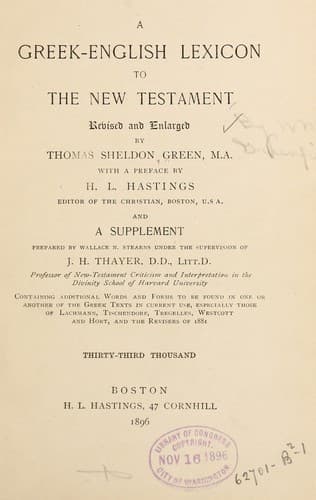
A Greek-English Lexicon to the New TestamentGreenfield, William
Religion
A Greek-English Lexicon to the New Testament
Greenfield, William
Bible. New Testament -- Dictionaries -- English; Greek language, Biblical -- Dictionaries -- English
earthen, of earthenware, 2 Co. 4.7. 2 Ti. 2.20. L.G.
Ὄσφρησις, εως, ἡ, (ὀσφραίνομαι, to smell)
smell, the sense of smelling, 1 Co. 12.17.
Ὀσφύς, ύος, ἡ, & pl. αἱ ὀσφύες,
the loins, Mat. 3.4. Mar. 1.6, et al..
Ὅταν, (ὅτε & ἄν)
conj. when, whenever, Mat. 5.11; 6.2. Mar. 3.11.
Re. 4.9, et al. freq.; in N.T., in case of, on
occasion of, Jno. 9.5. 1 Co. 15.27. He. 1.6.
Ὅτε,
adv. when, at the time that, at what time, Mat. 7.28; 9.25.
Lu. 13.35, et al. freq.
Ὅτι, (ὅστις)
that, Mat. 2.16, 22, 23; 6.5, 16; often used pleonastically
in reciting another's words, Mat. 9.18. Lu. 19.42. Ac. 5.23;
as a causal particle, for that, for, because,
Mat. 2.18; 5.3, 4, 5; 13.13; because, seeing that, since,
Lu. 23.40. Ac. 1.17.
Ὅτου,
see in ὅστις.
Οὗ, (pr. gen. of ὅς)
adv. where, in what place, Mat. 2.9; 18.20; whither,
to what place, Lu. 10.1; 22.10; 24.28;
οὗ ἐὰν, whithersoever, 1 Co. 16.6.
Οὐ,
before a consonant, οὐκ before a vowel with a lenis, & οὐχ
with an aspirate, adv. of negation, not, no.
Mat. 5.37; 12.43; 23.37; the peculiariteis of i
ts usage, and as distinct from μή, may be learnt
from the grammars.
Οὐά, (Lat. vah)
interj. expressive of insult and derision,
ah! aha! Mar. 15.29.
Οὐσί, (Lat. vœ)
interj. wo! alas! Mat. 11.21; 18.7; 23.13–16, et al.;
ἡ οὐαί, subs. a woe, calamity, Re. 9.12; 11.14.
Οὐδαμῶς, (οὐδαμός)
by no means, Mat. 2.6.
Οὐδέ (οὐ & δέ)
adv. neither, nor, and not, also not,
Mat. 5.15; 6.15, 20, 26, 28; when single,
not even, Mat. 6.29; 8.10.
Οὐδείς, οὐδεμία, οὐδέν, (οὐδέ & εἷς)
not one, no one, none, nothing, Mat. 5.13; 6.24; 19.17;
met. οὐδέν, nothing, of no account, naught,
Jno. 8.54. Ac. 21.24.
Οὐδέποτε, (οὐδέ & πότε)
never, Mat. 7.23; 21.16, 42, et al. freq.
Οὐδέπω, (οὐδέ & πω)
not yet, never yet, never, Lu. 23.53. Jno. 7.39, et al.
Οὐθείς, οὐθέν,
later forms for οὐδείς, οὐδέν, v.r. 1 Co. 13.2.
Οὐκ,
see οὐ.
Οὐκέτι, (οὐκ & ἔτι)
no longer, no more, Mat. 22.46, et al.
Οὐκοῦν,
then, therefore, Jno. 18.37.
Οὖν,
a particle expressing either simple sequence or consequence;
then, now then, Mat. 13.18. Jno. 19.29. et al.; then, thereupon,
Lu. 15.28. Jno. 6.14, et al.; therefore, consequently, Mat. 5.48.
Mar. 10.9, et al.; it also serves to mark the resumption of
discourse after an interruption by a parenthesis,
1 Co. 8.4, et al.
Οὔπω, (οὐ & πω)
adv. not yet, Mat. 15.17; 16.19; 24.6. Jno. 2.4, et al.
Οὐρά, ᾶς, ἡ,
a tail, Re. 9.10, 19; 12.4.
Οὐράνιος, ία, ιον, v. ίου, ὁ, ἡ, (οὐρανός)
heavenly, celestial, Mat. 6.14, 26, 32; 15.13, et al.
Οὐρανόθεν,
adv. from heaven, Ac. 14.17; 26.13:
from
Οὐρανός, οῦ, ὁ, & pl. οὐρανοί, ῶν, οἱ,
heaven, the heavens, the visible heavens and all their
phenomena, Mat. 5.18; 16.1; 24.29, et al. freq.; the air,
atmosphere, in which the clouds and tempests gather,
the birds fly, &c. Mat. 6.26; 16.2, 3, et al.; heaven,
the peculiar seat and abode of God, of angels, of glorified
Public-domain text, read in full here on John Shaqi.
Reviews
Reviews
No reviews yet
Be the first to share your thoughts on this work.
Elsewhere in the archive
Join the Discussion
Join the discussion
Sign in to leave a comment or review.
Sign InorCreate an account