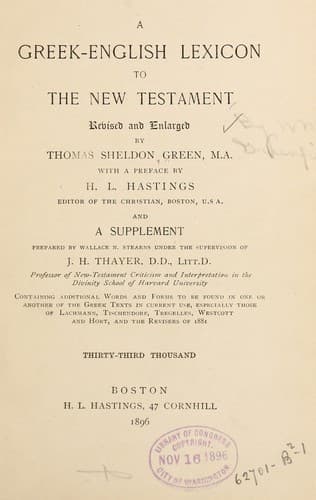
A Greek-English Lexicon to the New TestamentGreenfield, William
Religion
A Greek-English Lexicon to the New Testament
Greenfield, William
Bible. New Testament -- Dictionaries -- English; Greek language, Biblical -- Dictionaries -- English
spirits, &c., Mat. 5.34, 45, 48; 6.1, 9, 10; 12.50.
Jno 3.13, 31; 6.32, 38, 41, 42, 50, 51, 58; in N.T.,
heaven as a term expressive of the Divine Being,
His administration, &c., Mat. 19.14; 21.25.
Lu. 20.4, 5. Jno 3.27.
Οὖς, ὠτός, τό,
the ear, Mat. 10.27. Mar. 7.33. Lu. 22.50. Ac. 7.57, et al.
Οὐσία, ας, ἡ, (ὤν, οὖσα, ὄν, part. of εἰμι)
substance, propery, goods, fortune, Lu. 15.12, 13.
Οὔτε, (οὐ & τε)
neither, nor, Lu. 20.36; οὔτε—οὔτε v.
οὐδὲ—οὔτε, neither—nor, Lu. 20.35; Ga. 1.12; in N.T.,
also used singly in the sense of οὐδέ, not even,
Mar. 5.3. Lu. 12.26. 1 Co. 3.2.
Οὗτος, αὗτη, τοῦτο,
demons. pron. this, this person or thing,
Mat. 3.3, 9, 17; 8.9; 19.2; 24.34, et al. freq.;
used by way of contempt, this fellow, Mat. 13.55; 27.47;
αὐτὸ τοῦτο, this very thing, this same thing, 2 Co. 2.3; 7.11;
εἰς αὐτὸ τοῦτο, and elliptically,
αὐτὸ τοῦτο; for this same purpose, on this account,
Ep. 6.18, 22. 2 Pe. 1.5;
καὶ οὗτος, and moreover, Lu. 7.12; 16.1; 20.30;
καὶ τοῦτο, and that too, 1 Co. 6.6, 8;
τοῦτο μὲν—τοῦτο δὲ, partly—partly, He. 10.33.
Οὕτως, & οὕτω before a consonant, (οὗτος)
adv. thus, in this way, Mat. 1.18; 2.5; 5.16, et al. freq.;
ὅς μὲν οὕτως, ὅς δὲ οὕτως, one so, and another so, one in
one way, and another in another, 1 Co. 7.7, 26, 40; 9.14;
so, Mat. 7.12; 12.40; 24.27, 37, et al. freq.; thus,
under such circumstances, Ac. 20.11; 27.17; in an ordinary
way, Jno. 4.6.
Οὐχ,
see οὐ.
Οὐχί (οὐ)
adv. not, Jno. 13.10, 11; when followed by ἀλλά,
nay, not so, by no means, Lu. 1.60; 12.51;
used also in negative interrogations,
Mat. 5.46, 47; 6.25.
Ὀφειλέτης, ου, ὁ, (ὀφείλω)
a debtor, one who owes another, Mat. 18.24;
met. one who is in any way bound, or under obligation
to perform any duty, Ro. 1.14; 8.12; 15.27. Ga. 5.3;
in N.T., one who fails in duty towards any one,
a delinquent, offender, Mat. 6.12; a sinner,
Lu. 13.4, cf. v. 2.
Ὀφειλή, ῆς, ἡ, (fr. same)
a debt, Mat. 18.32; met. a duty, due, Ro. 13.7. 1 Co. 7.3.
Ὀφείλημα, ατος, τό,
a debt; a due, Ro. 4.4; in N.T., a delinquency,
offence, fault, sin, Mat. 6.12. cf. v. 14:
from
Ὀφείλω,
f. ήσω, a.2. ὤφελον,
to owe, be indebted, Mat. 18.28, 30, 34; to incur a
bond, to be bound to make discharge, Mat. 23.16, 18;
to be bound by what is due or fitting, Lu. 17.10.
Jno. 13.14, et al.; to incur desert, to deserve,
Jno. 19.7; to be due or fitting, 1 Co. 7.3, 36;
fr. the Aram. to be delinqent, Lu. 11.4.
Ὄφελον, (pr. a.2. of ὀφείλω)
used later and in N.T. as an interj.,
O that! would that! 1 Co. 4.8. Gal. 5.12, et al.
Ὄφελος, εος, τό, (ὀφέλλω, to further, augment)
profit, utility, advantage, 1 Co. 15.32, et al.
Ὀφθαλμοδουλεία, ας, ἡ, (ὀφθαλμός & δουλεία)
eye-service, service rendered only while under inspection,
Ep. 6.6. Col. 3.22. N.T.
Ὀφθαλμός, οῦ, ὁ, (ὄψομαι, ὤφθην)
an eye, Mat. 5.29, 38; 6.23; 7.3–5, et al.;
ὀφθαλμὸς πονηρός, an evil eye, an envious eye, envy,
Mat. 20.15. Mar. 7.22; met.
Public-domain text, read in full here on John Shaqi.
Reviews
Reviews
No reviews yet
Be the first to share your thoughts on this work.
Elsewhere in the archive
Join the Discussion
Join the discussion
Sign in to leave a comment or review.
Sign InorCreate an account