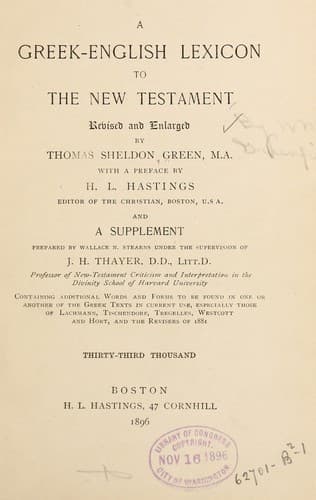
A Greek-English Lexicon to the New TestamentGreenfield, William
Religion
A Greek-English Lexicon to the New Testament
Greenfield, William
Bible. New Testament -- Dictionaries -- English; Greek language, Biblical -- Dictionaries -- English
Ἀμώμητος, ου, ὁ, ἡ, (ἀ & μῶμος)
blameless, irreprehensible, Phi. 2.15. 2 Pe. 3.14.
Ἄμωμον, ου, τό,
v.r. Re. 18.13, amomum, an odoriferous shrub, from which a
precious ointment was prepared.
Ἄμωμος, ου, ὁ, ἡ, (ἀ & μῶμος)
blameless.
Ἄν
The various constructions of this particle, and their
significations, must be learnt from the grammars.
Standing at the commencement of a clause, it is another
form of ἐάν, if Jno. 20.23.
Ἀνά,
prep. used in the N.T. only in certain forms.
Ἀνὰ μέρος, in turn; ἀνὰ μέσον, in turn; ἀνὰ μέσον, through
the midst, between; ἀνὰ δηνάριον, at the rate of a denarius;
with numeral, ἀνὰ ἑκατόν, 9in parties of a hundred.
In composition, step by step, up, back, again.
Ἀναβαθμός, οῦ, ὁ, (ἀνά & βαθμός)
the act of ascending; means of ascent, steps, stairs,
Ac. 21.35, 40:
from
Ἀναβαίνω, (ἀνά & βαίνω)
f. βήσομαι, p. βέβηκα, a.2 ἀνέβηω,
to go up, ascend; climb; embark; to rise, mount upwards,
as smoke; to grow or spring up, as plants; to spring up,
arise, as thoughts.
Ἀναβάλλω, (ἀνά & βάλλω)
f. βαλῶ, p. βέβληκα,
to throw back; mid. to put off, defer, adjourn, Ac. 24.22.
Ἀναβιβάζω, (ἀνά & βιβάζω)
f. άσω, a.1. ἀνεβιβασα,
to cause to come up or ascend, draw or bring up, Mat. 13.48.
Ἀναβλέπω, (ἀνά & Βλέπω)
f. ψω,
to look upwards; to see again, recover sight:
whence
Ἀνάβλεψις, εως, ἡ,
recovery of sight, Lu. 4.18.
Ἀναβοάω, ῶ, (ἀνά & βοάω)
f. ήσομαι, a.1. ησα,
to cry out or aloud, exclaim, Mat. 27.46. Mar. 15.8. Lu. 9.38.
Ἀναβολή, ῆς, ἡ, (ἀναβάλλω)
delay, Ac. 25.17.
Ἀνάγαιον, ου, τό
v.r. for ἀνώγεον, which see.
Ἀναγγέλλω, (ἀνά & ἀγγέλλω)
f. γελῶ, a.1. ἀνήγγειλα, a.2. pass. ἀνηγγέλην,
to bring back word, announce, report; to declare, set forth,
teach.
Ἀναγεννάω, ῶ, (ἀνά & γεννάω)
f. ήσά, p. pass. ἀναγεγέννημαι,
to beget or bring forth again; regenerate, 1 Pe. 1.3, 23. N.T.
Ἀναγινώσκω, (ἀνά & γινώσκω)
f. γνώσομαι, a.2. ἀνέγνων, a.1. pass. ἀνεγνώσθην,
to gather exact knowledge of, recognise, discern; especially,
to read.
Ἀναγκάζω, (ἀνάγκη)
f. άσω,
to force, compel; constrain, urge.
Ἀναγκαῖος, α, ον, (ἀνάγκη)
necessary, indispensable, 1 Co. 12.22; necessary, needful,
right, proper, Ac. 13.46. 2 Co. 9.5. Phi. 1.24; 2.25. He. 8.3;
near, initimate, closely connected, necessarius, as friends,
Ac. 10.24.
Ἀναγκαστῶς,
adv. by contraint or compulsion, unwillingly, opp. to
ἐκουσίως, 1 Pe. 5.2:
from
Ἀνάγκη, ης, ἡ, (ἄγχω, to compress)
necessity, constraint, compulsion; obligation of duty,
moral or spiritual necessity; distress, calamity, affliction.
Ἀηαγνωρίζω, (ἀνά & γνωρίζω)
f. ισω, a.1. pass. ἀηεγνωρίσθην,
to recognise; pass. to be made known, or to cause one's
self to be recognised, Ac. 7.13.
Ἀνάγνωσις, εως, ἡ, (ἀναγινώσκω)
reading, Ac. 13.15. 2 Co. 3.14. 1 Ti. 4.13.
Ἀνάγω, (ἀνά & ἄγω)
f. άξω, a.2. ἀνήγαγον, a.1. pass. ἀνήχθην,
to conduct; to lead or convey from a lower place to a
Public-domain text, read in full here on John Shaqi.
Reviews
Reviews
No reviews yet
Be the first to share your thoughts on this work.
Join the Discussion
Join the discussion
Sign in to leave a comment or review.
Sign InorCreate an account