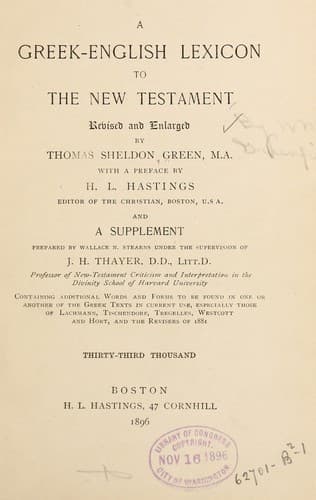
A Greek-English Lexicon to the New TestamentGreenfield, William
Religion
A Greek-English Lexicon to the New Testament
Greenfield, William
Bible. New Testament -- Dictionaries -- English; Greek language, Biblical -- Dictionaries -- English
Πάντοτε, (πᾶς)
adv. always, at all times, ever, Mat. 26.11. Mar. 14.7.
Lu. 15.31; 18.1, et al. L.G.
Πάντως, (πᾶς)
adv. wholly, altogether; at any rate, by all means,
1 Co. 9.22; by impl. surely, assuredly, certainly,
Lu. 4.23. Ac. 18.21; 21.22; 28.4;
οὐ πάντως, in nowise, not in the least,
Ro. 3.9. 1 Co. 5.10; 16.12.
Παρά
prep., with a genitive,from, indicating source or origin,
Mat. 2.4, 7. Mar. 8.11. Lu. 2.1, et al.;
οἱ παρ᾿ αὐτοῦ, his relatives or kinsmen, Mar. 3.21;
τὰ παρ᾿ αὐτῆς πάντα, all her substance, property, &c., Mar. 5.26;
with a dative, with, by, nigh to, in among, &c.
Matthew 6.1; 19.26; 21.25; 22.25;
παρ᾿ ἑαυτῷ, at home, 1 Co. 16.2;
in the sight of, in the judgment or estimation of,
1 Co. 3.19. 2 Pe. 2.11; 3.8;
with an accusative, motion by, near to, along, Mat. 4.18;
motion towards, to, at, Mat. 15.30. Mar. 2.13;
motion terminating in rest, at, by, near, by the side of,
Mar. 4.1, 4. Lu. 5.1; 8.5;
in deviation from, in violation of, inconsistently with,
Ac. 18.13. Ro. 1.26; 11.24;
above, more than, Lu. 13.2, 4. Ro. 1.25;
after comparatives, Lu. 3.13. 1 Co. 3.11;
except, save, 2 Co. 11.24;
beyond, past, He. 11.11;
in respect of, on the score of, 1 Co. 12.15, 16.
Παραβαίνω, (παρά & βαίνω)
f. βήσομαι, a.2. παρέβην,
pr. to step by the side of; to deviate; met. to transgress,
violate, Mat. 15.2, 3. 2 Jno. 9; to incur forfeiture, Ac. 1.25.
Παραβάλλω, (παρά & βάλλω)
f. βαλῶ,
to cast or throw by the side of; met. to compare, Mar. 4.30;
absol. a nautical term, to bring to, land, Ac. 20.15.
Παράβᾰσις, εως, ἡ, (παραβαίνω)
a stepping by the side, deviation; a transgression,
violation of law, Ro. 2.23; 4.15, et al.
Παραβάτης, ου, ὁ, (fr. same)
a transgressor, violator of law, Ro. 2.25, 27. Ga. 2.18.
Ja. 2.9, 11. (ᾰ.)
Παραβιάζομαι, (παρά & βιάζω)
f. άσομαι,
to force; to constrain, press with urgent entreaties,
Lu. 24.29. Ac. 16.15. L.G.
Παραβολεύομαιν, (παράβολος, risking, venturesome)
f. εύσομαι,
to stake or risk one's self, v.r. Ph. 2.30. N.T.
Παραβολή, ῆς, ἡ, (παραβάλλω)
a place one thing by the side of another; a comparing;
a parallel case cited in illustration; a comparison,
simile, similitude, Mar. 4.30. He. 11.19; a parable,
a short relation under which something else is figured,
or in which that which is fictitious is employed to
represent that which is real,
Mat. 13.3, 10, 13, 18, 24, 31, 33, 34, 36, 53;
21.33, 45; 22.1; 24.32, et al.;
in N.T., a type, pattern, emblem, He. 9.9;
a sentiment, grave and sententious precept, maxim,
Lu. 14.7; an obscure and enigmatical saying, any thing
expressed in remote and ambiguous terms, Mat. 13.35.
Mar. 7.17; a proverb, adage, Lu. 4.23.
Παραβουλεύομαι, (παρά & βουλεύω)
f. εύσομαι,
to be reckless, regardless, Ph. 2.30. N.T.
Παραγγελία, ας, ἡ,
a command, order, charge, Ac. 5.28; direction, precept,
1 Th. 4.2, et al.:
from
Παραγγέλλω, (παρά & ἀγγέλλω)
f. ελῶ
Public-domain text, read in full here on John Shaqi.
Reviews
Reviews
No reviews yet
Be the first to share your thoughts on this work.
Elsewhere in the archive
Join the Discussion
Join the discussion
Sign in to leave a comment or review.
Sign InorCreate an account