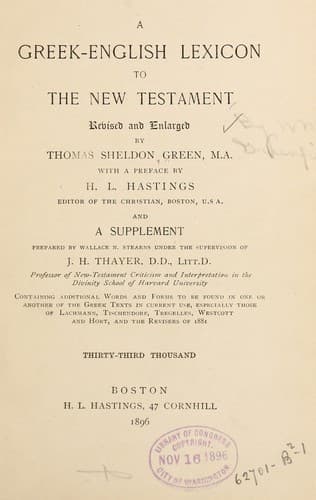
A Greek-English Lexicon to the New TestamentGreenfield, William
Religion
A Greek-English Lexicon to the New Testament
Greenfield, William
Bible. New Testament -- Dictionaries -- English; Greek language, Biblical -- Dictionaries -- English
to announce, notify; to command, direct, charge,
Mat. 10.5. Mar. 6.8; 8.6. Lu. 9.21, et al.;
to charge, obtest, entreat solemnly, 1 Ti. 6.13.
Παραγίνομαι, (παρά & γίνομαι)
f. γενήσομαι, a.2. παρεγενόμην,
to be by the side of; to come approach, arrive,
Mat. 2.1; 3.13. Mar. 14.43. Lu. 7.4, et al.; seq.
ἐπί, to come upon in order to seize, Lu. 22.52;
to come forth in public, make appearance,
Mat. 3.1. He. 9.11.
Παράγω, (παρά & ἄγω)
f. άξω,
to lead beside; intrans. to pass along or by,
Mat. 20.30. Jno. 9.1; to pass on, Mat. 9.9, 27;
intrans & mid. to pass away, be in a state of transition,
1 Co. 7.31. 1 Jno. 2.8, 17.
Παραδειγματίζω, (παράδειγμα, an example)
to make an example of; to expose to ignominy and shame,
Mat. 1.19. He. 6.6. L.G.
Παράδεισος, ου, ὁ, (of Oriental origin: in Heb. פרדס)
a park, a forest where wild beasts were kept for hunting;
a pleasure park, a garden of trees of various kinds;
used in the LXX. for the Garden of Eden; in N.T., the
celestial paradise, Lu. 23.43. 2 Co. 12.4. Re. 2.7.
Παραδέχομαι, (παρά & δέχομαι)
f. ξομαι,
to accept, receive; met. to receive, admit, yield assent to,
Mar. 4.20. Ac. 16.21; 22.18. 1 Ti. 5.19; in N.T., to receive
or embrace with favour, approve, love, He. 12.6.
Παραδιατρῐβή, ῆς, ἡ, (παρά & διατριβή)
useless disputation, 1 Ti. 6.5. N.T.
Παραδίδωμι, (παρά & δίδωμι)
f. δώσω,
to give over, hand over, deliver up,
Mat. 4.12; 5.25; 10.4, 17, et al.;
to commit, intrust, Mat. 11.27; 25.14, et al.;
to commit, commend, Ac. 14.26. 15.40;
to yield up, Jno. 19.30. 1 Co. 15.24;
to abandon, Ac. 7.42. Eph. 4.19;
to expose to danger, hazard, Ac. 15.26;
to deliver as a matter of injunction, instruction, &c.,
Mar. 7.13. Lu. 1.2. Ac. 6.14, et al.;
absol. to render a yield, to be matured, Mar. 4.29.
Παράδοξος, ου, ὁ, ἡ, (παρά & δόξαν, beside expectation)
unexpected, strange, wonderful, astonishing, Lu. 5.26.
Παράδοσις, εως, ἡ, (παραδίδωμι)
delivery, handing over, transmission;
in N.T., what is transmitted in the way of teaching,
precept, doctrine, 1 Co. 11.2. 2 Th. 2.15; 3.6; tradition,
traditionary law, handed down from age to age,
Mat. 15.2, 3, 6, et al.
Παραζηλόω, (παρά & ζηλόω)
f. ώσω,
to provoke to jealousy, Ro. 10.19; to excite to emulation,
Ro. 11.11, 14; to provoke to indignation, 1 Co. 10.22. S.
Παραθαλάσσιος, ία, ιον, (παρά & θάλασσα)
by the sea-side, situated on the sea-coast, maritime, Mat. 4.13.
Παραθεωρέω, ῶ, (παρά & θεωρέω)
f. ήσω
to look at things placed side by side, as in comparison,
compare in thus looking; to regard less in comparison,
overlook, neglect, Ac. 6.1.
Παραθήκη, ης, ἡ, (παρατίθημι)
a deposit, a thing committed to one's charge, a trust,
2 Ti. 1.12; v.r. 1 Ti. 6.20. 2 Ti. 1.14.
Παραινέω, ῶ, (παρά & αἰνέω)
f. έσω,
to advice, exhort, Ac. 27.9, 22.
Παραιτέομαι, οῦμαι, (παρά & αἰτέω)
f. ήσομαι,
to entreat; to beg off, excuse one's self, Lu. 14.18, 19;
Public-domain text, read in full here on John Shaqi.
Reviews
Reviews
No reviews yet
Be the first to share your thoughts on this work.
Elsewhere in the archive
Join the Discussion
Join the discussion
Sign in to leave a comment or review.
Sign InorCreate an account