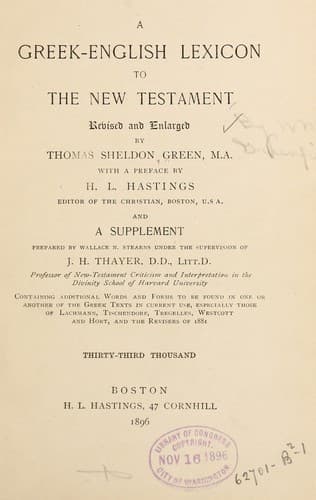
A Greek-English Lexicon to the New TestamentGreenfield, William
Religion
A Greek-English Lexicon to the New Testament
Greenfield, William
Bible. New Testament -- Dictionaries -- English; Greek language, Biblical -- Dictionaries -- English
16.21; 17.12, 15; 27.19;
absol. to suffer death, Lu. 22.15; 24.26, et al.
Πατάσσω,
f. άξω, a.1. ἐπάταξα,
to strike, beat upon; to smite, wound, Mat. 26.51. Lu. 22.49, 50;
by impl. to kill, slay, Mat. 26.31. Mar. 14.27. Ac. 7.24;
to strike gently, Ac. 12.7; fr. the Heb.
to smite, inflict evil, afflict with disease, plagues, &c.
Ac. 12.23. Re. 11.6; 19.15.
Πατέω, ῶ,(πάτος, a path)
intrans. to tread, Lu. 10.19; trans. to tread the winepress,
Re. 14.20; 19.15; to trample, Lu. 21.24. Re. 11.2.
Πατήρ, τέρος, τρός, ὁ,
a father, Mat. 2.22; 4.21, 22; spc. used of God,
as the Father of man by creation, preservation, &c.,
Mat. 5.16, 45, 48; and peculiarly as the Father of our
Lord Jesus Christ, Mat. 7.21. 2 Co. 1.3;
the founder of a race, remote progenitor, forefather,
ancestor, Mat. 3.9; 23.30, 32; an elder, senior,
father in age, 1 Jno. 2.13, 14; a spiritual father,
1 Co. 4.15; father, author, cause, source, Jno. 8.44.
He. 12.9. Ja. 1.17; used as an appellation of honour,
Mat. 23.9. Ac. 7.2.
Πατραλῴας, ου, ὁ, (πατήρ & ἀλοάω, v. ἀλοιάω, to smite)
a striker of his father; a parricide, 1 Ti. 1.9.
Πατριά, ᾶς, ἡ, (πατήρ)
descent, lineage; a family, tribe, race, Lu. 2.4.
Ac. 3.25. Ep. 3.15.
Πατριάρχης, ου, ὁ, (πατριά & ἀρχή)
a patriarch, head or founder of a family,
Ac. 2.29; 7.8, 9. He. 7.4. S.
Πατρικός, ή, όν, (πατήρ)
from fathers or ancestors, ancestral, paternal, Ga. 1.14.
Πατρίς, ίδος, ἡ, (fr. same)
one's native place, country, or city, Mat. 13.54, 57.
Mar. 6.1, 4. Lu. 4.23, 24. Jno. 4.44.
Πατροπαράδοτος, ου, ὁ, ἡ, (πατήρ & παραδοτός, fr. παραδίδωμι)
handed down or received by trandition from one's fathers
or ancestors, 1 Pe. 1.18. L.G.
Πατρῴος, α, ον, (πατήρ)
received from one's ancestors, paternal, ancestral,
Ac. 22.3; 24.14; 28.17.
Παύω,
f. παύσω,
to cause to pause or cease, restrain, prohibit, 1 Pe. 3.10;
mid. p. πέπαυμαι, to cease, stop, leave off, desist, refrain,
Lu. 5.4; 8.24, et al.
Παχύνω, (παχύς, fat, gross)
f. υνῶ, a.1. pass. ἐπαχύνθην,
to fatten, make gross; met. pass. to be rendered gross,
dull, unfeeling, Mat. 13.15. Ac. 28.27.
Πέδη, ης, ἡ, (πέζα, the foot)
a fetter, Mar. 5.4. Lu. 8.29.
Πεδῐνός, ή, όν, (πεδίον, a plain, πέδον, the ground)
level, flat, Lu. 6.17.
Πεζεύω, (πέζα, the foot)
f. εύσω,
pr. to travel on foot; to travel by land, Ac. 20.13.
Πεζἠ, (pr. dat. fem. of πεζός, ή, όν, pedestrian, fr. πέζα, the foot)
on foot, or, by land, Mat. 14.13. Mar. 6.33.
Πειθαρχέω, ῶ, (πείθομαι & ἀρχή)
f. ήσω,
to obey one in authority, Ac. 5.29, 32. Tit. 3.1;
genr. to obey, follow, or conform to advice, Ac. 27.21.
Πειθός, ή, όη, (πείθω)
persuasive, 1 Co. 2.4. N.T.
Πειθώ, όος, οῦς, ἡ,
Suada, the goddess of persusaion; persuasiveness, v.r. 1 Co. 2.4.
Πείθω,
f. πείσω, p. πέπεικα, a.1. ἔπεισα, p. pass. πέπεισμαι,
a.1. pass. ἐπείσθην,
to persuade, seek to persuade, endeavour to convince,
Ac. 18.4; 19.8, 26; 28.23; to persuade,
Public-domain text, read in full here on John Shaqi.
Reviews
Reviews
No reviews yet
Be the first to share your thoughts on this work.
Elsewhere in the archive
Join the Discussion
Join the discussion
Sign in to leave a comment or review.
Sign InorCreate an account