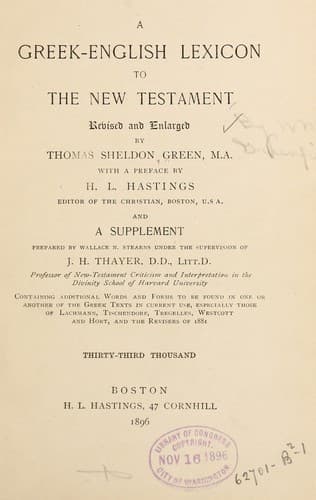
A Greek-English Lexicon to the New TestamentGreenfield, William
Religion
A Greek-English Lexicon to the New Testament
Greenfield, William
Bible. New Testament -- Dictionaries -- English; Greek language, Biblical -- Dictionaries -- English
similitude, figurative discourse, Jno. 10.6.
Πάροινος, ου, ὁ, ἡ, (παρά & οἶνος)
pr. pertaining to wine; given to wine, prone to intemperance,
drunken: hence, quarrelsome, insolent, overbearing,
1 Ti. 3.3. Tit. 1.7.
Παροίχομαι, (παρά & οἴχομαι)
f. οιχήσομαι, p. ῴχημαι,
to have gone by; p. part. παρῳχημένος, bygone, Ac. 14.16.
Παρομοιάζω,
f. άσω,
to be like, to resemble, Mat. 23.27: (N.T.)
from
Παρόμοιος, οία, οιον, (παρά & ὅμοιος)
nearly resembling, similar, like, Mar. 7.8, 13.
Παροξύνω, (παρά & ὀξύνω, to sharpen, fr. ὀξύς)
f. υνῶ,
to sharpen; met. to incite, stir up, Ac. 17.16;
to irritate, provoke, 1 Co. 13.5:
whence
Παροξυσμός, οῦ, ὁ,
an inciting, incitement, He. 10.24;
a sharp fit or anger, sharp contention,
angry dispute, Ac. 15.39.
Παροργίζω, (παρά & ὀργίζω)
f. ίσω,
to provoke to anger, irritate, exasperate,
Ro. 10.19. Ep. 6.4: (S.)
whence
Παροργισμός, οῦ, ὁ,
provocation to anger; anger excited, indignation,
wrath, Ep. 4.26. S.
Παροτρύνω, (παρά & ὀτρύνω, to excite)
f. υνῶ,
to stir up, incite, instigate, Ac. 13.50.
Παρουσία, ας, ἡ, (πάρειμι)
presence, 2 Co.10.10. Phi. 2.12; a coming, arrival, advent,
Ph. 1.26. Mat. 24.3, 27, 37, 39. 1 Co. 15.23, et al.
Παροψίς, ίδος, ἡ, (παρά & ὄψον)
pr. a dainty side-dish; meton. a plate, platter,
Mat. 23.25, 26.
Παῤῥησία, ας, ἡ, (ῥῆσις, a speech)
freedom in speaking, boldness of speech, Ac. 4.13. 1 Ti. 3.13;
παῤῥησίᾳ, as an adv. freely, boldly, Jno. 7.13, 26; so
μετὰ παῤῥησίαας, Ac. 2.29, 4.29, 31; license, authority, Philem. 8;
confidence, assurance, 2 Co. 7.4. Ep. 3.12. He. 3.6; 10.19;
openness, frankness, 2 Co. 3.12;
παῤῥησίᾳ, and ἐν παῤῥησίᾳ, adverbially, openly, plainly,
perspicuously, unambiguously, Mar. 8.32. Jno. 10.24;
publicly, before all, Jno. 7.4:
whence
Παῤῥησιάζομαι,
f. άσομαι,
to speak plainly, freely, boldly, and confidently,
Ac. 13.46; 14.3, et al.
Πᾶς, πᾶσα, πᾶν, gen. παντός, πάσης, παντός,
all; in the sing. all, the whole, usually when the subst.
has the article, Mat. 6.29; 8.32. Ac. 19.26, et al.;
every, only with an anarthrous subst., Mat. 3.10; 4.4; et al.;
plu. all, Mat. 1.17, et al. freq.;
πάντα, in all respects, Ac. 20.35. 1 Co. 9.25; 10.33; 11.2;
by a Hebraism, a negative with πᾶς is sometimes equivalent to
οὐδείς or μηδείς, Mat. 24.22. Lu. 1.37. Ac. 10.14. Ro. 3.20.
1 Co. 1.29. Eph. 4.29, et al.
Πάσχα, τό, indec. (Heb. פסח, Aram. פסחא, fr. פסח, to pass over)
the passover, the paschal lamb, Mat. 26.17. Mar. 14.12;
met. used of Christ, the true paschal lamb, 1 Co. 5.7;
the feat of the passover, the day on which the paschal lamb
was slain and eaten, the 14th of Nisan, Mat. 26.18. Mar. 14.1.
He. 11.28; more genr., the whole paschal festival,
including the seven days of the feast of unleavened bread,
Mat. 26.2. Lu. 2.41. Jno. 2.13, et al.
Πάσχω,
f. πείσομαι, a.2. ἔπᾰθον, p. πέπονθα,
to be affected by a thing whether good or bad; to suffer,
endure evil, Mat.
Public-domain text, read in full here on John Shaqi.
Reviews
Reviews
No reviews yet
Be the first to share your thoughts on this work.
Elsewhere in the archive
Join the Discussion
Join the discussion
Sign in to leave a comment or review.
Sign InorCreate an account