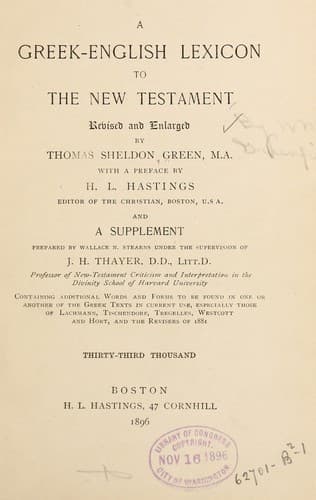
A Greek-English Lexicon to the New TestamentGreenfield, William
Religion
A Greek-English Lexicon to the New Testament
Greenfield, William
Bible. New Testament -- Dictionaries -- English; Greek language, Biblical -- Dictionaries -- English
10.18; to fall, fall prostrate,
fall down, Mat. 17.6; 18.29. Lu. 17.16; to fall down dead,
Lu. 21.24; to fall, fall in ruins, Mat. 7.25, 27. Lu. 11.17;
met. to fall, come by change, as a lot, Ac. 1.26;
to fall, to fail, become null and void, fall to the ground,
Lu. 16.17; to fall, to come into a worse state,
Re. 2.5; to come to ruin, Ro. 11.11. He. 4.11;
to fall into sin, Ro. 11.22. 1 Co. 10.12;
to fall in judgment, be condemned and punished, Re. 14.8,
to fall upon, seize, Re. 11.11;
to light upon, Re. 7.16;
to fall under, incur, Ja. 5.12.
Πιστεύω, (πίστις)
f. εύσω, p. πεπίστευκα,
to believe, give credit to, Mar. 1.15; 16.13. Lu. 24.25;
intrans. to believe, have a mental persuasion,
Mat. 8.13; 9.28. Ja. 2.19; to believe, be of opinion,
Ro. 14.2; in N.T.,
πιστεύειν ἐν, εἰς, ἐπί, to believe in or on,
Mat. 18.6; 27.42. Jno. 3.15, 16, 18;
absol. to believe, be a believer,
profess the religion of Jesus, Ac. 2.44; 4.4, 32; 13.48;
trans. to intrust, commit to the charge or power of,
Lu. 16.11. Jno. 2.24; pass. to be intrusted with,
Ro. 3.2. 1 Co. 9.17.
Πιστικός, ή, όν, (πιστός)
genuine, pure, unadulterated or (πίνω) —
Mar. 14.3. Jon. 12.3. N.T.
Πίστις, εως, ἡ, (πείθομαι)
faith, belief, firm persusasion, 2 Co. 5.7. He. 11.1;
assurance, firm conviction, Ro. 14.23; argument, proof,
assurance, Ac. 17.31; good faith, honesty, integrity,
Mat. 23.23. Ga. 5.22. Tit. 2.10; faithfulness,
truthfulness, Ro. 3.3; in N.T., faith in God and Christ,
Mat. 8.10. Ac. 3.16, et al. freq.; ἡ πίστις, the matter
of Gospel faith, Ac. 6.7. Jude 3, et al.
Πιστός, ή, όν, (πείθω)
faithful, true, trusty, Mat. 24.45; 25.21, 23.
Lu. 12.42. 2 Ti. 2.2; true, veracious, Re. 1.5; 2.13;
credible, sure, certain, indubitable, Ac. 13.34. 1 Ti. 1.15;
believing, yielding belief and confidence, Jno. 20.27.
Ga. 3.9; spec. a Christian believer, Ac. 10.45; 16.1, 15.
2 Co. 6.15:
whence
Πιστόω, ῶ,
f. ώσω,
to make trustworthy; pass. to be assured,
feel sure belief, 2 Ti. 3.14.
Πλανάω, ῶ,
f. ήσω, a.1 ἐπλάνησα,
to lead astray, cause to wander;
pass. to go astray, wander about, stray,
Mat. 18.12, 13. 1 Pe. 2.25;
met. to mislead, deceive, Mat. 24.4, 5, 11, 24;
pass. to be deceived, err, mistake, Mat. 22.29;
to seduce, delude, Jno. 7.12;
pass. to be seduced or wander from the path of virtue,
to sin, transgress, Tit. 3.3. He. 5.2. Ja. 5.19, et al.:
from
Πλάνη, ης, ἡ,
a wandering; deceit, deception, delusion, imposture,
fraud, Mat. 27.64. 1 Th. 2.3; seduction, deceiving,
Ep. 4.14. 2 Th 2.11. 1 Jno. 4.6; error, false opinion,
2 Pe. 3.17; wandering from the path of truth and virtue,
perverseness, wickedness, sin. Ro. 1.27. Ja. 5.20.
2 Pe. 2.18. Jude 11:
whence
Πλανήτης, ου, ὁ,
a rover, roving, a wanderer, wandering;
ἀστὴρ πλανήτης, a wandering star. Jude 13.
Πλάνος, η, ον & ος, ον,
a wanderer, vagabond; also act. deceiving, seducing;
a deceiver, impostor, Mat. 27.63. 2 Co. 6.8. 1 Ti. 4.1.
2 Jno. 7.
Public-domain text, read in full here on John Shaqi.
Reviews
Reviews
No reviews yet
Be the first to share your thoughts on this work.
Elsewhere in the archive
Join the Discussion
Join the discussion
Sign in to leave a comment or review.
Sign InorCreate an account