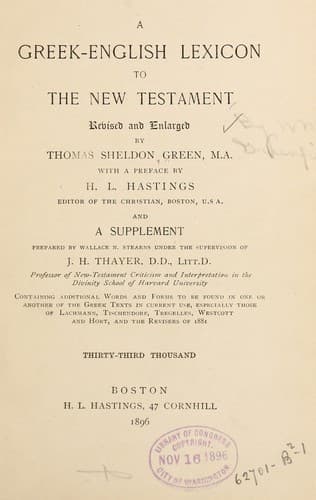
A Greek-English Lexicon to the New TestamentGreenfield, William
Religion
A Greek-English Lexicon to the New Testament
Greenfield, William
Bible. New Testament -- Dictionaries -- English; Greek language, Biblical -- Dictionaries -- English
Πλάξ, ακός, ἡ,
a flat broad surface; a table, tablet, 2 Co. 3.3. He. 9.4.
Πλάσμα, ατος, τό
a thing formed or fashioned; spc. a potter's vessel, Ro. 9.20:
from
Πλάσσω, v. ττω,
f. πλάσω, a.1. ἔπλασα, a.1. pass. ἐπλάσθην,
to form, fashion, mould, Ro. 9.20. 1 Ti. 2.13:
whence
Πλαστός, ή, όν,
formed, fashioned, moulded; met. fabricated, counterfeit, delusive, 2 Pe. 2.3.
Πλατεῖα, ας, ἡ, (pr. fem. of πλατύς)
a street, broad way, Mat. 6.5; 12.19. Lu. 10.10, et al.
Πλάτος, εος, τό, (fr. same)
breadth, Ep. 3.18. Re. 20.9; 21.16, bis.
Πλατύνω,
f. υνῶ, p. pass. πεπλάτυμαι, a.1. pass. ἐπλατύνθην,
to make broad, widen, enlarge, Mat. 23.5;
pass. met., of the heart,
from the Heb., to be expanded with kindly and genial feelings,
2 Co. 6.11, 13:
from
Πλατύς, εῖα, ύ,
broad, wide, Mat. 7.13.
Πλέγμα, ατος, τό, (πλέκω)
any thing plaited or intertwined; a braid of hair, 1 Ti. 2.9.
Πλεῖστος, η, ον,
most; very great, Mat. 11.20; 21.8;
τὸ πλεῖστον, as an adv. at most, 1 Co. 14.27:
superlat. of πολύς.
Πλείων, ονος, ὁ, ἡ, τό, -ον & πλέον, (comp. of πολύς)
more in number, Mat. 21.36; 26.53;
more in quantity, Mar. 12.43. Lu. 21.3;
οἱ πλείονες v. πλείους, the greater part, the majority,
Ac. 19.32; 27.12; the more, 1 Co. 9.19. 2 Co. 4.15;
neut. πλεῖον, as an adv. more, Lu. 7.42;
ἐπὶ πλεῖον, more, of time, longer, further, Ac. 24.4;
of space, more widely, Ac. 4.17. 2 Ti. 2.16; 3.9;
for the pos. much, of time, longer, Ac. 20.9;
more, higher, greater, more excellent, of higher value,
Mat. 5.20; 6.25.
Πλέκω,
f. ξω,
to interweave, weave, braid, plait, Mar. 15.17. Jno. 19.2.
Πλεονάζω, (πλείων, πλέον)
f. άσω, a.1. ἐπλεόνασα,
to be more than enough; to have in abundance,
superabound, 2 Co. 8.15; to abound, be abundant,
to increase, be augmented, Ro. 5.20; 6.1; in N.T.,
trans. to cause to abound or increase, to augment,
1 Th. 3.12.
Πλεονεκτέω, ῶ, (πλείων, πλέον & ἔχω)
f. ήσω,
to have more than another; to take advantage of;
to overreach, make gain of, 2 Co. 7.2; 12.17, 18;
to wrong, 1 Th. 4.6;
to get the better, or an advantage of, 2 Co. 2.11:
whence
Πλεονέκτης, ου, ὁ,
one who has or claims to have more than his share;
a covetous, avaricious person, one who defrauds
for the sake of gain, 1 Co. 5.10, 11; 6.10. Ep. 5.5.
Πλεονεξία, ας, ἡ,
some advantage which one possesses over another;
an inordinate desire of riches, covetousness,
Lu. 12.15, et al.; grasping, over-reaching, extortion,
Ro. 1.29. 1 Th. 2.5, et al.; a gift exacted by importunity
and conferred with grudging, 2 Co. 9.5; a scheme of
extortion, Mar. 7.22.
Πλευρά, ας,
pr. a rib; the side of the body, Jno. 19.34; 20.20, 25, 27.
Ac. 12.7.
Πλέω,
f. πλεύσομαι & πλευσοῦμαι, a.1. ἔπλευσα, p. πέπλευκα,
to sail, Lu. 8.23. Ac. 21.3; 27.2, 6, 24.
Πληγή, ῆς, ἡ, (πλήσσω)
a blow, stroke, stripe, Lu. 10.30; 12.48;
meton. a wound, Ac. 16.33. Re. 13.3, 12, 14;
fr. the Heb. a plague, affliction, calamity,
Re.
Public-domain text, read in full here on John Shaqi.
Reviews
Reviews
No reviews yet
Be the first to share your thoughts on this work.
Elsewhere in the archive
Join the Discussion
Join the discussion
Sign in to leave a comment or review.
Sign InorCreate an account