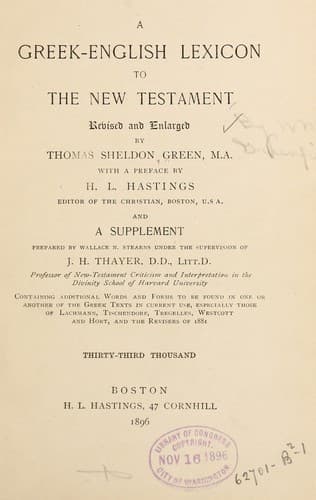
A Greek-English Lexicon to the New TestamentGreenfield, William
Religion
A Greek-English Lexicon to the New Testament
Greenfield, William
Bible. New Testament -- Dictionaries -- English; Greek language, Biblical -- Dictionaries -- English
one who tends flocks or heards, a shepherd, herdsman,
Mat. 9.36; 25.32;
met. a pastor, superintendent, guardian,
Jno. 10.11, 14, 16, et al.
Ποίμνη, ης, ἡ
a flock of sheep, Lu. 2.8. 1 Co. 9.7;
met. a flock of disciples, Mat. 26.31. Jno. 10.16.
Ποίμνιον, ου, τό, (contr. for ποιμένιον, a flock)
a flock; met. a flock of Christian disciples,
Lu. 12.32. Ac. 20.28, 29. 1 Pe. 5.2, 3.
Ποῖος, οία, οῖον,
of what kind, sort, or species, Jno. 12.33; 21.19;
what? which?, Mat. 19.18; 21.23, 24, 27, et al.
Πολεμέω, ῶ,
f. ήσω, a.1. ἐπολέμησα,
to make or wage war, fight, Re. 2.16; 12.7, et al.;
to battle, quarrel, Ja. 4.2:
from
Πόλεμος, ου, ὁ,
war, Mat. 24.6. Mar. 13.7; battle, engagement, combat,
1 Co. 14.8. He. 11.34; battling, strife, Ja. 4.1, et al.
Πόλις, εως, ἡ,
a city, an enclosed and walled town, Mat. 10.5, 11; 11.1;
meton. the inhabitants of a city, Mat. 8.34; 10.15;
with a gen. of person, or a personal pron., the city of any one,
the city of one's birth or residence, Mat. 9.1. Lu. 2.4, 11;
ἡ πόλις, the city, κατ᾿ ἐξοχήν, Jerusalem, Mat. 21.18; 28.11;
met. a place of permanent residence, abode, home,
He. 11.10, 16; 13.14.
Πολῑτάρχης, ου, ὁ, (πόλις & ἄρχω)
a ruler or prefect of a city, city magistrate,
Ac. 17.6, 8. N.T.
Πολῑτεία, ας, ἡ, (πολιτεύω)
the state of being a citizen; citizenship,
the right or privilege of being a citizen,
freedom of a city or state, Ac. 22.28;
a commonwealth, community, Eph. 2.12.
Πολίτευμα, ατος, τό,
the administration of a commonwealth; in N.T.,
equivalent to πολιτεία, a community, commonwealth,
Phi. 3.20:
from
Πολιτεύω,
f. εύσω,
intrans. to be a citizen; trans. to govern a
city or state, administer the affairs of a state;
pass. to be governed; in N.T., to order one's life
and conduct, converse, live, in a certain manner
as to habits and principles, Ac. 23.1. Ph 1.27:
from
Πολίτης, ου, ὁ, (πόλις)
a citizen, Lu. 15.15; 19.14. Ac. 21.39. (ῑ.)
Πολλάκις, (πολύς)
adv. many times, often, frequently,
Mat. 17.15. Mar. 5.4; 9.22, et al. (ᾰ.)
Πολλαπλᾰσίων, ονος, ὁ, ἡ, τό, -ον,
(a later equivalent to πολλαπλάσιος, fr. πολύς)
manifold, many times more, Lu. 18.30.
Πολυεύσπλαγχνος, ου, ὁ, ἡ, (πολύς, εὖ, & σπλάγχνον)
very merciful, very compassionate, v.r. Ja. 5.11. N.T.
Πολυλογία, ας, ἡ, (πολύς & λόγος)
wordiness, loquacity, Mat. 6.7.
Πολυμερῶς, (πολυμερής, consisting of many parts, πολύς & μέρος)
adv. in many parts or parcels, He. 1.1.
Πολυποίκῐλος, ου, ὁ, ἡ, (πολύς & ποικίλος)
exceedingly various, multifarious, multiform, manifold;
by impl. immense, infinite, Ep. 3.10.
Πολύς, πολλή, πολύ, gen. πολλοῦ, πολλῆς, πολλοῦ,
great in magnitude or quantity, much, large,
Mat. 13.5. Jno. 3.23; 15.8;
pl. many, Mat. 3.7;
in time, long, Mat. 25.19. Mar. 6.35. Jno. 5.6;
οἱ πολλοί, the many, the mass, Ro. 5.15; 12.5. 1 Co. 10.33;
τὸ πολύ, much, 2 Co. 8.15;
πολύ, as an adv. much, greatly, Mar. 12.27. Lu. 7.47;
Public-domain text, read in full here on John Shaqi.
Reviews
Reviews
No reviews yet
Be the first to share your thoughts on this work.
Elsewhere in the archive
Join the Discussion
Join the discussion
Sign in to leave a comment or review.
Sign InorCreate an account