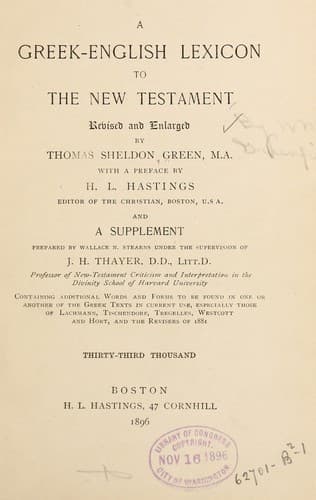
A Greek-English Lexicon to the New TestamentGreenfield, William
Religion
A Greek-English Lexicon to the New Testament
Greenfield, William
Bible. New Testament -- Dictionaries -- English; Greek language, Biblical -- Dictionaries -- English
of time, ἐπ᾿ πολύ, a long time, Ac. 28.6;
μετ᾿ οὐ πολύ, not long after, Ac. 27.14;
followed by a compar. much, 2 Co. 8.22;
πολλῷ, much, by much, Mat. 6.30. Mar. 10.48;
τὰ πολλά, as an adv. most frequently, generally, Ro. 15.22;
πολλά, as an adv. much, greatly, vehemently, Mar. 1.45; 3.12;
of time, many times, frequently, often Mat. 9.14.
Πολύσπλαγχνος, ου, ὁ, ἡ, (πολύς & σπλάγχνον)
very merciful, very compassionate, Ja. 5.11. N.T.
Πολυτελής, έος, οῦς, ὁ, ἡ, (πολύς & τέλος)
expensive, costly, Mar. 14.3. 1 Ti. 2.9; of great value,
very precious, 1 Pe. 3.4.
Πολύτῑμος, ου, ὁ, ἡ, (πολύς & τιμή)
of great price, costly, precious, Mat. 13.46. Jno. 12.3.
Πολυτρόπως, (πολύτροπος, manifold, various, πολύς & τρόπος)
adv. in many ways, in various modes, He. 1.1.
Πόμα, ατος, τό, (πέπομαι, p. pass. of πίνω)
drink, 1 Co. 10.4. He. 9.10.
Πονηρία, ας, ἡ,
pr. badness, bad condition; in N.T.,
evil disposition of mind, wickedness, mischief, malignity,
Mat. 22.18, et al.;
pl. πονηρίαι, wicked deeds, villainies, Mar. 7.23. Ac. 3.26:
from
Πονηρός, ά, όν,
bad, unsound, Mat. 6.23; 7.17, 18; evil, afflictive,
Ep. 5.16; 6.13. Re. 16.2; evil, wrongful, malignant,
malevolent, Mat. 5.11, 39. Ac. 28.21; evil, wicked,
impious, and τὸ πονηρόν, evil, wrong, wickedness,
Mat. 5.37, 45; 9.4; slothful, inactive, Mat. 25.26. Lu. 19.22;
ὁ πονηρός, the evil one, the devil, Mat. 13.19, 38. Jno. 17.15;
evil eye, i.q. φθονερός, envious, Mat. 20.15. Mar. 7.22;
impl. covetous, niggardly, Mat. 7.11:
from
Πόνος, ου, ὁ, (πένομαι)
labour, travail; pain, misery, anguish, Re. 16.10, 11; 21.4.
Ποντικός, ή, όν,
belonging to, or an inhabitant of Πόντος, Ac. 18.2.
Πορεία, ας, ἡ,
a going, progress; a journey, travel, Lu. 13.22;
fr. the Heb. way or manner of life, business, occupation,
Ja. 1.11:
from
Πορεύομαι, (mid. of πορεύω, to convey, transport, fr. πόρος)
f. εύσομαι, a. ἐπορεύθην,
to go, pass from one place to another, Mat. 17.27; 18.12;
to go away, depart, Mat. 24.1; 25.41. Jno. 14.2, 3;
trop. to go away, depart from life, to die, Lu. 22.22;
to go, pass on one's way, journey, travel, Mat. 2.8, 9. Lu 1.39. 2.41;
πορεύομαι ὀπίσω, to go after, to become a follower or partisan,
Lu. 21.8; or, to pursue after, be devoted to, 2 Pe. 2.10;
fr. the Heb. to go or proceed in any way or course of life,
live in any manner, Lu. 1.6; 8.14. Ac. 9.31.
Πορθέω, ῶ, (a collateral from of πέρθω)
f. ήσω,
to lay waste, destroy; impl. to harass, ravage,
Ac. 9.21. Ga. 1.13, 23.
Πορισμός, οῦ, ὁ,
(πορίζομαι, to furnish to one's self, acquire, gain,
mid. of πορίζω, to furnish, supply)
a providing, procuring; meton. source of gain, 1 Ti. 6.5, 6. L.G.
Πορνεία, ας, ἡ,
fornication, whoredom, Mat. 15.19. Mar. 7.21. Ac. 15.20, 29;
concubinage, Jno. 8.41; adultery, Mat. 5.32; 19.9;
incest, 1 Co. 5.1; lewdness, uncleanness, genr., Ro. 1.29;
from the Heb. put symbolically for idolatry, Re. 2.21; 14.8:
from
Πορνεύω,
f. εύσω, a.1.
Public-domain text, read in full here on John Shaqi.
Reviews
Reviews
No reviews yet
Be the first to share your thoughts on this work.
Elsewhere in the archive
Join the Discussion
Join the discussion
Sign in to leave a comment or review.
Sign InorCreate an account