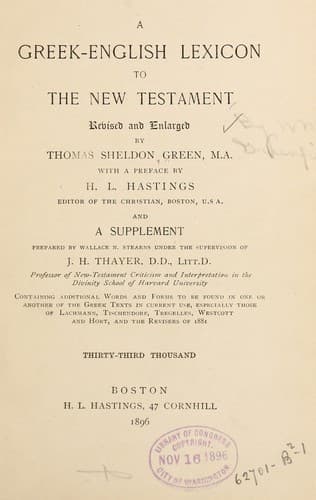
A Greek-English Lexicon to the New TestamentGreenfield, William
Religion
A Greek-English Lexicon to the New Testament
Greenfield, William
Bible. New Testament -- Dictionaries -- English; Greek language, Biblical -- Dictionaries -- English
a bringing to; in N.T., an offering, an act of offering up
or sacrificing, He. 10.10; trop. Ro. 15.16;
an offering, oblation, a thing offered, Ep. 5.2. He. 10.5, 8;
a sacrifice, victim offered, Ac. 21.26; 24.17.
Προσφωνέω, ῶ, (πρός & φωνέω)
f. ήσω,
to speak to, address, Mat. 11.16. Lu. 7.32; 13.12, et al.;
to address, harangue, Ac. 22.2; to call to one's self,
Lu. 6.13.
Πρόσχῠσις, εως, ἡ, (προσχέω, to pour out upon, besprinkle,
fr. πρός & χέω)
an effusion, sprinkling, He. 11.28. L.G.
Προσψαύω, (πρός & ψαύω, to touch)
f. αύσω,
to touch upon, to touch lightly, Lu. 11.46.
Προσωποληπτέω, ῶ,
f. ήσω,
to accept or respect the person of any one, to pay regard to
external appearance, condition, circumstances, &c.,
to show partiality to, Ja. 2.9: (N.T.)
from
Προσωπολήπτης, ου, ὁ, ἡ, (πρόσωπον & λαμβάνω)
a respecter of persons, Ac. 10.34. N.T.
Προσωποληψία, ας, ἡ, (πρόσωποληπτέω)
respect of persons, partiality, Ro. 2.11, et al. N.T.
Πρόσωπον, ου, τό, (πρός & ὤψ)
the face, countenance, visage, Mat. 6.16, 17; 17.2, 6,
according to later usage, a person, individual, 2 Co. 1.11;
hence, personal presence, 1 Th. 2.17;
fr. the Heb. πρόσωπον πρὸς πρόσωπον, face to face,
clearly, perfectly, 1 Co. 13.12; face, surface, external form,
figure, appearance, Mat. 16.3. Lu. 12.56;
external circumstances, or condition of any one,
Mat. 22.16. Mar. 12.14;
πρόσωπον λαμβάνειν, to have respect to the external
circumstances of any one, Lu. 20.21. Ga. 2.6;
ἐν προσώπῳ, in the person, in the name, or
by the authority, 2 Co. 2.10;
ἀπὸ προσώπου, from the presence of, from, Ac. 3.19,
from before, Ac. 7.45;
εἰς πρόσωπον, in the presence of, before, 2 Co. 8.24;
κατὰ πρόσωπον, in the presence of, before, Ac. 3.13;
openly, Ga. 2.11;
κατὰ πρόσωπον ἔχειν, to have before one's face,
to have any one present, Ac. 25.16;
ἀπὸ προσώπου, from Re. 12.14;
πρὸ προσώπου, before, Ac. 13.24.
Προτάσσω, v. ττω, (πρό & τάσσω)
f. ξω,
to place or arrange in front; to assign beforehand,
foreordain, Ac. 17.26.
Προτείνω, (πρό & τείνω)
f. ενῶ,
to extend before; to stretch out, Ac. 22.25.
Πρότερον,
adv. before, first, Jno. 7.51. 2 Co. 1.15;
ὁ, ἡ, πρότερον, former, He. 10.32, et al.:
pr. neut. of
Πρότερος, α, ον, (comp. of πρό)
former, prior, Ep. 4.22; τὸ πρότερον,
as an adv. before, formerly, Jno. 6.62, et al.
Προτίθημι, (πρό & τίθημι)
f. προθήσω,
to place before; to set forth, propose publicly, Ro. 3.2;
προτίθεμαι, to purpose, determine, design beforehand, Ro. 1.13. Ep. 1.9.
Προτρέπω, (πρό & τρέπω)
f. ψω,
to turn forwards; to impel; to excite, urge, exhort, Ac. 18.27.
Προτρέχω, (πρό & τρέχω)
a.2. προὔδραμον,
to run before, or in advance, Lu. 19.4. Jno. 20.4.
Προϋπάρχω, (πρό & ὑπάρχω)
f. ξω, imperf. προϋπῆρχον,
to be before, or formerly, Lu. 23.12. Ac. 8.9.
Πρόφᾰσις, εως, ἡ, (πρό & φαίνω)
pr. that which appears in front, that which is put forward
Public-domain text, read in full here on John Shaqi.
Reviews
Reviews
No reviews yet
Be the first to share your thoughts on this work.
Elsewhere in the archive
Join the Discussion
Join the discussion
Sign in to leave a comment or review.
Sign InorCreate an account