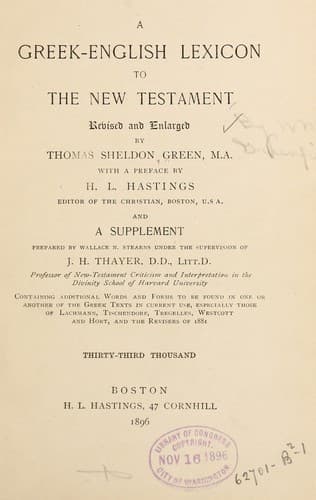
A Greek-English Lexicon to the New TestamentGreenfield, William
Religion
A Greek-English Lexicon to the New Testament
Greenfield, William
Bible. New Testament -- Dictionaries -- English; Greek language, Biblical -- Dictionaries -- English
to hide the true state of things; a fair show or pretext,
Ac. 27.30; a specious cloke, Mat. 23.13. 1 Th. 2.5;
an excuse, Jno. 15.22.
Προφέρω, (πρό & φέρω)
f. προοίσω,
to bring before, present; to bring forth or out,
produce, Lu. 6.45, bis.
Προφητεία, ας, ἡ,
prophecy, a prediction of future events, Mat. 13.14. 2 Pe. 1.20, 21;
prophecy, a gifted faculty of setting forth and enforcing revealed
truth, 1 Co. 12.10; 13.2, et al.; prophecy, matter of divine
teaching set forth by special gift, 1 Ti. 1.18:
from
Προφητεύω,
f. εύσω, a.1. προεφήτευσα,
to exercise the function of a προφήτης;
to prophesy, to foretel the future, Mat. 11.13;
to divine, Mat. 26.68. Mar. 14.65. Lu. 22.64;
to prophesy, to set forth matter of divine teaching
by special faculty, 1 Co. 13.9; 14.1, et al.:
from
Προφήτης, ου, ὁ, (πρό & φημί)
pr. a spokesman for another;
spc. a spokesman or interpreter for a deity;
a prophet, seer, Tit 1.12;
in N.T., a prophet, a divinely commissioned and
inspired person, Mat. 14.5. Lu. 7.16, 39. Jno. 9.17, et al.;
a prophet in the Christian Church, a person gifted for the
exposition of divine truth, 1 Co. 12.28, 29, et al.;
a prophet, a foreteller of the future, Mat. 1.22, et al. freq.;
οἱ προφῆται, the prophetic scriptures of the Old Testament,
Lu. 16.29, et al.:
whence
Προφητικός, ή, όν,
prophetic, uttered by prophets, Ro. 16.26. 2 Pe. 1.19. L.G.
Προφῆτις, ιδος, ἡ,
a prophetess, a divinely gifted female teacher,
Lu. 2.36. Re. 2.20.
Προφθάνω, (πρό & φθάνω)
f. άσω, & ήσομαι, a.1. προέφθᾰσα,
to outstrip, anticipate; to anticipate any one in doing or
saying a thing, be beforehand with, Mat. 17.25.
Προχειρίζομαι, (πρό & χείρ)
f. ίσομαι,
to take into the hand, to make ready for use or action;
to constitute, destine, Ac. 22.14; 26.16.
Προχειροτονέω, ῶ,(πρό & χειροτονέω)
f. ήσω,
pr. to elect before; to fore-appoint, Ac. 10.41.
Πρύμνα, ης, ἡ, (πρυμνός, last, hindmost)
the hinder part of a vessel, stern, Mar. 4.38, et al.
Πρωΐ,
adv. in the morning, early, Mat. 16.3; 20.1. Mar. 15.1. Ac. 28.23, et al.;
the morning watch, which ushers in the dawn, Mar. 13.35;
whence
Πρώΐα, ας, ἡ, (pr. fem. of πρώϊος, α, ον, in the morning, early)
sc. ὥρα,
morning, the morning hour, Mat. 21.18; 27.1. Jno. 18.28; 21.4.
Πρώϊμος, η, ον,
early, Ja. 5.7.
Πρωϊνός, ή, όν, (a later form of πρώϊος)
belonging to the morning, morning, Re. 2.28; 22.16.
Πρῴρα, ας, ἡ, (πρό)
the forepart of a vessel, prow, Ac. 27.30, 41.
Πρωτεύω (πρῶτος)
f. εύσω
to be first, to hold the first rank or highest dignity,
have the preeminence, be chief, Col. 1.18.
Πρωτοκαθεδρια, ας, ἡ, (πρῶτος & καθέδρα)
the first or uppermost seat, the most honourable seat,
Mat. 23.6. Mar. 12.39. Lu. 11.43; 20.46. N.T.
Πρωτοκλισία, ας, ἡ, (πρῶτος & κλισία)
the first place of reclining at table,
the most honourable place at table,
Mat. 23.6. Mar. 12.39. Lu. 14.7, 8; 20.46. N.T.
Πρῶτον,
adv.
Public-domain text, read in full here on John Shaqi.
Reviews
Reviews
No reviews yet
Be the first to share your thoughts on this work.
Elsewhere in the archive
Join the Discussion
Join the discussion
Sign in to leave a comment or review.
Sign InorCreate an account