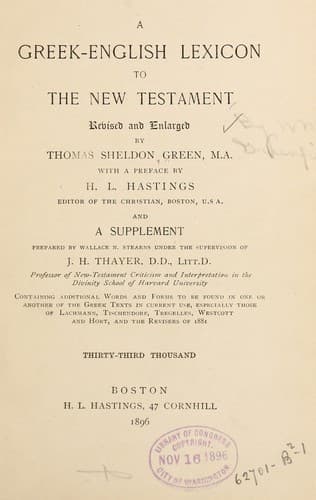
A Greek-English Lexicon to the New TestamentGreenfield, William
Religion
A Greek-English Lexicon to the New Testament
Greenfield, William
Bible. New Testament -- Dictionaries -- English; Greek language, Biblical -- Dictionaries -- English
to be morally polluted, Re. 22.11, bis.
Ῥύσις, εως, ἡ, (ῥέω)
a flowing; a morbid flux, Mar. 5.25. Lu. 8.43, 44.
Ῥυτίς, ίδος, ἡ, (ῥύω)
a wrinkle;
met. a disfiguring wrinkle, flaw, blemish, Ep. 5.27.
Ῥωμαϊκός, ή, όν,
Roman, Latin, Lu. 23.38:
from
Ῥωμαῖος, ου, ὁ, (Ῥώμν, Rome)
a Roman, Roman citizen, Jno. 11.48. Ac. 2.10; 16.21, et al.:
whence
Ῥωμαϊστί,
adv. in the Roman language, in Latin, Jno. 19.20.
Ῥώννυμι, v. νύω,
f. ῥώσω,
to strengthen, render firm;
pass. perf. ἔῤῥωμαι, to be well, enjoy firm health;
imperative ἔῤῥωσο, ἔῤῥωσθε, at the end of letters,
like the Lat. vale, farewell, Ac. 15.29; 23.30.
Σ, σ, Σίγμα
Σαβαχθανί, (Aram. שבקתני, fr. שבק, to leave, forsake)
sabacthani, thou hast forsaken me;
interrogatively, hast thou forsaken me?
Mat. 27.46. Mar. 15.34.
Σαβαώθ, (Heb. צבאות, pl. of צבא)
hosts, armies, Ro. 9.29. Ja. 5.4.
Σαββατισμός, οῦ, ὁ, (σαββατίζω, i.q. Heb. שבת,
whence it is formed, to cease or rest from labour,
and thus keep sabbath)
pr. a keeping of a sabbath; a state of rest, a sabbath-state, He. 4.9.
Σάββᾰτον, ου, τό, (Heb. שבת)
pr. cessation from labour, rest; the Jewish sabbath,
both in the sing. and pl., Mat. 12.2, 5, 8; 28.1. Lu. 4.16;
a week, sing. and pl., Mat. 28.1. Mar. 16.9, et al.;
pl. sabbaths, or times of sacred rest, Col. 2.16.
Σαγήνη, ης, ἡ, (σαγή, fr. σάττω, to load)
a large net, drag, Mat. 13.47. L.G.
Σαδδουκαῖος, ου, ὁ,
a Sadducee, one belonging to the sect of the Sadducees,
which, according to the Talmudists, was founded by one צדוק, Sadoc,
about three centuries before the Christian era: they were directly
opposed in sentiments to the Pharisees,
Mat. 3.7; 16.1, 6, 11, 12; 22.23, 34, et al.
Σαίνω,
f. σανῶ, a.1. ἔσηνα & ἔσᾱνα,
pr. to wag the tail; to fawn, flatter, cajole;
pass. to be cajoled; to be wrought upon, to be perturbed,
1 Th. 3.3.
Σάκκος, ου, ὁ, (Heb. שק)
sackcloth, a species of very coarse black cloth made of hair,
Re. 6.12; a mourning garment of sackcloth,
Mat. 11.21. Lu. 10.13. Re. 11.3.
Σαλεύω,
f. εύσω, a.1. ἐσάλευσα,
to make to rock, to shake,
Mat. 11.7; 24.29. Lu. 6.48. Ac. 4.31, et al.;
to shake down or together, Lu. 6.38;
met. to stir up, excite the people, Ac. 17.13;
to agitate, disturb mentally, Ac. 2.25. 2 Th. 2.2;
pass. impl. to totter, be ready to fall, be near to ruin,
met. He. 12.27:
from
Σάλος, ου, ὁ,
agitation, tossing, rolling, spc. of the sea, Lu. 21.25.
Σάλπιγξ, ιγγος, ἡ,
a trumpet, Mat. 24.31. 1 Th. 4.16, et al.:
from
Σαλπίζω,
f. ίγξω, & later, ίσω, a.1. ἐσάλπιγξα & ἐσάλπισα,
to sound a trumpet, Re. 8.6, 7, 8, 10, 12, 13, et al.:
whence
Σαλπιστής, οῦ, ὀ,
a trumpeter, Re. 18.22. L.G.
Σαμαρείτης, ου, ὀ,
a Samaritan, an inhabitant of the city or region of Σαμάρεια,
Samaria, applied by the Jews as a term of reproach and
contempt, Mat. 10.5. Jno. 4.9; 8.48, et al.:
whence
Σαμαρεῖτις, ιδος,
a Samaritan woman, Jno. 4.9, bis.
Σανδάλιον, ου, τό, (pr. dimin.
Public-domain text, read in full here on John Shaqi.
Reviews
Reviews
No reviews yet
Be the first to share your thoughts on this work.
Elsewhere in the archive
Join the Discussion
Join the discussion
Sign in to leave a comment or review.
Sign InorCreate an account