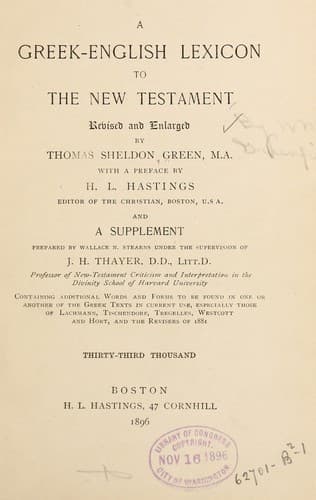
A Greek-English Lexicon to the New TestamentGreenfield, William
Religion
A Greek-English Lexicon to the New Testament
Greenfield, William
Bible. New Testament -- Dictionaries -- English; Greek language, Biblical -- Dictionaries -- English
to rend, shatter; to break or burst in pieces,
Mat. 9.17. Mar. 2.22. Lu. 5.37, et al.;
to rend, lacerate, Mat. 7.6; to cast or dash upon the ground, convulse,
Mar. 9.18. Lu. 9.42;
absol. to break forth into exclamation, Ga. 4.27.
Ῥῆμα, ατος, τό, (ἐρῶ)
that which is spoken; declaration, saying, speech, word,
Mat. 12.36; 26.75. Mar. 9.32; 14.72;
a command, mandate, direction, Lu. 3.2; 5.5;
a promise, Lu. 1.38; 2.29;
a prediction, prophecy, 2 Pe. 3.2;
a doctrine of God or Christ, Jno. 3.34; 5.47; 6.63, 68. Ac. 5.20;
an accusation, charge, crimination, Mat. 5.11; 27.14;
fr. the Heb. a thing, Mat. 4.4. Lu. 4.4;
a matter, affair, transaction, business,
Mat. 18.16. Lu. 1.65. 2 Co. 13.1, et al.
Ῥήσσω,
see ῥήγνυμι.
Ῥήτωρ, ορος, ὁ, (ἐρῶ)
an orator, advocate, Ac. 24.1.
Ῥητῶς, (ῥητός, ἐρῶ)
in express words, expressly, 1 Ti. 4.1. L.G.
Ῥίζα, ης, ἡ,
a root of a tree, Mat. 3.10; 13.6;
met. ἔχειν ῥίζαν, v. ἔχειν ῥίζαν ἐν ἑαυτῷ, to be rooted in faith,
Mat. 13.21. Mar. 4.17. Lu. 8.13;
met. cause, source, origin, 1 Ti. 6.10. He. 12.15;
by synecd, the trunk, stock of a tree,
met. Ro. 11.16, 17, 18;
met. offspring, progeny, a descendant, Ro. 15.12. Re. 5.5; 22.16:
whence
Ῥιζόω, ῶ,
f. ώσω,
to root, cause to take root;
pass. part. perf. ἐῤἑιζωμένος,
firmly rooted, strengthened with roots;
met. firm, constant, firmly fixed, Ep. 3.18. Col. 2.7.
Ῥιπή, ῆς, ἡ (ῥίπτω)
pr. a rapid sweep, jerk; a wink, twinkling of the eye, 1 Co. 15.52.
Ῥιπίζω, (ῥιπίς, a fan or bellows, fr. ῥίπτω)
f. ίσω,
to fan, blow, ventilate; to toss, agitate,
e.g. the ocean by the wind, Ja. 1.6.
Ῥιπτέω, ῳ,
to toss repeatedly, toss up with violent gesture,
Ac. 22.23: freq.
from
Ῥίπτω
f. ψω, a.1. ἔῤῥιψα, p. pass. ἔῤῥιμμαι,
to hurl, throw, cast; to throw or cast down,
Mat. 27.5. Lu. 4.35; 17.2;
to throw or cast out, Ac. 27.19, 29;
to lay down, set down, Mat. 15.30;
pass. to be dispersed, scattered, Mat. 9.36.
Ῥοιζηδόν, (ῤοῖζος, a whizzing, a rushing noise)
adv. with a noise, with a crash, &c., 2 Pe. 3.10. L.G.
Ῥομφαία, ας, ἡ,
pr. a Thracian broad-sword; a sword, Re. 1.16; 2.12;
by meton, war, Re. 6.8;
met. a thrill of anguish, Lu. 2.35.
Ῥύμη, ης, ἡ (ῥύω)
pr. a rush or sweep of a body in motion;
a street, Ac. 9.11; 12.10;
a narrow street, lane, alley, as distinguished from πλατεῖα,
Mat. 6.2. Lu. 14.21.
Ῥύομαι,
f. ῥύσομαι, a.1. ἐῤῥυσάμην,
to drag out of danger, to rescue, save,
Mat. 6.13; 27.43;
later also pass., a.1. ἐῤῥύσθην,
to be rescued, delivered,
Lu. 1.74. Ro. 15.31. 2 Th. 3.2. 2 Ti. 4.17.
Ῥυπαρεύομαι, (ῥυπαρός)
to be filthy, squalid;
met. to be polluted, v.r. Re. 22.11. N.T.
Ῥυπαρία, ας, ἡ,
filth; met. moral filthiness, uncleanness, pollution, Ja. 1.21:
from
Ῥυπᾰρός, ά, όν,
filthy, squalid, sordid, dirty, Ja. 2.2;
met. defiled, polluted, v.r. Re. 22.11:
from
Ῥύπος, ου, ὁ,
filth, squalor, 1 Pe. 3.21:
whence
Ῥυπόω, ῶ
f. ώσω,
to be filthy; met.
Public-domain text, read in full here on John Shaqi.
Reviews
Reviews
No reviews yet
Be the first to share your thoughts on this work.
Elsewhere in the archive
Join the Discussion
Join the discussion
Sign in to leave a comment or review.
Sign InorCreate an account